Within Benin UFOs
Why Is Benin's UFO Record So Thin?
Oral reporting, weak digitisation, language barriers, and the absence of a dedicated national programme leave many possible observations undocumented.
On this page
- Missing institutions and public reporting channels
- Press digitisation and French language search barriers
- How voluntary databases create geographic bias
Page outline Jump by section
Introduction
The absence of a searchable UFO archive for the Republic of Benin is best explained by how information has been collected, preserved and published—not by evidence that unusual aerial observations never occurred. Unlike a small number of countries that established official reporting programmes, military investigation units or publicly indexed case files, Benin has never developed a dedicated national system for recording unidentified aerial sightings. As a result, any isolated reports that may have existed have remained scattered across local media, personal testimony or unpublished administrative records rather than becoming part of a searchable national archive.[DAN Archives]archivesnationales.gouv.bjDAN Archives Accueil | Archive Nationale Du BeninDAN Archives Accueil | Archive Nationale Du Benin
This distinction is important when assessing Benin’s place in UFO research. Sparse public records should not automatically be interpreted as evidence that there were no reports. Instead, they largely reflect institutional priorities, limited digitisation of historical material, language barriers and the way international UFO databases have historically favoured countries with established reporting networks.
Why Benin Never Developed a National UFO Archive
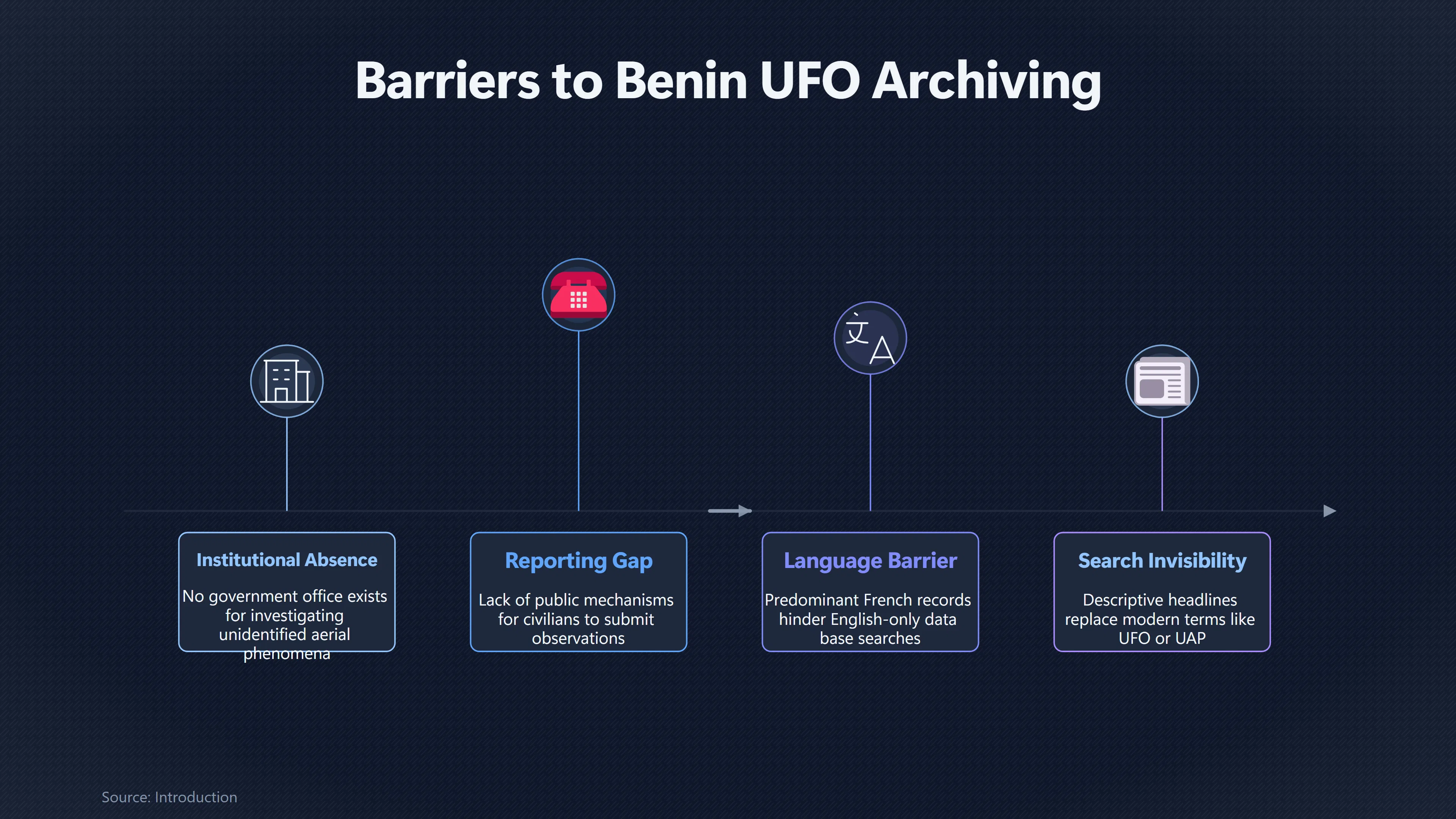
The most significant reason for the archival gap is straightforward: Benin has never operated a government office dedicated to investigating unidentified aerial phenomena.
Countries with extensive searchable UFO collections generally accumulated them because a public body routinely received reports, opened case files and preserved correspondence over many years. Examples include military projects, aviation reporting systems or scientific organisations that retained their records for later public release. Benin has no known equivalent programme, meaning there was no central institution responsible for gathering sightings into a permanent collection.[National Archives]archives.govNational ArchivesRecords Related to Unidentified Flying Objects (UFOs) and Unidentified Anomalous Phenomena (UAPs) at the National Archiv…
Without such an institution:
- reports would have remained with local authorities, journalists or individual witnesses;
- there was no standard reporting form or investigation procedure;
- no national catalogue of cases was created; and
- later researchers inherited little structured material to digitise.
This institutional absence explains much of today’s lack of searchable information.
Missing Public Reporting Channels
Another obstacle is the absence of a long-standing public mechanism encouraging civilians to report unusual aerial observations.
In countries with substantial UFO archives, reports often entered official systems through police forces, aviation authorities, defence ministries or specialist civilian organisations. Even when many reports later proved mundane, the reporting process itself generated searchable documentation.
No comparable nationwide reporting culture is evident for Benin. Available public sources do not identify:
- an official civilian UFO reporting office;
- a defence ministry archive devoted to unidentified aerial events;
- a recognised national civilian investigation organisation with publicly accessible records; or
- a sustained academic programme cataloguing aerial anomalies.
Consequently, even genuine witness observations would have been much less likely to become permanent public records.
Press Digitisation and French-Language Search Barriers
The lack of an online UFO archive should not be confused with the absence of historical newspapers.
Benin’s National Archives preserve extensive official publications, newspapers and periodicals, including both government and private press collections. The institution has expanded digitisation and online archival services in recent years, but the searchable online catalogue remains incomplete, and not all holdings have been digitised or indexed for keyword searching.[gouv.bj]archivesnationales.gouv.bjOpen source on gouv.bj.
This creates several practical barriers for researchers.
First, many historical newspapers remain accessible primarily through physical archives or partially digitised collections rather than fully searchable databases.
Second, Benin’s documentary record is predominantly in French. Researchers searching only English-language sources are therefore likely to overlook locally published material.
Third, older newspapers frequently used descriptive headlines instead of modern terms such as “UFO” or “UAP”. A report might describe a “strange light”, “mysterious object” or “unusual aerial phenomenon” without using terminology that modern database searches expect.
Together, these factors mean that even if isolated reports appeared in regional newspapers decades ago, they may remain effectively invisible to internet searches.
Oral Reporting Leaves Little Permanent Evidence
Benin also illustrates a broader challenge found in parts of West Africa: many unusual events are shared orally rather than through permanent written documentation.
Communities may discuss unexpected lights or aerial phenomena within families, villages or local networks without generating newspaper articles, police reports or scientific investigations. Oral testimony can preserve local memory, but it rarely produces searchable records decades later unless historians or researchers actively document those accounts.
This does not make oral reports unreliable by definition. Instead, it means they are difficult to verify independently because key information—dates, locations, witness identities and contemporaneous documentation—may no longer be recoverable.
For UFO researchers, the result is a persistent evidence gap rather than a body of cases that can be systematically analysed.
How International Databases Create Geographic Bias
Many widely used UFO databases rely on voluntary submissions.
That creates an important geographic bias.
Countries with active reporting organisations, large internet-connected communities and established UFO research groups naturally contribute far more entries than countries lacking those structures. Database size therefore reflects reporting infrastructure as much as the actual frequency of unusual observations.
Benin exemplifies this effect.
A country without:
- a national reporting office,[statemediamonitor.com]statemediamonitor.comOffice national d’imprimerie et de presse – State Media MonitorMay 24, 2026 — OFFICE NATIONAL D’IMPRIMERIE ET DE PRESSE May 24, 2026May 26, 2026 QUICK FACTS Office national d’imprimerie et de presse (…
- a long-running civilian investigation network,
- extensive digitised local archives, and
- high international visibility in UFO research
will inevitably appear to have very few cases in global databases, even if isolated observations occurred.
Researchers should therefore avoid treating database counts as direct measures of how often unexplained aerial events are witnessed.
Existing Archives Focus on Government Records, Not UFO Cases
Benin does possess an active National Archives system responsible for preserving the country’s documentary heritage. Its collections include official journals, administrative records, historical newspapers and photographs, while ongoing digitisation initiatives aim to improve public access over time.[DAN Archives]archivesnationales.gouv.bjDAN Archives Accueil | Archive Nationale Du BeninDAN Archives Accueil | Archive Nationale Du Benin
However, these archives were created to preserve governmental, legal and historical records—not to catalogue unidentified aerial phenomena.
This contrasts with countries where dedicated UFO files became part of archival holdings because government agencies had already accumulated thousands of reports. Benin’s archival institutions preserve history broadly rather than maintaining subject-specific collections on unexplained aerial sightings.
What the Thin Record Actually Tells Us
The lack of a searchable Beninese UFO archive should not be interpreted as proof either for or against the occurrence of unusual aerial observations.
Instead, the available evidence supports a more cautious conclusion:
- Benin has no known national UFO investigation programme whose files could later be released.
- Historical reporting appears fragmented across local media and oral accounts rather than centralised institutions.
- French-language materials and incomplete newspaper digitisation make retrospective searching difficult.
- International UFO databases disproportionately represent countries with established reporting cultures, producing a significant geographic bias.
Within the wider study of UFO reports in Benin, the country’s exceptionally thin public record is therefore better understood as an archival and documentation problem than as evidence that unusual aerial observations were uniquely absent.

Amazon book picks
Further Reading
Books and field guides related to Why Is Benin's UFO Record So Thin?. Use these as the next step if you want deeper reading beyond the article.

UFOs and Government: A Historical Inquiry
Explains why some nations lack searchable UFO archives.
In Plain Sight: an Investigation Into UFOs and Impossible Sci...
Keeps recommendations commercially strong despite sparse local literature.

UFOs: Generals, Pilots, and Government Officials Go on the Re...
Focuses on credible documentation and official records.
eBay marketplace picks
Marketplace Samples
Live-tested eBay searches with available results related to this page.
Selected fromUFO poster oneBay.co.uk.


Current eBay listing
I Want To Believe UFO Poster Giclée Fine Art Heavyweight Print


Current eBay listing
VINTAGE UFO FLYING SAUCERS COMIC ADVERTISING A2 POSTER PRINT
Endnotes
1.
Source: archives.gov
Link:https://www.archives.gov/research/topics/uaps/textual-and-microfilm
Source snippet
National ArchivesRecords Related to Unidentified Flying Objects (UFOs) and Unidentified Anomalous Phenomena (UAPs) at the National Archiv...
2.
Source: archives.gov
Link:https://www.archives.gov/research/topics/uaps/rg-collections
Source snippet
Records Related to Unidentified Flying Objects (UFOs) and Unidentified Anomalous Phenomena (UAPs) at the National Archives: Research by R...
3.
Source: dan.gouv.bj
Link:https://dan.gouv.bj/recherche
Source snippet
Archives National du Bénin (ANB)...
4.
Source: archives.gov
Link:https://www.archives.gov/research/catalog/catalog-bulk-downloads/uap-bulk-download
Source snippet
April 24, 2025 — BULK DOWNLOADS FOR RECORDS RELATED TO UNIDENTIFIED ANOMALOUS PHENOMENA (UAPS) Digitized and born-digital records related...
Published: April 24, 2025
5.
Source: archivesnationales.gouv.bj
Title: DAN Archives Accueil | Archive Nationale Du Benin
Link:https://archivesnationales.gouv.bj/
6.
Source: archivesnationales.gouv.bj
Link:https://archivesnationales.gouv.bj/archives
7.
Source: statemediamonitor.com
Title: Office national d’imprimerie et de presse – State Media Monitor
Link:https://statemediamonitor.com/2026/05/office-national-dimprimerie-et-de-presse/
Source snippet
May 24, 2026 — OFFICE NATIONAL D’IMPRIMERIE ET DE PRESSE May 24, 2026May 26, 2026 QUICK FACTS Office national d’imprimerie et de presse (...
Published: May 24, 2026
8.
Source: dan.gouv.bj
Title: bj Demande de reproduction
Link:https://dan.gouv.bj/services/demande-reproduction
9.
Source: archivesnationales.gouv.bj
Link:https://archivesnationales.gouv.bj/autres_fonds
10.
Source: archivesnationales.gouv.bj
Link:https://archivesnationales.gouv.bj/reproduction-document
11.
Source: dan.gouv.bj
Title: bj Fonds anciens
Link:https://dan.gouv.bj/documentheque/fonds-anciens
12.
Source: archivesnationales.gouv.bj
Link:https://archivesnationales.gouv.bj/recherche
13.
Source: nationalarchives.gov.uk
Title: UF O reports
Link:https://www.nationalarchives.gov.uk/explore-the-collection/explore-by-time-period/postwar/ufo-reports/
Additional References
14.
Source: ufosearch.org
Title: The full Department of War PURSUE archive — d
Link:https://ufosearch.org/
Source snippet
UFO Search — PURSUE UAP ArchiveMay 8, 2026 — P PRESIDENTIAL UNSEALING & REPORTING SYSTEM FOR UAP ENCOUNTERS▍ RELEASE 01 · CLEARED 2026-05...
Published: May 8, 2026
15.
Source: youtube.com
Title: If You Think Aliens Are NOT Real, You NEED To See This
Link:https://www.youtube.com/watch?v=zTm6Mragtnk
Source snippet
These videos provide essential context regarding the archival, cultural, and investigative challenges surrounding UFO phenomena in Africa...
16.
Source: youtube.com
Title: The Most Convincing UFO Story From South Africa: The Kalahari Event
Link:https://www.youtube.com/watch?v=LFswmAii4rw
Source snippet
Ariel Phenomenon UFO Documentary | Talking Strange...
17.
Source: uapobservatory.org
Title: UAP Observatory
Link:https://uapobservatory.org/
Source snippet
Analysis second. Public archive UAP Observatory * Home * Archive * Methodology * Support * Contact Public archive and research program SE...
18.
Source: youtube.com
Link:https://www.youtube.com/watch?v=fmDitpLCXQQ
Source snippet
The Most Convincing UFO Story From South Africa: The Kalahari Event...
19.
Source: casefiles.space
Link:https://www.casefiles.space/
20.
Source: ufodna.org
Link:https://www.ufodna.org/
21.
Source: youtube.com
Title: Ariel Phenomenon UFO Documentary | Talking Strange
Link:https://www.youtube.com/watch?v=gRtp_jUCq0o
Source snippet
Ariel Phenomenon [Alien Contact in Africa]...
22.
Source: youtube.com
Title: Ariel Phenomenon [Alien Contact in Africa]
Link:https://www.youtube.com/watch?v=xznBc7FGqvg
Source snippet
If You Think Aliens Are NOT Real, You NEED To See This...
23.
Source: benin-news.com
Title: Bénin-Médias: liste des 68 journaux et écrits périodiques autorisés par la Haac
Link:https://benin-news.com/2024/07/11/benin-medias-liste-des-68-journaux-et-ecrits-periodiques-autorises-par-la-haac/