Within Central African UFOs
How Could a Central African UFO Report Be Tested?
Reports near Bangui could be checked against aviation and weather records, while remote sightings may leave far fewer traces.
On this page
- Aircraft, Satellites and Astronomical Objects
- Bangui Airport Records and Weather Data
- Investigating Reports From Remote Communities
Page outline Jump by section
Introduction
Testing a reported UFO sighting in the Central African Republic depends heavily on where it occurred. A report from Bangui or its surroundings can often be compared against civil aviation activity, meteorological observations, astronomical data and satellite imagery. By contrast, reports from remote communities such as Obo or other sparsely connected regions are much harder to verify because they typically lack continuous weather observations, dense air traffic records and multiple independent witnesses.
This difference does not mean that reports from remote areas are less sincere. Rather, it means the available evidence differs sharply. In the Central African Republic, where no well-documented national UFO case has yet emerged from the public record, the quality of any future investigation would depend more on collecting verifiable information than on the unusual nature of the claim itself.
Aircraft, Satellites and Astronomical Objects
The first stage in assessing any reported aerial anomaly is to determine whether a conventional explanation fits the observed time and place.
For a sighting near Bangui, investigators would normally compare the report with:
- Scheduled and unscheduled aircraft movements.
- Military or humanitarian aviation operating in the region.
- Satellite passes that can produce bright moving reflections.
- Visible planets, especially Venus and Jupiter, which are frequent sources of misidentification.
- Meteor activity and known meteor showers.
- Re-entering space debris, which can produce dramatic slow-moving fireballs visible across large areas.
Many apparent “hovering” lights are explained by aircraft approaching or departing an airport directly along the observer’s line of sight. Likewise, satellites can appear to brighten suddenly because of changing reflection angles before fading again.
Descriptions should therefore be compared against objective characteristics:
Reported featureQuestions to testBright stationary lightWas a planet visible in that direction?Slow moving white lightDid a satellite pass occur at that time?Flashing coloured lightsWas an aircraft operating nearby?Loud objectCould the sound have come from delayed aircraft noise or thunder?Brilliant fireballWere meteor networks or re-entry trackers reporting an event?
Only after these possibilities have been examined does a report become genuinely unexplained rather than simply unidentified.
Modern scientific approaches to unidentified aerial phenomena increasingly emphasise combining multiple independent measurements—optical observations, weather data, radar where available, and environmental sensors—rather than relying on witness testimony alone.[arXiv]arxiv.orgThe Scientific Investigation of Unidentified Aerial Phenomena (UAP) Using Multimodal Ground-Based ObservatoriesMay 29, 2023…
Bangui Airport Records and Weather Data
Bangui offers the best opportunity in the country for objective verification because it possesses the Central African Republic’s principal civil aviation infrastructure.
Aviation records
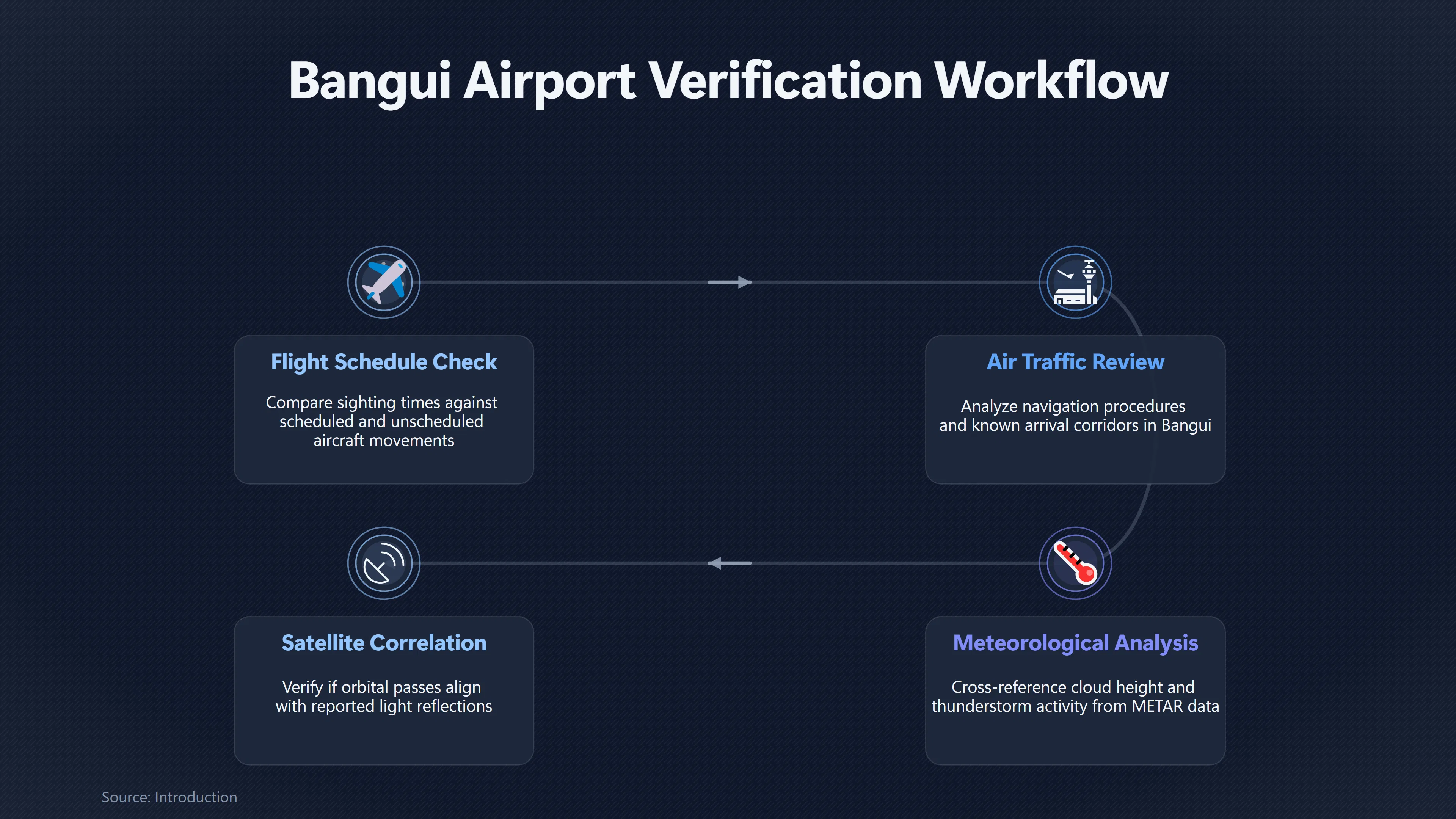
Bangui M’Poko Airport sits within a controlled terminal airspace managed through the regional ASECNA air navigation system. Aircraft approaching or departing the airport operate within established control procedures, meaning reported sightings near the capital can potentially be compared with:
- Flight schedules.
- Air traffic control records where available.
- Navigation procedures.
- Known arrival and departure corridors.
ASECNA documentation confirms that Bangui operates controlled terminal airspace with tower and approach services, providing a structured aviation environment against which reported observations can be assessed.[Asecna AIM]aim.asecna.aeroAsecna AIMAIP ASECNA (section ENR-2.1) valide à partir du 16 MAY 2024…
This does not mean all operational data are publicly available, but it greatly increases the possibility of reconstructing ordinary aircraft activity.
Weather observations
Weather information is equally important.
Cloud layers, thunderstorms, temperature inversions and atmospheric haze can all produce unusual visual effects. Bangui’s meteorological service generates routine aviation weather products including METAR and SPECI observations, aerodrome warnings and satellite-derived weather information. Meteorological equipment available at the airport includes cloud-height measurement, wind sensors and access to Meteosat satellite imagery.[Asecna AIM]aim.asecna.aeroAsecna AIMAIP ASECNA (section AD-2.FEFF) valide à partir du 07 AUG 2025August 7, 2025…
If a witness reports:
- glowing objects disappearing into cloud,
- lights changing colour,
- apparently impossible movement,
those claims should first be compared against recorded cloud cover, visibility, thunderstorm activity and wind conditions.
Weather records cannot explain every report, but they can eliminate many common optical phenomena.
Investigating Reports From Remote Communities
The situation changes dramatically outside the capital.
Communities in eastern and south-eastern regions such as Obo may experience:
- little or no routine aviation traffic,
- limited communications,
- sparse meteorological observations,[aim.asecna.aero]aim.asecna.aeroSource details in endnotes.
- fewer independent witnesses,
- delayed reporting.
These conditions create two opposing effects.
First, there are fewer conventional aircraft that might explain unusual lights.
Second, there is much less objective evidence available to determine what actually happened.
A report received several days after an event may lack:
- an exact time,
- precise direction,
- duration,
- photographs,
- weather observations,
- corroborating witnesses.
Without those details, even an entirely genuine observation may remain impossible to classify.
Investigators therefore place particular importance on documenting information immediately after an event while memories remain fresh.
What Information Makes a Report Testable?
A useful field investigation focuses on collecting observations that can later be checked independently.
The most valuable information includes:
- Exact date and local time.
- Precise location using coordinates if possible.
- Compass direction of the object.
- Estimated elevation above the horizon.
- Duration.
- Apparent size relative to the Moon or another familiar object.
- Colour changes.
- Sound.
- Motion relative to fixed landmarks.
- Weather conditions.
- Names of independent witnesses.
Photographs or videos become much more useful if investigators know exactly where the camera was positioned and the direction in which it was pointed.
Even simple sketches showing the object’s path across familiar landmarks can provide more reliable reconstruction than dramatic descriptions recorded weeks later.

Why Bangui and Remote Reports Require Different Standards
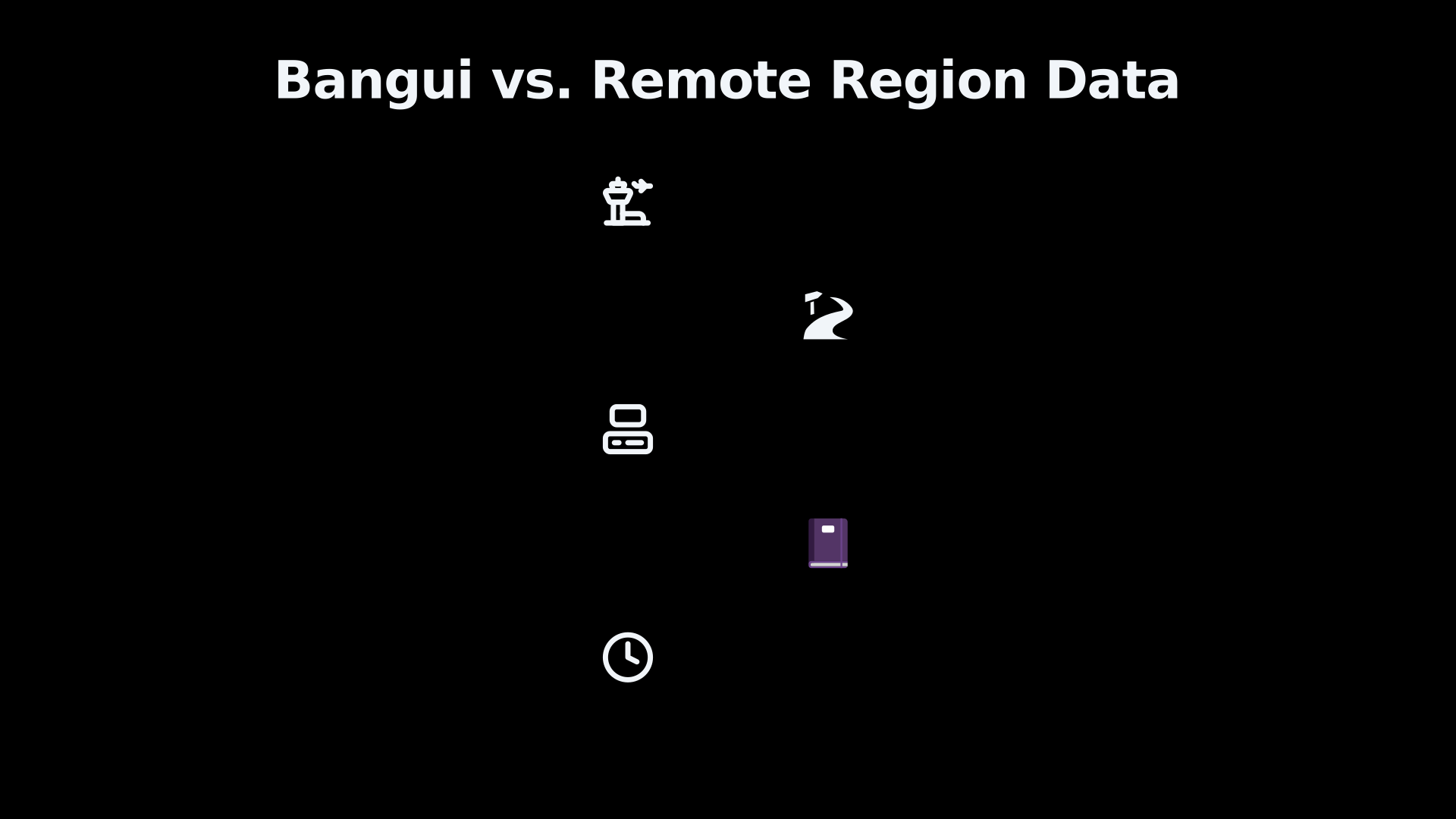
A report near Bangui can often be examined against multiple independent datasets:
- aviation activity,
- airport weather observations,[weatherspark.com]weatherspark.com75°F warm Dew Pt. 72°F oppressive Rel. Humi2026 Past Weather at Bangui Airport, Central African Republic - Weather SparkMarch 29, 2026 — 2026 WEATHER HISTORY AT BANGUI AIRPORT CENT…
- satellite imagery,
- astronomical software,
- publicly available flight tracking where coverage exists.
A report from an isolated village may instead depend almost entirely on witness testimony and whatever physical evidence, photographs or additional observers can be located afterwards.
That difference affects confidence rather than credibility. A sincere witness in a remote district may describe a real but ultimately unidentifiable event because insufficient independent evidence survives for testing.
For the Central African Republic, where the documented historical UFO record remains extremely limited, future investigations would benefit most from careful documentation rather than speculation. Reports that include precise timing, location, environmental conditions and multiple independent observations are far more likely to distinguish ordinary aircraft, atmospheric effects or astronomical objects from genuinely unexplained aerial phenomena.
Amazon book picks
Further Reading
Books and field guides related to How Could a Central African UFO Report Be Tested?. Use these as the next step if you want deeper reading beyond the article.
The UFO Experience: A Scientific Inquiry
Directly relevant to evaluating reported sightings.

UFOs: Generals, Pilots, and Government Officials Go on the Re...
Shows how stronger cases are documented.
eBay marketplace picks
Marketplace Samples
Live-tested eBay searches with available results related to this page.
Selected fromUFO disclosure print oneBay.co.uk.




Endnotes
1.
Source: arxiv.org
Link:https://arxiv.org/abs/2305.18566
Source snippet
The Scientific Investigation of Unidentified Aerial Phenomena (UAP) Using Multimodal Ground-Based ObservatoriesMay 29, 2023...
Published: May 29, 2023
2.
Source: aim.asecna.aero
Link:https://aim.asecna.aero/html/eAIP/FR-_04ENR-2.1-01-fr-FR.html
Source snippet
Asecna AIMAIP ASECNA (section ENR-2.1) valide à partir du 16 MAY 2024...
Published: MAY 2024
3.
Source: aim.asecna.aero
Link:https://aim.asecna.aero/html/eAIP/FR-_04GEN-1.6-01-fr-FR.html
Source snippet
Asecna AIMAIP ASECNA (section GEN-1.6) valide à partir du 15 AUG 2019...
4.
Source: aim.asecna.aero
Link:https://aim.asecna.aero/html/eAIP/FR-_04AD-2.FEFF-fr-FR.html
Source snippet
Asecna AIMAIP ASECNA (section AD-2.FEFF) valide à partir du 07 AUG 2025August 7, 2025...
Published: August 7, 2025
5.
Source: aim.asecna.aero
Link:https://aim.asecna.aero/html/eAIP/FR-_05GEN-3.5-01-fr-FR.html
Source snippet
Asecna AIMAIP ASECNA (section GEN-3.5) valide à partir du 27 JAN 2022...
6.
Source: aim.asecna.aero
Link:https://aim.asecna.aero/html/eAIP/FR-_04GEN-4.3-01-fr-FR.html
Source snippet
ASECNA (section GEN-4.3) valide à partir du 28 DEC 2023December 28, 2023 — GEN 4 REDEVANCES D'AÉRODROME/D'HÉLISTATION ET DE SERVICES DE N...
Published: December 28, 2023
7.
Source: aim.asecna.aero
Link:https://aim.asecna.aero/html/eAIP/FR-_00ENR-1.6-01-fr-FR.html
8.
Source: aim.asecna.aero
Link:https://aim.asecna.aero/html/eAIP/FR-_00GEN-3.5-01-fr-FR.html
9.
Source: asecna.aero
Title: ASECN A online
Link:https://www.asecna.aero/index.php/fr/publications-media/actualite/a-la-une/118-le-ministre-des-transports-de-centrafrique-au-siege
10.
Source: asecna.aero
Title: ASECN A online
Link:https://www.asecna.aero/index.php/en/2014-03-31-16-47-52-fr/2014-03-31-16-53-9-en/un-peu-d-histoire-en
11.
Source: afdb.org
Title: Central African Republic
Link:https://www.afdb.org/en/documents/central-african-republic-bangui-mpoko-international-airport-modernisation-support-project-phase-ii-pamab-ii-project-appraisal-report
Additional References
12.
Source: weatherspark.com
Title: 75°F warm Dew Pt. 72°F oppressive Rel. Humi
Link:https://weatherspark.com/h/y/148410/2026/Historical-Weather-during-2026-at-Bangui-Airport-Central-African-Republic
Source snippet
2026 Past Weather at Bangui Airport, Central African Republic - Weather SparkMarch 29, 2026 — 2026 WEATHER HISTORY AT BANGUI AIRPORT CENT...
Published: March 29, 2026
13.
Source: archives.gov
Title: Project BLUE BOOK
Link:https://www.archives.gov/research/military/air-force/ufos
Source snippet
AIR FORCE FACT SHEET CONCERNING UFOS AND PROJECT BLUE BOOK The following is a copy of the US Air Force Fact Sheet distributed by Wright-P...
14.
Source: usgs.gov
Link:https://www.usgs.gov/publications/bangui-magnetic-anomaly-central-african-empire-final-trip-report
15.
Source: ufouap.net
Title: This gu
Link:https://www.ufouap.net/en/explainers/common-ufo-misidentifications
Source snippet
Common UFO misidentifications: drones, satellites, balloons, aircraft, planets, and camera artifacts | Global UFO ArchiveJune 21, 2026 —...
Published: June 21, 2026
16.
Source: sciencedirect.com
Link:https://www.sciencedirect.com/science/article/abs/pii/0012821X85901050
17.
Source: sciencedirect.com
Link:https://www.sciencedirect.com/science/article/pii/0012821X85901050
18.
Source: narcap.org
Link:https://www.narcap.org/technical-reports
19.
Source: aaro.mil
Link:https://www.aaro.mil/
20.
Source: youtube.com
Link:https://www.youtube.com/watch?v=EoPkT_-dRf4
21.
Source: youtube.com
Link:https://www.youtube.com/watch?v=LFswmAii4rw