Within Nepal
Why US Intelligence Examined Nepal's UFO Debris
Declassified cables show that American officials examined Nepalese debris to identify possible Soviet or Chinese space technology.
On this page
- What Project Moon Dust Did
- How the Fragment Reached America
- What the Released Records Do Not Prove
Page outline Jump by section
Introduction
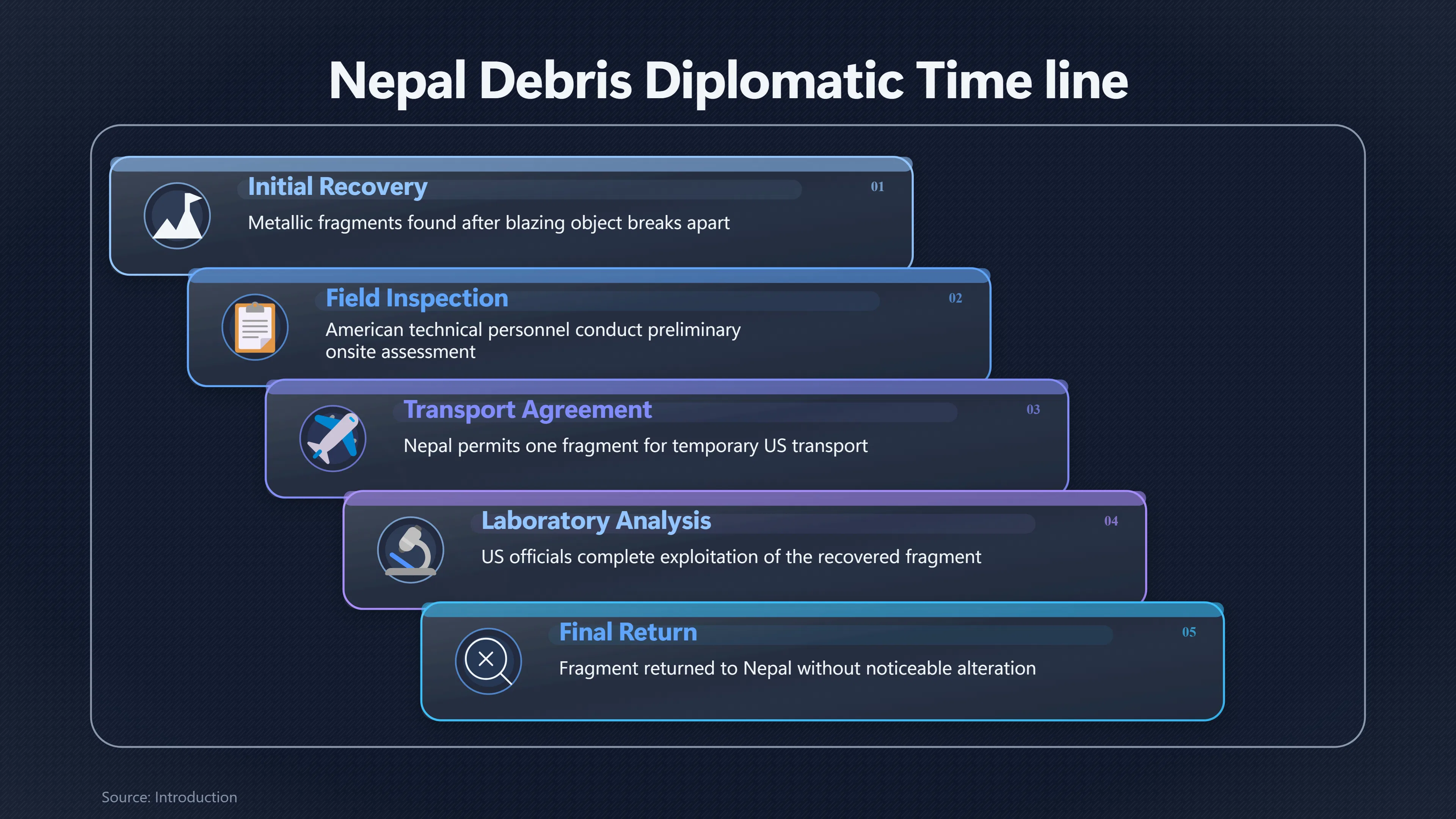
The declassified Project Moon Dust records are the most important documentary evidence explaining why the United States became involved in examining debris recovered after Nepal’s best-known UFO incident in March 1968. Far from demonstrating official belief in an extraterrestrial craft, the records show a Cold War intelligence operation focused on determining whether unidentified metal fragments represented Soviet or Chinese space technology. The surviving cables reveal a practical intelligence investigation: Nepal allowed American specialists to inspect the material, laboratory analysis was requested because the origin could not be determined in the field, and a small fragment was later taken to the United States under diplomatic agreement before eventually being returned. These records provide rare insight into how an event initially reported as an unidentified flying object evolved into an international intelligence matter.

What Project Moon Dust Actually Did
Project Moon Dust was a classified United States programme established during the Cold War to locate, recover and analyse foreign aerospace hardware. Rather than concentrating on extraterrestrial objects, its principal mission was to exploit Soviet and other foreign missiles, satellites, rocket stages and related technology whenever such material landed outside the United States. Recovering fragments could reveal engineering methods, manufacturing techniques and technological capabilities that were otherwise inaccessible.[National Security Archive]nsarchive.gwu.eduNational Security ArchiveScavenging for Intelligence: The U.S. Government’s Secret Search for Foreign Objects during the Cold War | Natio…
Because unidentified debris often fell before its origin was known, Moon Dust teams investigated objects that were initially described simply as “unidentified”. This terminology has sometimes been misunderstood in later UFO discussions. Within the programme, “unidentified” usually meant that investigators had not yet established whether the object originated from a satellite, launch vehicle, missile or another human-made source. The Nepal case fits this pattern precisely.[National Security Archive]nsarchive.gwu.eduNational Security ArchiveScavenging for Intelligence: The U.S. Government’s Secret Search for Foreign Objects during the Cold War | Natio…
For Nepal, the programme became relevant after reports that a blazing object broke apart over the Pokhara region on 25 March 1968, leaving several substantial metallic fragments. The unusual appearance of the debris naturally generated local speculation, but intelligence officials viewed it primarily as a potential source of foreign aerospace technology.
Why Nepal’s Debris Attracted US Intelligence
The recovered objects fell during one of the most competitive phases of the Cold War. Nepal occupied a strategically sensitive position between India and China, while Soviet and Chinese space programmes were rapidly expanding. Any unidentified re-entry object therefore carried possible intelligence value.
Declassified diplomatic cables show that American officials believed several possibilities had to be considered:
- Soviet launch vehicle components.
- Chinese rocket technology influenced by Soviet designs.
- Other unidentified space hardware requiring laboratory examination.
Rather than assuming a single explanation, investigators attempted to determine the launch authority through physical examination combined with orbital tracking data. According to the American Embassy’s report, the field inspection could not establish a definitive origin. Officials concluded that more sophisticated laboratory analysis in the United States would be necessary before identifying the country responsible.[National Security Archive]nsarchive.gwu.edu16287 document 34b space debris nepal cableNational Security ArchiveSpace Debris in Nepal. Cable from American Embassy, Katmandu to Secretary of State 28 August 1968 | National Sec…
One particularly revealing cable notes that some recovered pieces appeared to originate from different objects or different dates, complicating identification and illustrating why investigators remained cautious rather than reaching immediate conclusions.[National Security Archive]nsarchive.gwu.eduNational Security Archive OCR of the Document | National Security ArchiveNational Security ArchiveOCR of the Document | National Security ArchiveAugust 28, 1968…

How the Fragment Reached America
The surviving correspondence provides an unusually detailed picture of the diplomatic negotiations surrounding the debris.
Initially, American technical personnel examined the objects inside Nepal. After completing a preliminary assessment, they informed Nepalese officials that the available evidence suggested the material could have originated from Soviet hardware, although Chinese technology could not be ruled out because of similarities between the two countries’ rocket programmes. The examination was considered incomplete without laboratory testing.[National Security Archive]nsarchive.gwu.eduNational Security Archive OCR of the Document | National Security ArchiveNational Security ArchiveOCR of the Document | National Security ArchiveAugust 28, 1968…
Nepal did not simply surrender the debris. The government expressed concern about preserving the objects and wanted assurances that they would not be damaged during analysis. Several years later, another diplomatic cable recorded an agreement allowing one fragment to be transported temporarily to the United States on the condition that it would be returned without any noticeable alteration.[National Security Archive]nsarchive.gwu.edu16288 document 34b space debris nepal cableNational Security ArchiveSpace Debris in Nepal. Cable from American Embassy, Katmandu to Secretary of State, 12 August 1971 | National Se…
By March 1972, American officials reported that exploitation of the fragment had been completed and arrangements were made to return it essentially unchanged, fulfilling the earlier diplomatic commitment.[National Security Archive]nsarchive.gwu.edu16289 document 34d space debris nepal cableNational Security ArchiveSpace Debris in Nepal. Cable from Secretary of State to American Embassy, Katmandu, 1 March 1972 | National Secu…
These documents demonstrate that the investigation extended over several years rather than ending immediately after the 1968 recovery.
What the Released Records Do Not Prove
The Moon Dust files are frequently cited in discussions about UFOs, but they do not support several common claims.
First, the documents do not state that investigators concluded the debris was extraterrestrial. On the contrary, the correspondence consistently frames the investigation as an effort to identify the national origin of suspected space hardware.[National Security Archive]nsarchive.gwu.edu16287 document 34b space debris nepal cableNational Security ArchiveSpace Debris in Nepal. Cable from American Embassy, Katmandu to Secretary of State 28 August 1968 | National Sec…
Second, the records do not claim that Project Moon Dust existed to recover alien spacecraft. Although the programme investigated unidentified objects, its documented Cold War mission focused on recovering foreign aerospace technology with intelligence value.[National Security Archive]nsarchive.gwu.eduNational Security ArchiveScavenging for Intelligence: The U.S. Government’s Secret Search for Foreign Objects during the Cold War | Natio…
Third, the files do not conclusively identify the recovered Nepalese fragments as belonging to a specific Soviet launch. The embassy’s preliminary assessment suggested a possible Soviet origin, while also acknowledging that Chinese technology shared important characteristics. Officials repeatedly stated that definitive identification required additional laboratory work. The publicly released records do not include a final technical report naming a specific launch vehicle.[National Security Archive]nsarchive.gwu.eduNational Security Archive OCR of the Document | National Security ArchiveNational Security ArchiveOCR of the Document | National Security ArchiveAugust 28, 1968…
This distinction matters because later commentary has sometimes presented the Nepal incident either as confirmed alien technology or as definitively solved Soviet debris. The available documentary record supports neither extreme with complete certainty.
Why the Moon Dust Files Matter for Nepal’s UFO History
The Moon Dust correspondence changes how Nepal’s most famous UFO incident should be interpreted.
Rather than showing secret confirmation of extraterrestrial visitation, the records demonstrate that the event became significant because unidentified physical evidence existed and because that evidence might have yielded valuable intelligence during the Cold War. Unlike many UFO reports that consist only of witness testimony, the Pokhara case generated diplomatic exchanges, technical inspections and years of documented government correspondence.
The records also explain why multiple governments expressed interest. One cable notes that India and China sought to inspect the objects, while the Soviet Union reportedly showed no comparable interest at that stage. Such diplomatic activity reflects the strategic importance attached to unidentified aerospace debris during the space race rather than any documented belief that the material originated beyond Earth.[National Security Archive]nsarchive.gwu.eduNational Security Archive OCR of the Document | National Security ArchiveNational Security ArchiveOCR of the Document | National Security ArchiveAugust 28, 1968…
Within Nepal’s broader catalogue of unidentified aerial phenomena, the Moon Dust documents therefore stand out not because they validate extraordinary claims, but because they provide a rare paper trail connecting a local incident to international intelligence operations. They remain among the strongest primary-source records explaining how an apparently mysterious object recovered in rural Nepal became the subject of classified Cold War investigation, while leaving the precise identity of every recovered fragment unresolved in the publicly available record.
Amazon book picks
Further Reading
Books and field guides related to Why US Intelligence Examined Nepal's UFO Debris. Use these as the next step if you want deeper reading beyond the article.

UFOs and Government: A Historical Inquiry
Directly relates to government handling of UFO reports.
The Hunt for Zero Point
Discusses secret aerospace research and recovered technology claims.
eBay marketplace picks
Marketplace Samples
Live-tested eBay searches with available results related to this page.
Selected fromrocket model oneBay.co.uk.

Endnotes
1.
Source: nsarchive.gwu.edu
Link:https://nsarchive.gwu.edu/briefing-book/intelligence/2018-01-31/scavenging-intelligence-us-governments-secret-search-foreign-objects-during-cold-war
Source snippet
National Security ArchiveScavenging for Intelligence: The U.S. Government’s Secret Search for Foreign Objects during the Cold War | Natio...
2.
Source: nsarchive.gwu.edu
Title: 16287 document 34b space debris nepal cable
Link:https://nsarchive.gwu.edu/document/16287-document-34b-space-debris-nepal-cable
Source snippet
National Security ArchiveSpace Debris in Nepal. Cable from American Embassy, Katmandu to Secretary of State 28 August 1968 | National Sec...
Published: August 1968
3.
Source: nsarchive.gwu.edu
Title: National Security Archive OCR of the Document | National Security Archive
Link:https://nsarchive.gwu.edu/media/16287/ocr
Source snippet
National Security ArchiveOCR of the Document | National Security ArchiveAugust 28, 1968...
Published: August 28, 1968
4.
Source: nsarchive.gwu.edu
Title: 16288 document 34b space debris nepal cable
Link:https://nsarchive.gwu.edu/document/16288-document-34b-space-debris-nepal-cable
Source snippet
National Security ArchiveSpace Debris in Nepal. Cable from American Embassy, Katmandu to Secretary of State, 12 August 1971 | National Se...
Published: August 1971
5.
Source: nsarchive.gwu.edu
Title: 16289 document 34d space debris nepal cable
Link:https://nsarchive.gwu.edu/document/16289-document-34d-space-debris-nepal-cable
Source snippet
National Security ArchiveSpace Debris in Nepal. Cable from Secretary of State to American Embassy, Katmandu, 1 March 1972 | National Secu...
Published: March 1972
6.
Source: nsarchive2.gwu.edu
Link:https://nsarchive2.gwu.edu/NSAEBB/NSAEBB479/
7.
Source: nsarchive.gwu.edu
Link:https://nsarchive.gwu.edu/
8.
Source: nsarchive.gwu.edu
Title: 16286 document 34a space debris nepal memorandum
Link:https://nsarchive.gwu.edu/document/16286-document-34a-space-debris-nepal-memorandum
9.
Source: youtube.com
Title: Nepali Farmer Discovers UFO Parts: The Pokhara Crash Mystery
Link:https://www.youtube.com/watch?v=orLpAjTf2eI
Source snippet
Project Moon Dust | Episode 8 | The Secret UFO Retrieval Program...
10.
Source: youtube.com
Title: Project Moon Dust | Episode 8 | The Secret UFO Retrieval Program
Link:https://www.youtube.com/watch?v=uKAT4yK_AyY
Source snippet
Secret Space Debris Mission?! #OperationMoondust...
Additional References
11.
Source: sentinel-files.com
Link:https://sentinel-files.com/files/cia-uap-016-sightings-of-unidentified-flying-ojbects-in-ladakh-ne-sf-2026-000160
Source snippet
June 12, 2026 — SF-2026-000160 UnverifiedAliens & UAPs SIGHTINGS OF UNIDENTIFIED FLYING OBJECTS IN LADAKH, NEPAL, SIKKIM AND BHUTAN This...
Published: June 12, 2026
12.
Source: ufotransparency.com
Link:https://ufotransparency.com/files/1961-04-15-project-moon-dust-blue-fly-cables-project-moon-dust-blue-fly-cables
Source snippet
UFO TransparencyProject Moon Dust / Project Blue Fly, State Department, USAF, and DIA Cables (1967–1972), U.S. Department of State / USAF...
13.
Source: uaplogbook.com
Title: cia uap 016 himalayan ufo file
Link:https://uaplogbook.com/cia-uap-016-himalayan-ufo-file/
Source snippet
CIA-UAP-016: Himalayan UFO file, Pokhara disc, 1968 sightingsJune 15, 2026 — News / Jun 15, 2026 THE POKHARA DISC IN THE CIA'S HIMALAYAN...
Published: June 15, 2026
14.
Source: disclosurevault.org
Title: The Disclosure Vault
Link:https://www.disclosurevault.org/docs/297b08d4-2316-45cf-9f22-906a5fdbc546
Source snippet
June 12, 2026 — T1 · RELEASE · CIA - UAP Records (June 2026) CIA-D016: SIGHTINGS OF UNIDENTIFIED FLYING OJBECTS IN LADAKH NEPAL SIKKIM AN...
Published: June 12, 2026
15.
Source: youtube.com
Title: Kosmos 482: The Soviet Spacecraft About to Crash to Earth After 53 Years
Link:https://www.youtube.com/watch?v=JcStqMQ1Lqw
Source snippet
After 45 Years of Silence, This Cold War Satellite Started Transmitting Again...
16.
Source: youtube.com
Title: Secret Space Debris Mission?! #Operation Moondust
Link:https://www.youtube.com/watch?v=Uc2f8l2Imho
Source snippet
Kosmos 482: The Soviet Spacecraft About to Crash to Earth After 53 Years...
17.
Source: cia.gov
Title: SCIENTIST S REFUTE CLAIMS OF ‘UFO’ SIGHTINGS | CIA FOIA (foia.cia.gov)
Link:https://www.cia.gov/readingroom/document/cia-rdp81r00560r000100010014-6
18.
Source: cia.gov
Title: SOVIET S SPRINKLED ‘SPY DUST’ FOR YEARS | CIA FOIA (foia.cia.gov)
Link:https://www.cia.gov/readingroom/document/cia-rdp90-00965r000100120044-3
19.
Source: cia.gov
Title: T V’S VERDICT ON SPY DUST | CIA FOIA (foia.cia.gov)
Link:https://www.cia.gov/readingroom/document/cia-rdp90-00965r000605320005-4
20.
Source: repository.narchives.gov.np
Link:https://repository.narchives.gov.np/