Within Mozambique
Why Mozambique's UFO Archives Are So Thin
Mozambique's UFO history is difficult to verify because local records, named testimony, and accessible colonial-era documentation are largely absent.
On this page
- What primary records have not been found
- How colonial reporting shaped the surviving record
- Where future archival searches could focus
Page outline Jump by section
Introduction
Mozambique’s UFO archive is notable less for what it contains than for what it lacks. Unlike countries with dedicated military investigations, surviving government files or active civilian research organisations, Mozambique has no publicly accessible body of primary documentation that allows historians to reconstruct alleged UFO incidents in detail. Instead, the country’s best-known case—the reported Beira incident of April 1960—survives largely through foreign publications that cite one another rather than through identifiable Mozambican records or preserved witness testimony.[Ufologie]patrickgross.orgUfologieufoUFOS at close sight: URECAT-000139 - April 5, 1960, Beira, Sofala, MozambiqueApril 1, 2007

That absence is itself historically significant. Mozambique was still a Portuguese colony in 1960, and the surviving documentary record reflects the priorities and preservation practices of the colonial administration rather than any systematic effort to document unexplained aerial reports. Understanding why the archives are so thin is therefore essential to judging the reliability of the country’s UFO history.
What primary records have not been found?
The central problem is not simply that evidence is weak, but that the expected categories of evidence have not surfaced despite repeated references to them.
For the alleged Beira event, researchers have not located:
- A contemporaneous Mozambican police investigation.
- Portuguese colonial administrative reports describing the incident.
- Military, aviation or civil defence files linked to the claim.
- Identifiable witness statements with names and dates.
- Contemporary photographs or physical evidence.
- A preserved local newspaper investigation describing interviews or official enquiries.[Ufologie]patrickgross.orgUfologieufoUFOS at close sight: URECAT-000139 - April 5, 1960, Beira, Sofala, MozambiqueApril 1, 2007
Instead, later UFO catalogues generally trace back to a remarkably short documentary chain. Jacques Vallée’s Passport to Magonia cites Flying Saucer Review, while later catalogues repeat Vallée or one another. Patrick Gross’s review of the case notes that even the reported underlying sources—a May 1960 article in the French newspaper Le Dauphiné Libéré and the relevant issue of Flying Saucer Review—were themselves unavailable for direct inspection during his evaluation, preventing independent verification of exactly what they originally contained.[Ufologie]patrickgross.orgUfologieufoUFOS at close sight: URECAT-000139 - April 5, 1960, Beira, Sofala, MozambiqueApril 1, 2007
This creates an evidential gap: historians can confirm that the story circulated internationally, but they cannot confirm that the underlying events occurred as later retold.

How colonial reporting shaped the surviving record
Mozambique’s status as Portuguese East Africa strongly influenced how information travelled.
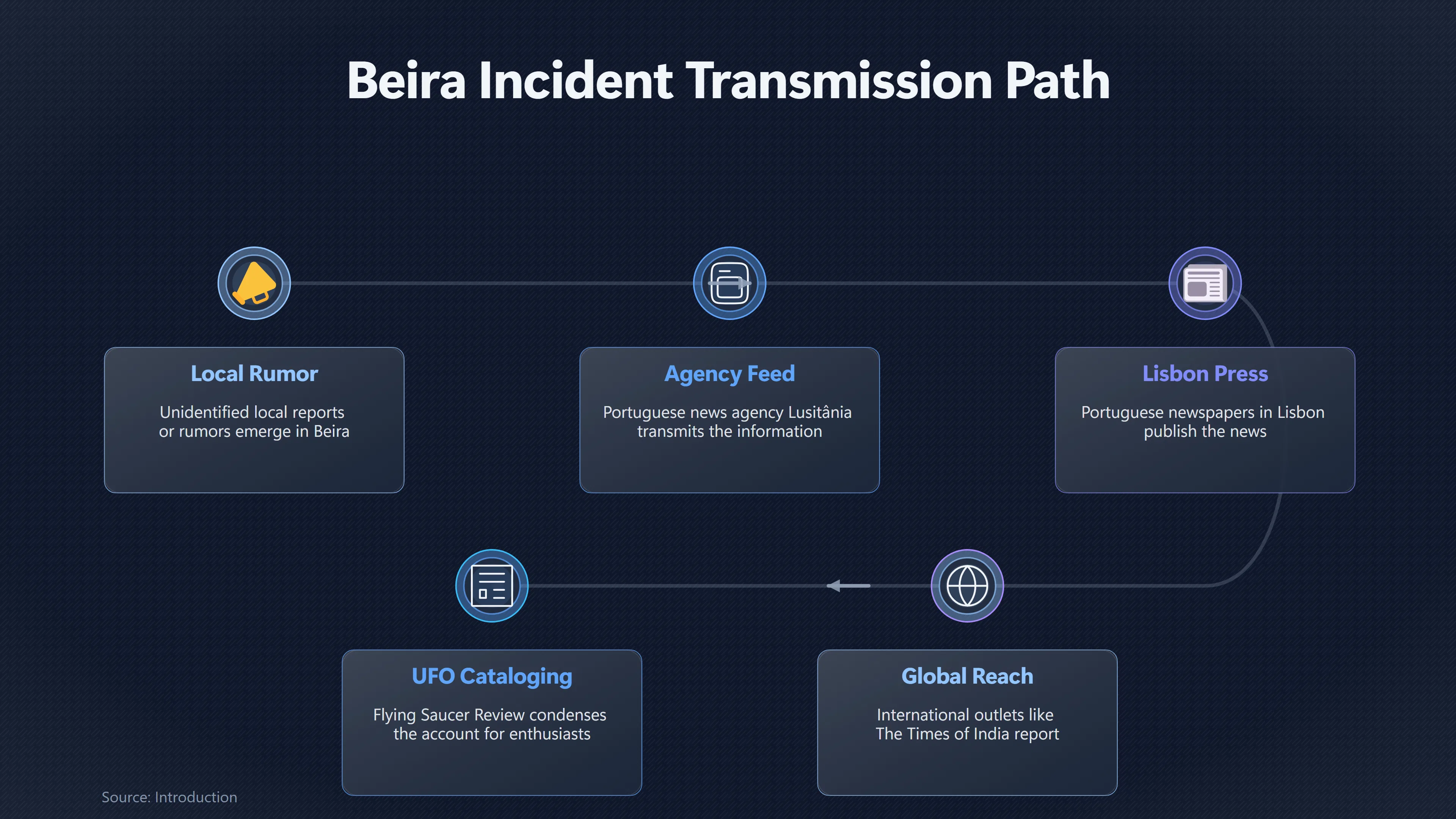
If the reported transmission route is accurate, the alleged Beira story moved through several editorial layers:
- An unidentified local report or rumour.
- Transmission by the Portuguese news agency Lusitânia.
- Coverage in Lisbon newspapers.
- Re-publication abroad, including The Times of India.
- Condensation in Flying Saucer Review.[sourcewatch.org]sourcewatch.orgFlying Saucer ReviewFlying Saucer Review
- Inclusion in later UFO catalogues. Ufologie
Each stage potentially introduced editorial shortening, translation, summarisation or embellishment. By the time the account entered international UFO literature, readers were several removes away from any original witnesses.
Equally important is what this chain does not contain. There is no identified surviving Mozambican journalist’s notebook, no named colonial official confirming the report, and no preserved investigative correspondence that would allow researchers to compare successive versions against an original account.
Why colonial-era newspapers are difficult to verify
At first glance, newspapers appear to offer an obvious route to verification. In practice, they present several obstacles.
Many colonial-era Mozambican newspapers survive only incompletely, often on microfilm rather than in searchable digital form. The principal Beira newspaper, Diário de Moçambique, existed during the relevant period and survives in archival collections, but comprehensive searchable runs are not generally available online, making targeted verification of early April 1960 reports difficult without archival access. The Library of Congress
Researchers therefore face several practical limitations:
- Limited digitisation of colonial newspapers.
- Incomplete indexing for specific dates.
- Portuguese-language reporting that has rarely been systematically searched by UFO researchers.
- Dependence on overseas repositories rather than local online collections.
These limitations mean that the absence of a currently accessible newspaper report should not automatically be interpreted as proof that none ever existed. It does, however, prevent historians from treating later retellings as verified accounts.
Why missing archives matter more than missing stories
The distinction between an undocumented event and an undocumented archive is important.
Historical research routinely encounters missing records because files are destroyed, never transferred to archives, or remain uncatalogued. Colonial administrations also tended to preserve material according to governmental priorities rather than modern historical interests.
For UFO claims, however, archival absence has a particularly strong effect because extraordinary claims usually depend on contemporaneous documentation. Without original reports, investigators cannot determine:
- whether witnesses actually described an unidentified object;
- whether the event was later exaggerated;
- whether journalists misunderstood the original account;
- whether the story originated as rumour rather than reporting.
Consequently, the lack of archives does not demonstrate that an event never occurred, but neither can it be used as evidence that extraordinary claims are true.
Assessing the reliability of colonial-era UFO sources
The surviving Mozambique material illustrates several warning signs recognised by historians of anomalous claims.
Multiple generations of citation. Later catalogues frequently cite earlier catalogues rather than original documents, making errors difficult to detect. Ufologie
Anonymous witnesses. No accessible primary source identifies the alleged observers by name or records direct testimony.
International rather than local preservation. The story survives mainly because foreign UFO researchers repeated it, not because Mozambican documentation remained available.
Compression over time. Short catalogue entries often omit uncertainty, causing speculative details to appear increasingly settled through repetition.
These characteristics reduce confidence in precise narrative details even if they do not entirely rule out the possibility that an unusual event prompted the earliest reports.
Where future archival searches could focus
Although the available evidence remains limited, several research avenues offer more promise than repeatedly citing existing UFO catalogues.
Priority targets include:
- Colonial Portuguese newspapers published in April 1960.
- Surviving editions of Diário de Moçambique from Beira.
- Portuguese National Archives collections relating to the Lusitânia news agency and colonial administration.
- French newspaper archives containing the reported Le Dauphiné Libéré article.
- Aviation, port authority and civil administration records for Beira during early April 1960.
- Private collections, memoirs or correspondence from journalists and colonial officials working in Beira at the time. The Library of Congress
Such work is valuable regardless of whether it ultimately supports or undermines the UFO interpretation, because it would clarify how the story entered the historical record.
What the thin archive tells us about Mozambique’s UFO record
The scarcity of reliable documentation is itself one of the defining characteristics of Mozambique’s UFO history. Unlike countries where official investigations generated substantial files, Mozambique’s record is dominated by secondary literature, incomplete citation chains and missing primary evidence.
For the wider study of UFO claims in Mozambique, this means evidence must be graded carefully. It is well established that reports about Beira circulated internationally during 1960 and were incorporated into influential UFO catalogues. It is not established, on currently accessible evidence, that the reported landing, explosion or humanoid encounter can be reconstructed from surviving Mozambican primary sources. That distinction should guide interpretation of both the Beira case and the country’s broader historical UFO record. Ufologie
Amazon book picks
Further Reading
Books and field guides related to Why Mozambique's UFO Archives Are So Thin. Use these as the next step if you want deeper reading beyond the article.

UFOs and Government: A Historical Inquiry
Examines documentary records and official files.
eBay marketplace picks
Marketplace Samples
Live-tested eBay searches with available results related to this page.
Selected fromUFO wall art oneBay.co.uk.




Endnotes
2.
Source: nationalarchives.gov.uk
Title: The National Archives UFOs
Link:https://www.nationalarchives.gov.uk/help-with-your-research/research-guides/ufos/
Source snippet
The National ArchivesUFOs - The National Archives...
3.
Source: loc.gov
Title: The Library of Congress Diário de Moçambique. | Library of Congress
Link:https://www.loc.gov/item/sn93021183/
4.
Source: ufologie.patrickgross.org
Link:https://www.ufologie.patrickgross.org/1954/18oct1954dieppe.htm
Source snippet
Please cite this reference in any correspondence with me regarding this case. SUMMARY: Th...
5.
Source: archives.gov
Title: Project BLUE BOOK
Link:https://www.archives.gov/research/military/air-force/ufos
Source snippet
Unidentified Flying Objects | National ArchivesJune 25, 2024 — PROJECT BLUE BOOK - UNIDENTIFIED FLYING OBJECTS GENERAL INFORMATION The Un...
Published: June 25, 2024
6.
Source: ufologie.patrickgross.org
Link:https://www.ufologie.patrickgross.org/1954/18oct1954frevent.htm
7.
Source: media.nationalarchives.gov.uk
Link:https://media.nationalarchives.gov.uk/index.php/ufo-files-national-archives/
8.
Source: sourcewatch.org
Title: Flying Saucer Review
Link:https://www.sourcewatch.org/index.php/Flying_Saucer_Review
9.
Source: GOV.UK
Title: www.gov.uk Colonial administration files
Link:https://www.gov.uk/guidance/colonial-administration-files
10.
Source: GOV.UK
Title: www.gov.uk Foreign Office publishes review on release of colonial documents
Link:https://www.gov.uk/government/news/foreign-office-publishes-review-on-release-of-colonial-documents
11.
Source: media.nationalarchives.gov.uk
Link:https://media.nationalarchives.gov.uk/index.php/the-truth-is-in-here-ufos-at-the-national-archives/
12.
Source: ufologie.patrickgross.org
Link:https://www.ufologie.patrickgross.org/ce3/1955-mozambique-saomartinhof.htm
13.
Source: ufologie.patrickgross.org
Link:https://www.ufologie.patrickgross.org/ce3/1955-mozambique-saomartinho.htm
14.
Source: ufologie.patrickgross.org
Link:https://www.ufologie.patrickgross.org/ce3/1960-04-05-mozambique-beiraf.htm
15.
Source: ufologie.patrickgross.org
Link:https://www.ufologie.patrickgross.org/ce3/1954-23-08-france-lugrin.htm
16.
Source: loc.gov
Title: Diário de Moçambique | Library of Congress
Link:https://www.loc.gov/item/sn93021184/
17.
Source: ufology.patrickgross.org
Link:https://ufology.patrickgross.org/1954/10sep1954quarouble.htm
Additional References
18.
Source: cambridge.org
Link:https://www.cambridge.org/core/journals/history-in-africa/article/african-and-asian-writings-from-mozambique-uncovering-indigenous-records-in-a-portuguese-colonial-archive/24A1DA2E74FB77E279E7757C524FB5A4
Source snippet
e CoreOctober 9, 2025 — AFRICAN AND ASIAN WRITINGS FROM MOZAMBIQUE: UNCOVERING INDIGENOUS RECORDS IN A PORTUGUESE COLONIAL ARCHIVE Publis...
Published: October 9, 2025
19.
Source: journals.unza.zm
Link:https://journals.unza.zm/index.php/zjh/article/view/1373
Source snippet
a National Colonial Archive: Considering the Influence and Historical Legacy of the Kaunda Era on Zambia’s Archives | Zambia Journal of H...
20.
Source: youtube.com
Link:http://www.youtube.com/watch?v=invFaw8Br9M
Source snippet
Colonial archives reliability africa history The True Map of Africa - Before Colonial Borders AfriEye...
21.
Source: aeceiiikp.blogspot.com
Link:https://aeceiiikp.blogspot.com/search?by-date=false&max-results=10&reverse-paginate=true&start=152&updated-max=2024-06-10T15%3A28%3A00-07%3A00
Source snippet
Journalist Pablo Villarrubia Mauso of the Brazilian ufology magazine "Revista UFO", noted that he had heard from Fernando Da Silva Martin...
22.
Source: youtube.com
Title: How Mozambique Rose From Colonization To Independence
Link:http://www.youtube.com/watch?v=39x7WOrjGFs
Source snippet
The History of Mozambique Explained | From Ancient Trade Routes to Post-Colonial Struggles...
23.
Source: youtube.com
Title: Mozambique’s Journey From Colonization to Independence
Link:http://www.youtube.com/watch?v=Gcabf4EbDuo
Source snippet
How Mozambique Rose From Colonization To Independence...
24.
Source: uem.mz
Link:https://uem.mz/arquivo-historico-de-mocambique/
25.
Source: cambridge.org
Link:https://www.cambridge.org/core/journals/history-in-africa/article/abs/arquivo-historico-de-mocambique-and-historical-research-in-maputo/56614F4613F696F670768B2775646FFD
26.
Source: cambridge.org
Link:https://www.cambridge.org/core/journals/history-in-africa/article/wiriyamu-and-the-colonial-archive-reading-it-against-the-grain-along-the-grain-read-it-at-all/ED57DE86F8CB6923FD0DBCC812BA0A58
27.
Source: ahm.uem.mz
Link:https://ahm.uem.mz/home.htm/