Within Iceland UFO Files
Why Iceland's Skies Create UFO Reports
Auroras, aircraft, satellites, and atmospheric effects explain many Icelandic UFO reports while highlighting the challenges of observation.
On this page
- Auroras and optical effects
- Aircraft and North Atlantic routes
- Identifying unknown lights
Page outline Jump by section
Introduction
Iceland is one of the world’s best places to observe the night sky, but the same conditions that attract astronomers and aurora enthusiasts can also make ordinary phenomena appear extraordinary. Long winter darkness, exceptionally low light pollution outside urban areas, highly transparent air, dramatic weather changes and busy North Atlantic air routes all increase the likelihood that unfamiliar lights will be reported as unidentified objects. Most Icelandic UFO reports involving distant lights are consistent with known natural or human-made phenomena, although some remain unexplained simply because the available evidence is too limited for a firm identification.[northiceland.is]northiceland.isNorth Iceland Travel Guide Northern Lights | Visit North IcelandNorth Iceland Travel Guide Northern Lights | Visit North Iceland
Understanding why Iceland’s skies produce unusual visual experiences is therefore essential for interpreting the country’s UFO reports. Rather than dismissing witnesses, investigators typically begin by examining whether auroral activity, atmospheric optics, aircraft, satellites or astronomical objects could account for what was seen before considering more unusual possibilities.
Why Iceland is especially prone to unusual sky observations
Several environmental factors combine to make Iceland an ideal setting for misidentified aerial phenomena.
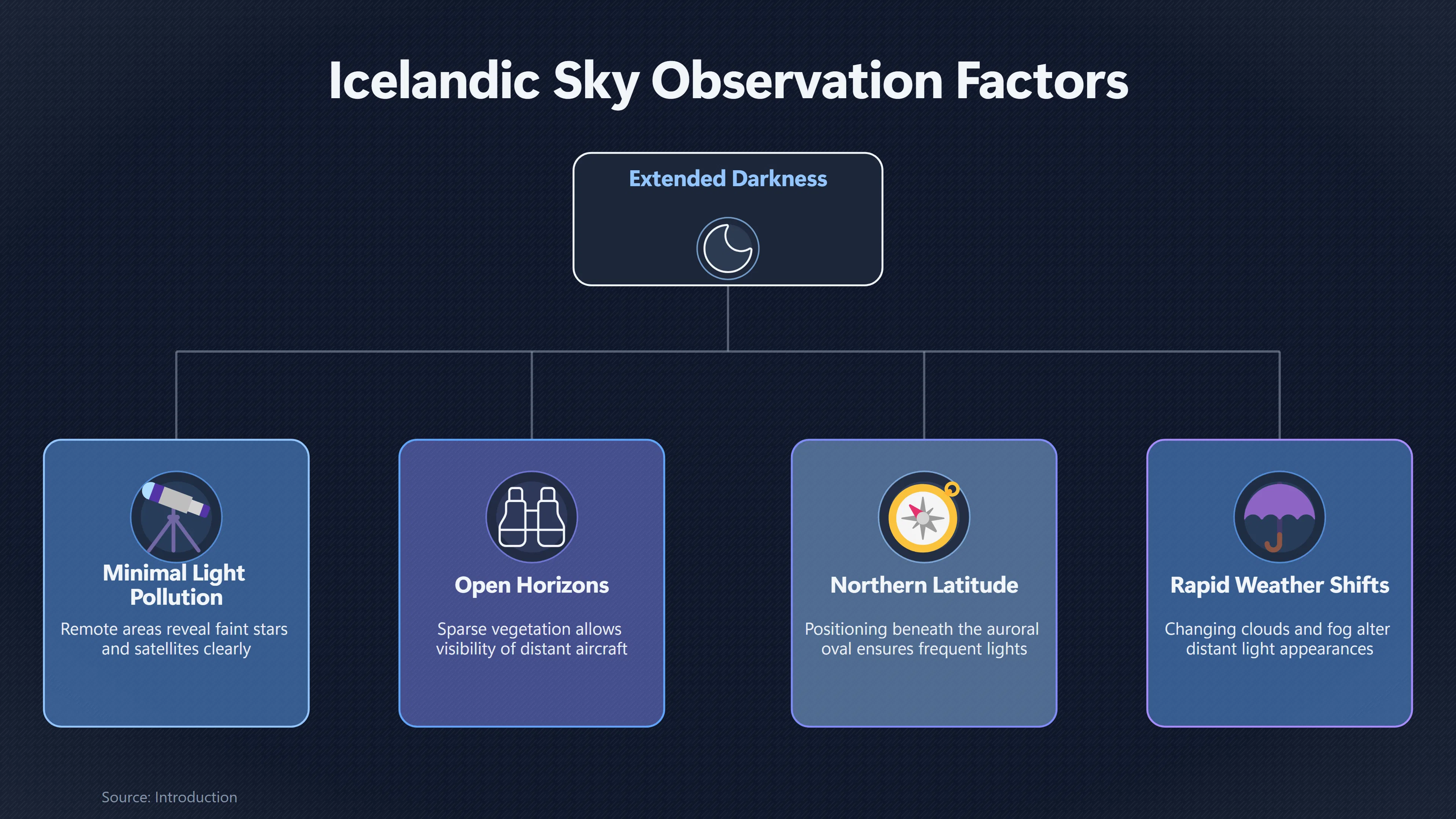
- Extended darkness: During autumn and winter, long nights provide many hours for observing the sky.
- Minimal light pollution: Outside Reykjavík and a handful of towns, exceptionally dark skies reveal faint stars, satellites and atmospheric effects that are invisible in brighter locations.
- Rapidly changing weather: Clear air can alternate quickly with cloud, fog or precipitation, altering the appearance of distant lights.
- Open horizons: Iceland’s sparse vegetation and broad landscapes make distant aircraft and celestial objects visible over great distances.
- Northern latitude: Iceland lies directly beneath the auroral oval during many geomagnetic events, making the Northern Lights a frequent feature of the night sky.[North Iceland Travel Guide]northiceland.isNorth Iceland Travel Guide Northern Lights | Visit North IcelandNorth Iceland Travel Guide Northern Lights | Visit North Iceland
These conditions increase both the number of genuine observations and the difficulty of judging distance, speed and size, especially when there are few nearby landmarks for comparison.
How the aurora creates convincing UFO reports
The Northern Lights are highly variable
Aurora Borealis is the single most distinctive natural light phenomenon visible from Iceland. Produced when charged particles from the Sun interact with Earth’s upper atmosphere, aurora can appear as curtains, arcs, rays, rapidly moving streaks or isolated patches of light. Colours vary from green to red, purple and white depending on altitude and atmospheric composition.[Space Weather]spaceweather.govSpace Weather Aurora | NOAA / NWS Space Weather Prediction CenterSpace Weather Aurora | NOAA / NWS Space Weather Prediction Center
To someone unfamiliar with auroral behaviour, these displays can resemble intelligent movement. Bright sections may suddenly intensify, fade, split or appear to race across the sky. Because the lights occur roughly 100–250 kilometres above Earth, there are few visual cues that allow observers to estimate their true distance.[North Iceland Travel Guide]northiceland.isNorth Iceland Travel Guide Northern Lights | Visit North IcelandNorth Iceland Travel Guide Northern Lights | Visit North Iceland
Why witnesses sometimes describe structured objects
Most experienced observers distinguish aurora from solid objects, but certain circumstances make confusion understandable.
For example:
- isolated bright auroral patches may resemble glowing discs;
- rapidly changing brightness can suggest acceleration or manoeuvring;
- gaps in cloud can create the illusion that a light is moving behind terrain;
- reflections from ice crystals or thin cloud layers may distort the apparent shape of an auroral feature.
Photographs taken with long camera exposures can also exaggerate colour and structure, making a scene appear more dramatic than it looked to the naked eye.
Atmospheric optics can transform ordinary lights
Aurora is only one source of unusual visual effects. Iceland’s cold maritime climate frequently produces atmospheric conditions that alter how light travels.
Temperature inversions, layers of moist air and suspended ice crystals can bend or scatter light, causing distant sources to appear displaced, enlarged or shimmering. Aircraft landing lights, ships beyond the horizon or bright planets may therefore seem to hover motionless before suddenly disappearing as atmospheric conditions change.
Cloud also contributes to misidentification. Thin cloud can diffuse bright stars into glowing patches, while broken cloud moving quickly across the sky creates the impression that the light itself is changing speed or direction.
These mechanisms are well understood in atmospheric physics and are regularly considered when evaluating reports of unidentified lights in Icelandic skies.
Aircraft over the North Atlantic
Many people imagine Iceland as isolated, yet it occupies an important position between North America and Europe.
International flights cross Icelandic-controlled airspace every day, while Keflavík International Airport serves as a major North Atlantic gateway. Aircraft approaching or departing Iceland may be observed from long distances, particularly at night when landing lights remain visible for many tens of kilometres.[eaip.isavia.is]eaip.isavia.isBI GEN 1.2 en GBBI GEN 1.2 en GB
Several characteristics commonly reported in UFO sightings are entirely consistent with distant aircraft:
- lights that appear stationary before suddenly moving;
- apparent hovering for several minutes;
- slow lateral movement near the horizon;
- sudden disappearance after turning or entering cloud;
- alternating white and coloured flashes from navigation lights.
Perspective plays a major role. An aircraft flying almost directly towards an observer shows little sideways motion, creating the impression of a hovering object. Once its flight path changes, the same aircraft may appear to accelerate dramatically despite maintaining a constant speed.
Satellites and the changing night sky
The increasing number of satellites has noticeably altered what observers can expect to see above Iceland.
Individual satellites typically appear as silent, steady lights crossing the sky. Under favourable illumination they may brighten suddenly as sunlight reflects from solar panels before fading within seconds. Earlier generations of Iridium satellites became famous for these dramatic flashes, but other satellites—including modern Starlink spacecraft—can also produce striking reflections depending on viewing geometry.[National Geographic]nationalgeographic.comNational GeographicWill SpaceX's Starlink satellites harm astronomy? Here's what we know. | National GeographicMay 29, 2019…
New satellite constellations have introduced additional sources of confusion:[iauarchive.eso.org]iauarchive.eso.orgsatellite constellationssatellite constellations
- multiple satellites travelling in a straight line shortly after launch;
- groups of evenly spaced lights crossing the sky;
- objects that brighten and disappear unexpectedly;
- moving lights visible despite complete silence.
For observers encountering such formations for the first time, they can appear highly unusual. In recent years, many widely shared “fleet” UFO reports around the world have later been identified as Starlink satellite deployments rather than unknown craft.[National Geographic]nationalgeographic.comNational GeographicWill SpaceX's Starlink satellites harm astronomy? Here's what we know. | National GeographicMay 29, 2019…
Identifying genuinely unknown lights
A report remaining “unidentified” does not necessarily imply an extraordinary explanation. In Iceland, many cases simply lack sufficient information for a confident conclusion.
Investigators generally look for questions such as:
- Was there simultaneous auroral activity?
- Were commercial aircraft operating in the same direction?
- Could satellites have been visible at that time?
- Did multiple independent witnesses observe the same event?
- Are photographs or video available?
- Can weather records explain unusual optical conditions?
If these questions cannot be answered because the report contains only a brief recollection or lacks timing and location details, the event may remain unresolved without implying anything beyond insufficient evidence.
Why misidentification is not the same as unreliability
One common misconception is that natural explanations imply witnesses imagined what they saw. In reality, most witnesses accurately report their observations while misidentifying the underlying cause.
Human perception estimates distance, size and speed using familiar visual references. Iceland’s expansive landscapes, dark skies and sparse artificial lighting remove many of those references. A distant aircraft, a bright planet near the horizon or an unusually active aurora can therefore appear far closer, larger or more manoeuvrable than it actually is.
This distinction is important in evaluating Icelandic UFO reports. A sincere witness can describe an event faithfully while still reaching an incorrect interpretation of its origin.
What Iceland’s skies tell us about UFO reports
The strongest evidence suggests that Iceland’s environment naturally generates conditions in which unfamiliar aerial phenomena are both common and difficult to identify. Auroras, atmospheric refraction, aircraft on North Atlantic routes, satellites and astronomical objects together explain a substantial proportion of reported lights in the country’s skies.[northiceland.is]northiceland.isNorth Iceland Travel Guide Northern Lights | Visit North IcelandNorth Iceland Travel Guide Northern Lights | Visit North Iceland
At the same time, a minority of reports remain unresolved because they lack the observational detail needed for confident identification. Within the broader study of Icelandic UFO reports, these natural mechanisms provide the essential baseline against which more unusual claims should be assessed, helping distinguish genuinely unexplained observations from phenomena that only appear mysterious under Iceland’s remarkable skies.
Amazon book picks
Further Reading
Books and field guides related to Why Iceland's Skies Create UFO Reports. Use these as the next step if you want deeper reading beyond the article.
UFOs: Generals, Pilots, and Government Officials Go on the Re...
Balances unexplained and explained cases.
NightWatch: A Practical Guide to Viewing the Universe
Helps identify celestial objects.
eBay marketplace picks
Marketplace Samples
Live-tested eBay searches with available results related to this page.
Selected fromIceland landscape print oneBay.co.uk.

Endnotes
1.
Source: eaip.isavia.is
Title: BI GEN 1.2 en GB
Link:https://eaip.isavia.is/A_06-2026_2026_06_11/eAIP/BI-GEN%201.2-en-GB.html
2.
Source: eaip.isavia.is
Title: BI ENR 1.2 en GB
Link:https://eaip.isavia.is/A_06-2026_2026_06_11/eAIP/BI-ENR%201.2-en-GB.html
3.
Source: iceland.org
Title: best locations
Link:https://www.iceland.org/northern-lights/best-locations
4.
Source: eaip.isavia.is
Link:https://eaip.isavia.is/A_06-2026_2026_06_11/eAIP/BI-ENR%201.1-en-GB.html
5.
Source: northiceland.is
Title: North Iceland Travel Guide Northern Lights | Visit North Iceland
Link:https://www.northiceland.is/en/experiences/northern-lights
6.
Source: spaceweather.gov
Title: Space Weather Aurora | NOAA / NWS Space Weather Prediction Center
Link:https://www.spaceweather.gov/phenomena/aurora
7.
Source: nationalgeographic.com
Link:https://www.nationalgeographic.com/science/article/elon-musk-starlink-internet-satellites-trouble-for-astronomy-light-pollution
Source snippet
National GeographicWill SpaceX's Starlink satellites harm astronomy? Here's what we know. | National GeographicMay 29, 2019...
Published: May 29, 2019
8.
Source: northiceland.is
Title: Top Spots to See the Northern Lights in North Iceland | Visit North Iceland
Link:https://www.northiceland.is/en/moya/news/top-spots-to-see-the-northern-lights-in-north-iceland
9.
Source: iauarchive.eso.org
Title: satellite constellations
Link:https://iauarchive.eso.org/public/themes/satellite-constellations/
10.
Source: nationalgeographic.com
Title: See Why Iceland Is for Astronomy Lovers | National Geographic
Link:https://www.nationalgeographic.com/science/article/iceland-auroras-sky-watching-one-strange-rock-space-science
11.
Source: weather.metoffice.gov.uk
Title: metoffice.gov.uk Auroras
Link:https://weather.metoffice.gov.uk/learn-about/space-weather/auroras
12.
Source: met.ie
Title: The Northern Lights
Link:https://www.met.ie/education/the-northern-lights
Additional References
13.
Source: eso.org
Link:https://www.eso.org/public/news/eso2607/
Source snippet
July 1, 2026 — PRESS RELEASE "BEYOND THE LIMIT": ONE MILLION SATELLITES AND MIRRORS IN SPACE POSE GRAVE THREAT TO THE NIGHT SKY 1 July 20...
Published: July 1, 2026
14.
Source: aurora-iceland.com
Title: How to See the Northern Lights from a Keflavík Airport Layover — Aurora Iceland
Link:https://www.aurora-iceland.com/blog/northern-lights-keflavik-airport-layover/
Source snippet
May 1, 2026 — HOW TO SEE THE NORTHERN LIGHTS FROM A KEFLAVÍK AIRPORT LAYOVER May 1, 2026 · 5 min read Image: Vibrant green aurora boreali...
Published: May 1, 2026
15.
Source: science.nasa.gov
Title: northern glow spans iceland and canada
Link:https://science.nasa.gov/earth/earth-observatory/northern-glow-spans-iceland-and-canada/
Source snippet
Glow Spans Iceland and Canada - NASA ScienceFebruary 19, 2026 — Earth Observatory 3 min read NORTHERN GLOW SPANS ICELAND AND CANADA Image...
Published: February 19, 2026
16.
Source: arxiv.org
Link:https://arxiv.org/abs/2208.03226
17.
Source: youtube.com
Title: Orographic Clouds
Link:https://www.youtube.com/watch?v=InulE0WLekQ
Source snippet
The Science Behind the Northern Lights | Star Gazers...
18.
Source: nature.com
Title: Satellite megaconstellations will threaten space-based astronomy | Nature
Link:https://www.nature.com/articles/s41586-025-09759-5
19.
Source: aanda.org
Link:https://www.aanda.org/articles/aa/abs/2024/09/aa51856-24/aa51856-24.html
20.
Source: icelandair.com
Link:https://www.icelandair.com/pl-pl/o-icelandair/nasza-flota/hekla-aurora/
21.
Source: icelandair.com
Link:https://www.icelandair.com/hekla-aurora/
22.
Source: avians.is
Link:https://www.avians.is/en/reykjavik-control-area-/reykjavik-control-area