Within Kazakhstan UFOs
When Baikonur Launches Look Like UFOs
Sunlit rocket plumes, staging events and falling debris can create spirals and glowing clouds visible far beyond Baikonur.
On this page
- How twilight rocket plumes form
- Launch corridors, stages and debris
- Clues that separate rockets from unknown objects
Page outline Jump by section
Introduction
Baikonur Cosmodrome has produced some of the most spectacular sky displays ever mistaken for unidentified flying objects over Kazakhstan. Unlike many UFO reports, however, these events have a well-understood physical cause. Rockets launched during twilight can leave enormous glowing plumes, expanding spirals and luminous clouds that remain illuminated by the Sun long after darkness has fallen on the ground. Because Baikonur launches are visible across vast areas of Kazakhstan, observers hundreds of kilometres from the launch site may witness unfamiliar shapes without hearing or seeing the rocket itself. Understanding how these displays form is essential when assessing unusual sky reports from central and southern Kazakhstan, where genuine aerospace activity frequently provides a more convincing explanation than an unknown aerial phenomenon.
How twilight rocket plumes create UFO-like displays
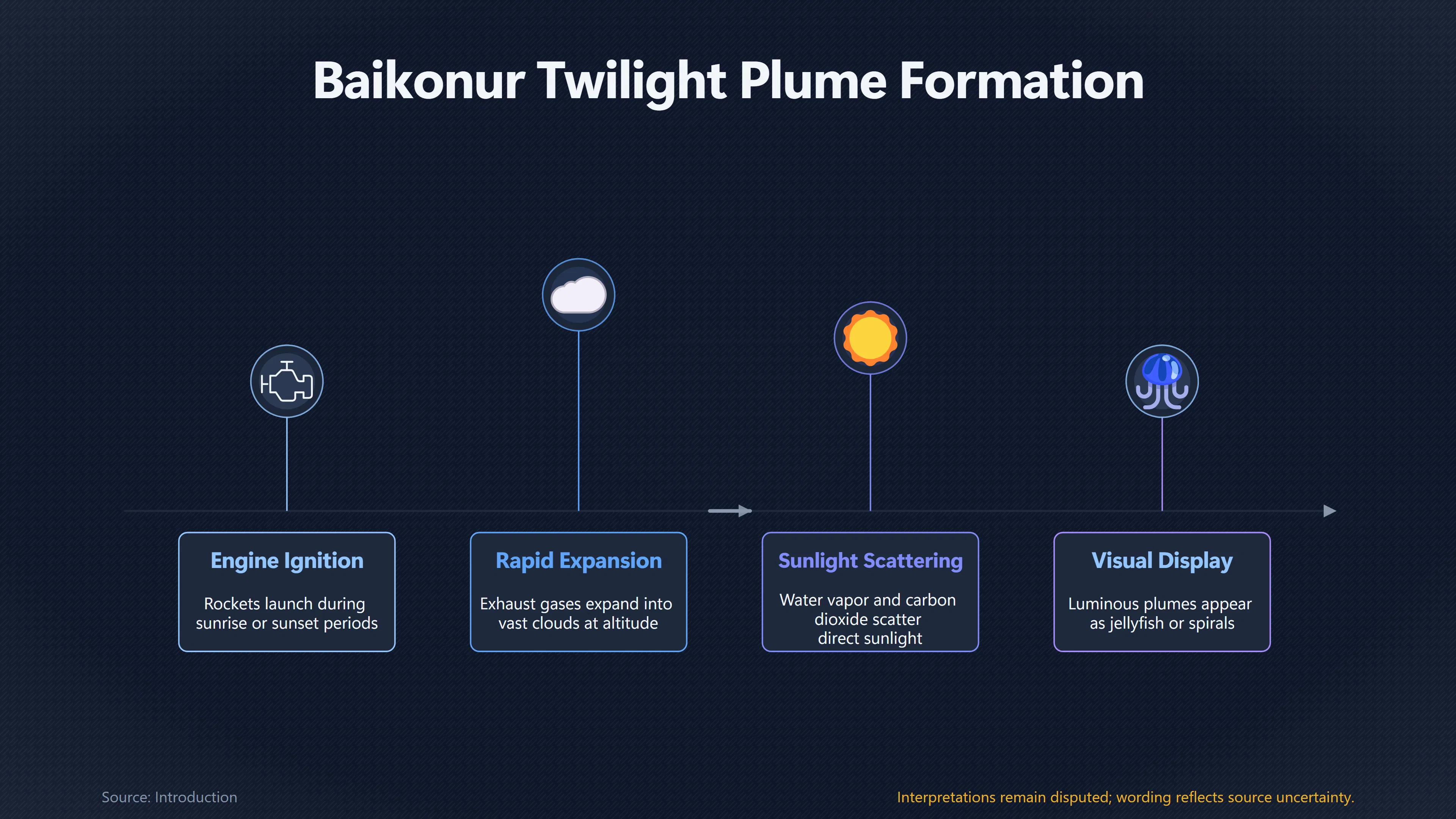
The most dramatic Baikonur-related sightings occur when launches take place shortly before sunrise or shortly after sunset. During these periods, people on the ground are in darkness or deep twilight, while a rocket climbing above roughly 80–150 kilometres remains in direct sunlight.
At those altitudes the atmosphere is extremely thin. Exhaust leaving the engine expands rapidly into a vast cloud rather than remaining as a narrow flame. Water vapour, carbon dioxide and other combustion products scatter sunlight, producing an intensely bright plume that can appear white, blue, turquoise, pink or orange depending on the viewing geometry and atmospheric conditions. This phenomenon is widely known as the twilight phenomenon or the space jellyfish effect.[nasa.gov]apod.nasa.govAstronomy Picture of the DayAPOD: 2026 March 19 – Launch Plume: SpaceX JellyfishMarch 19, 2026…
To an observer unfamiliar with launch dynamics, the result can seem extraordinary:
- a glowing disc that suddenly expands;
- a jellyfish-shaped cloud with trailing “tentacles”;
- a luminous spiral apparently hanging motionless;
- an object that appears to change size without moving rapidly;
- a bright cloud that slowly fades over several minutes.
These appearances differ dramatically from the familiar image of a rocket ascending with a bright flame, making misidentification understandable.
Why Baikonur can surprise observers far from the launch site
One of the most confusing aspects of Baikonur launches is that many witnesses are nowhere near the cosmodrome.
After leaving the launch pad, rockets climb rapidly into the upper atmosphere where the curvature of the Earth allows the exhaust plume to become visible over enormous distances. Someone several hundred kilometres away may see only the illuminated plume while the rocket itself is too distant or too small to recognise.
This geometry creates several misleading impressions:
- the object appears silent;
- it seems to hover because its distance masks its true speed;
- it grows rapidly as the exhaust cloud expands;
- it may appear detached from any obvious source.
Kazakhstan’s broad open landscapes, relatively dark skies and sparse population in many regions further enhance visibility, allowing twilight plumes to dominate the horizon over exceptionally large areas.[Astronomy Picture of the Day]apod.nasa.govAstronomy Picture of the DayAPOD: 2026 March 19 – Launch Plume: SpaceX JellyfishMarch 19, 2026…
Launch corridors, rocket stages and falling debris
Not every unusual object associated with Baikonur is the main launch vehicle.
As missions progress, several additional events can generate reports:
- Stage separation. Booster stages detach, briefly producing multiple luminous points before following independent trajectories.
- Upper-stage engine burns. Restarting engines can create fresh expanding clouds that appear suddenly in an otherwise dark sky.
- Fuel venting. Releasing residual propellant may generate circular or spiral patterns as the rotating stage disperses frozen exhaust.
- Re-entering hardware. Discarded stages or fragments can produce bright streaks resembling slow meteors if they re-enter the atmosphere.
Kazakhstan also contains designated impact zones where certain rocket stages descend after separation. Residents within or near these corridors have occasionally reported unusual lights, loud sounds or falling objects before learning that a scheduled launch had taken place. Such reports reflect the country’s continuing role as an active launch region rather than evidence of unidentified craft.
Why spirals sometimes appear
Among the most striking rocket-related sky displays are glowing spirals.
These are generally produced when an upper stage rotates while venting unused propellant. As the stage spins, escaping gas spreads into a widening corkscrew pattern. High-altitude sunlight illuminates the expanding cloud, producing a luminous spiral that can remain visible for several minutes before dispersing.
Because the spiral appears geometrically precise and often develops rapidly, it has repeatedly generated UFO speculation in many countries. Similar displays linked to documented launches have been observed across Europe and North America, demonstrating that this is a recognised consequence of rocket operations rather than an unknown atmospheric anomaly.[theguardian.com]theguardian.comHowever, it has been determined that the phenomenon was caused by a SpaceX rocket, specifically the Falcon 9, which launched from Cape Ca…
Clues that separate rockets from unknown objects
Most Baikonur-related sky phenomena share several consistent characteristics that distinguish them from genuinely unexplained reports.
Strong indicators of a launch-related event include:
- occurrence within an hour of sunrise or sunset;
- gradual expansion into a large cloud rather than abrupt manoeuvres;
- colours changing as the Sun’s illumination angle changes;
- visibility over a very large geographical area;
- disappearance through diffusion rather than rapid acceleration;
- timing that matches publicly announced launches.
By contrast, reports describing rapid directional changes, prolonged low-altitude manoeuvring, close-range structured objects or behaviour inconsistent with known launch physics require separate investigation. Even then, a lack of corroborating evidence often prevents firm conclusions.
For investigators examining Kazakhstan UFO reports, checking Baikonur launch schedules is therefore a routine first step before considering more unusual explanations.

What this means for Kazakhstan’s UFO record
Baikonur is one of the world’s longest-operating spaceports, and its continuing launch activity has inevitably shaped Kazakhstan’s catalogue of unusual sky observations.
This does not mean every report near Baikonur can automatically be dismissed. Witnesses occasionally observe events lacking sufficient data for confident identification, and incomplete documentation can leave some cases unresolved. Nevertheless, the presence of frequent rocket launches substantially increases the likelihood that dramatic twilight displays, expanding luminous clouds and glowing spirals have conventional aerospace origins.
Within Kazakhstan’s broader history of anomalous aerial reports, Baikonur therefore serves less as evidence for extraordinary craft than as a reminder that advanced aerospace activity can produce spectacular visual phenomena capable of convincing experienced observers that they have witnessed something genuinely unknown.
Amazon book picks
Further Reading
Books and field guides related to When Baikonur Launches Look Like UFOs. Use these as the next step if you want deeper reading beyond the article.

UFOs: Generals, Pilots, and Government Officials Go on the Re...
General UFO evidence framework.


eBay marketplace picks
Marketplace Samples
Live-tested eBay searches with available results related to this page.
Selected fromBaikonur poster oneBay.co.uk.

Endnotes
1.
Source: Wikipedia
Title: Twilight phenomenon
Link:https://en.wikipedia.org/wiki/Twilight_phenomenon
2.
Source: space.com
Link:https://www.space.com/spacex-rocket-launch-nebula-images-by-photographers.html
3.
Source: space.com
Title: Russian Rocket Sparks Deadly Fire: How It Happened | Space
Link:https://www.space.com/37207-russian-rocket-launch-sparks-deadly-fire-progress-67.html
4.
Source: apod.nasa.gov
Link:https://apod.nasa.gov/apod/ap260319.html
Source snippet
Astronomy Picture of the DayAPOD: 2026 March 19 – Launch Plume: SpaceX JellyfishMarch 19, 2026...
Published: March 19, 2026
5.
Source: theguardian.com
Link:https://www.theguardian.com/world/2025/mar/25/alien-hopes-crash-to-earth-glowing-spiral-uk-spacex-rocket
Source snippet
However, it has been determined that the phenomenon was caused by a SpaceX rocket, specifically the Falcon 9, which launched from Cape Ca...
6.
Source: thetimes.co.uk
Link:https://www.thetimes.co.uk/article/space-x-sky-spiral-yorkshire-t2cpgdxn2
Source snippet
Experts attribute the phenomenon to a fuel dump from a SpaceX Falcon 9 rocket launched earlier that day from Florida, carrying a national...
7.
Source: philsa.gov.ph
Title: Philippine Space Agency
Link:https://philsa.gov.ph/news/advisory-on-space-jellyfish-sighting-on-june-04/
8.
Source: philsa.gov.ph
Title: Philippine Space Agency
Link:https://philsa.gov.ph/news/advisory-on-space-jellyfish-sighting-on-may-12/
9.
Source: star.ucl.ac.uk
Link:https://www.star.ucl.ac.uk/~apod/apod/ap260319.html
10.
Source: apod.nasa.gov
Link:https://apod.nasa.gov/rjn/apod/ap240312.html
11.
Source: nasa.gov
Title: The launch plume of Russia’s Progress 76 resupply ship
Link:https://www.nasa.gov/image-article/launch-plume-of-russias-progress-76-resupply-ship/
12.
Source: ntrs.nasa.gov
Link:https://ntrs.nasa.gov/citations/20000091012
13.
Source: ntrs.nasa.gov
Link:https://ntrs.nasa.gov/citations/19990041839
14.
Source: nti.org
Link:https://www.nti.org/education-center/facilities/baikonur-cosmodrome/
Additional References
15.
Source: mdpi.com
Link:https://www.mdpi.com/2226-4310/13/7/572
Source snippet
June 25, 2026 — OPTIMIZATION OF LAND-BASED IMPACT ZONES FOR SPENT ROCKET STAGES LAUNCHED FROM THE BAIKONUR COSMODROME by Gulnaz Yermoldin...
Published: June 25, 2026
16.
Source: bruneiastronomy.org
Title: strange light phenomenon observed over brunei darussalam 4 june 2026
Link:https://bruneiastronomy.org/web/2026/06/strange-light-phenomenon-observed-over-brunei-darussalam-4-june-2026/
Source snippet
Strange Light Phenomenon Observed Over Brunei Darussalam (4 June 2026) – BruneiAstronomyJune 12, 2026 — STRANGE LIGHT PHENOMENON OBSERVED...
Published: june 2026
17.
Source: mexc.com
Title: Mysterious Glow in the Sky?
Link:https://www.mexc.com/en-GB/news/1141507
Source snippet
Don't Call It a UFO Just Yet – The SpaceX Rocket Launch Jellyfish Effect and Spiral Phenomenon Explained | MEXC NewsJune 12, 2026 — This...
Published: June 12, 2026
18.
Source: youtube.com
Title: A Giant Jellyfish-like Light Trail Appears in the Russian Sky
Link:https://www.youtube.com/watch?v=fGUv7T41maM
Source snippet
SpaceX Falcon 9 Produces "Space Jellyfish Effect" During Launch of Crew 12 to the ISS (Feb 13, 2026)...
19.
Source: youtube.com
Link:https://www.youtube.com/watch?v=MPHNZPmQEpY
Source snippet
Russia Gi AREA 51 Kapustin Yar | New Mystery Unlocked...
20.
Source: youtube.com
Title: Russian rocket is seen streaking accross night sky in Russia
Link:https://www.youtube.com/watch?v=b60SM627Qrg
Source snippet
A Giant Jellyfish-like Light Trail Appears in the Russian Sky...
21.
Source: factsanddetails.com
Link:https://factsanddetails.com/central-asia/Kazakhstan/sub8_4f/entry-4682.html
22.
Source: discovermagazine.com
Link:https://www.discovermagazine.com/in-russias-space-graveyard-locals-scavenge-fallen-spacecraft-for-profit-368
23.
Source: cbsnews.com
Link:https://www.cbsnews.com/news/russian-cargo-ship-launch-international-space-station-2021-06-29/
24.
Source: societyandspace.org
Link:https://www.societyandspace.org/articles/when-things-fall-from-the-sky-understanding-rocket-stages-on-the-kazakh-steppe-as-imperial-debris