Within Ukraine UFO Files
How Soviet Secrecy Shaped Ukraine's UFO Archive
Ukraine's UFO archive begins inside Soviet defence and scientific programs whose records are now fragmented across institutions and private collections.
On this page
- The Setka program and its Ukrainian links
- What surviving records can actually establish
- Why fragmented custody complicates verification
Page outline Jump by section
Introduction
Ukraine’s surviving UFO archive is inseparable from the Soviet institutions that created it. Before Ukrainian independence in 1991, reports of unusual aerial phenomena from Ukrainian territory were not investigated by a national Ukrainian agency but entered a Soviet-wide system involving the military, scientific institutes and specialist commissions. The result is an archive that is both unusually extensive and unusually fragmented. Documents are scattered across former Soviet military repositories, academic institutions, regional archives, private collections and later Ukrainian research groups.
For historians, this fragmented record is more valuable than it is sensational. It demonstrates that Soviet authorities regarded unexplained aerial observations as potential military, technical or scientific problems worthy of systematic collection. At the same time, the surviving documentation does not establish evidence of extraterrestrial technology. Instead, it reveals how secrecy, bureaucratic compartmentalisation and the later collapse of the USSR created enduring difficulties for verification and historical reconstruction.[Skeptical Inquirer]skepticalinquirer.orgSkeptical InquirerA History of State UFO Research in the USSR | Skeptical InquirerDecember 1, 2000…
How the Setka programme connected Ukraine to Soviet UFO research
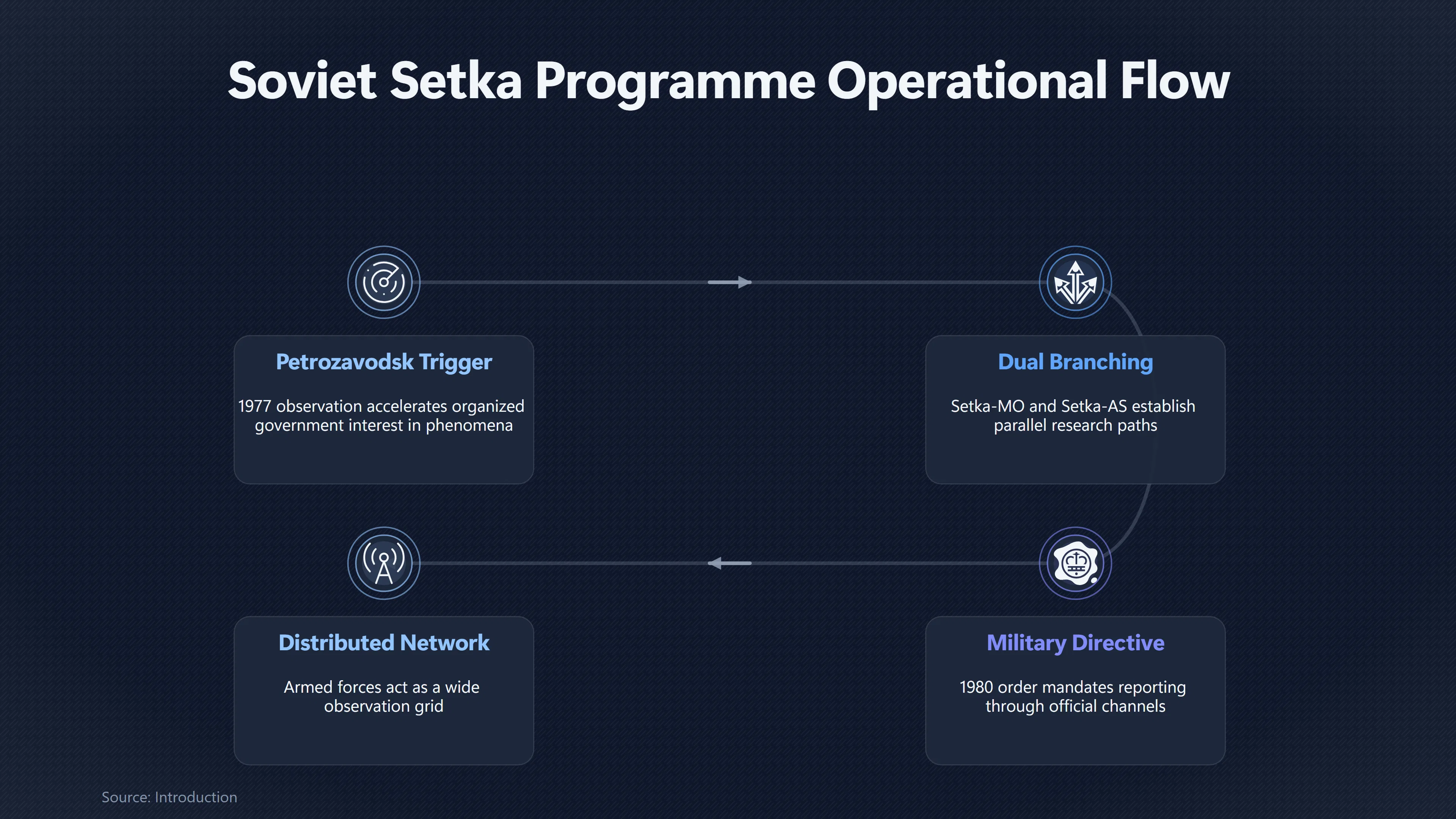
The Soviet government’s organised interest in unidentified aerial phenomena accelerated after the widely observed Petrozavodsk phenomenon of September 1977. Rather than creating a single “UFO office”, Soviet authorities established two complementary research programmes commonly known by the codename Setka (“Grid” or “Network”).
These parallel branches had different responsibilities:
- Setka-MO, administered through the Ministry of Defence, collected reports from military personnel and examined whether unexplained phenomena affected weapons, radar, communications or personnel.
- Setka-AS, managed through the Academy of Sciences, focused on atmospheric physics, astronomy and other scientific explanations for unusual observations.[Skeptical Inquirer]skepticalinquirer.orgSkeptical InquirerA History of State UFO Research in the USSR | Skeptical InquirerDecember 1, 2000…
Ukraine formed an important part of this network because it contained numerous strategic military installations, radar facilities, air-defence units, aerospace industries and scientific institutes. Reports originating in what is now Ukraine were therefore processed within the wider Soviet reporting system rather than under an independent Ukrainian authority.
A 1980 military directive significantly expanded the programme by requiring Soviet servicemen to report unusual atmospheric or aerial events through official channels. This transformed much of the armed forces into a distributed observation network. Incidents involving apparent equipment malfunctions or operational impacts received particularly rapid reporting.[Skeptical Inquirer]skepticalinquirer.orgSkeptical InquirerA History of State UFO Research in the USSR | Skeptical InquirerDecember 1, 2000…
Ukrainian institutions inside the Soviet research network
Although Moscow coordinated the overall programme, scientific work was distributed across numerous Soviet republics.
Ukraine contributed through:
- Academy-affiliated scientific institutes.
- Universities and technical organisations.
- Military research facilities.
- Specialist scientific societies studying anomalous phenomena.[zond.kiev.ua]zond.kiev.uaSource details in endnotes.
Following independence, several Ukrainian researchers argued that these Soviet-era activities formed the intellectual foundation for later civilian organisations. Among the best known is the Ukrainian Scientific Research Centre for the Study of Anomalies (Zond), which traces its origins to Soviet scientific commissions associated with the Popov Scientific and Technical Society during the late Soviet period.
This institutional continuity matters because many surviving files were never formally transferred into a single national archive. Instead, expertise and privately retained documents often followed individual researchers rather than government repositories.
What surviving records actually demonstrate
One of the most common misunderstandings is that Soviet secrecy itself proves extraordinary discoveries. The surviving documentation supports a more measured conclusion.
The available records establish several well-supported facts:
- Soviet authorities systematically collected reports of unusual aerial observations.
- Military personnel were expected to report anomalous events.
- Scientists analysed reports using conventional physical and atmospheric explanations whenever possible.
- Investigators distinguished between observations that could be identified and those that remained unresolved because evidence was insufficient.
The records do not demonstrate:
- Official confirmation of extraterrestrial spacecraft.
- Recovery of verified alien technology.
- Scientific consensus that unexplained reports represented non-human intelligence.
According to researchers involved in the Academy of Sciences component of Setka, roughly 3,000 reports were examined during the programme’s lifetime. Most were ultimately attributed to rocket launches, satellites, atmospheric optics, balloons, astronomical objects or other identifiable causes. A much smaller proportion remained unresolved because available information was incomplete rather than because investigators established extraordinary origins.[Skeptical Inquirer]skepticalinquirer.orgSkeptical InquirerA History of State UFO Research in the USSR | Skeptical InquirerDecember 1, 2000…
This distinction is crucial when interpreting Ukrainian material inherited from the Soviet period.
Why so much of Ukraine’s archive is fragmented
Unlike countries that later released relatively centralised government UFO files, Ukraine inherited only portions of a much larger Soviet documentation system.
Several historical processes contributed to today’s fragmented archive.
The collapse of Soviet institutions
When the USSR dissolved in 1991, responsibility for archives became divided among newly independent states.
Records originating in Ukraine could remain:
- in Russian military repositories,
- inside Ukrainian institutions,
- among successor scientific organisations,
- or in personal collections retained by former officials and researchers.
Many original reporting chains effectively disappeared.

Military classification
Some files were never classified because they described UFOs. Instead, they remained restricted because they identified:
- radar capabilities,
- missile units,
- military communications,
- observation methods,
- or sensitive installations.
Even if the aerial phenomenon itself proved mundane, associated operational information could remain protected.
Informal preservation
Some Soviet researchers preserved working papers, correspondence and unpublished material privately after official programmes ended.
These collections can provide valuable historical context but often lack complete provenance, making independent verification difficult.
The problem of missing provenance
For historians, provenance—the documented history of how a record was created, handled and preserved—is almost as important as the observation itself.
Many Ukrainian UFO documents survive only as:
- photocopies,
- later translations,
- secondary quotations,
- memoirs,
- or references within private archives.
Without original registration numbers, complete witness statements, accompanying technical data or archival custody records, researchers cannot always establish:
- whether documents are complete,
- whether edits occurred,
- whether later copies introduced errors,
- or whether multiple published versions refer to the same original incident.
Consequently, even genuine Soviet documents may have limited evidential value if separated from their original administrative context.
Why later sensational claims require caution
The fragmented state of Soviet records has created fertile ground for exaggerated narratives.
Over the past three decades, numerous books, documentaries and internet publications have claimed access to “secret Soviet UFO archives”. Some reproduce authentic administrative forms or genuine reporting procedures while combining them with poorly sourced anecdotes, unattributed testimony or stories that cannot be traced to original documentation.
A recurring pattern is that authentic bureaucratic material is presented alongside extraordinary claims without distinguishing between:
- verified archival documents,[fisu.gov.ua]fisu.gov.uaDeclassified ArchivesOctober 28, 2024 — FOREIGN INTELLIGENCE SERVICE OF UKRAINE УкрEng Image: Background ARCHIVAL DOCUMENTS The Collection “Ukrainian Emigrati…
- witness recollections,
- journalistic retellings,
- and folklore that entered UFO literature years later.
The existence of genuine Soviet investigation programmes should therefore not be treated as validation of every dramatic story later associated with them.
What this means for Ukrainian UFO research today
Modern Ukrainian researchers inherit both strengths and weaknesses from the Soviet system.
The strengths include:
- an unusually large historical body of observations,
- evidence that scientists and military specialists treated reports systematically,
- and documentation showing how anomalous observations entered official reporting channels.
The weaknesses are equally significant:
- incomplete archives,
- uncertain document custody,
- loss of original supporting evidence,
- inconsistent declassification,
- and geopolitical separation of Soviet records after 1991.
These factors explain why many Ukrainian Cold War cases remain unresolved. In most instances, “unresolved” means investigators lack sufficient original evidence to reach a confident conclusion—not that extraordinary explanations have been demonstrated.
How Soviet secrecy shaped today’s archive
The legacy of Soviet UFO programmes is less a hidden catalogue of alien encounters than a complex historical archive shaped by Cold War priorities. Setka treated unusual aerial reports as possible defence, scientific and technical problems rather than proof of extraterrestrial visitors. Ukraine’s role within that system was significant because of its military infrastructure and scientific institutions, but independence left the resulting records dispersed across multiple custodians.
For modern researchers, the principal challenge is therefore archival rather than paranormal. The most reliable surviving records illuminate how the Soviet Union investigated unexplained observations, how those investigations were organised, and why many Ukrainian cases remain difficult to verify decades later. The archive reveals a bureaucracy built to collect and analyse anomalous reports, while offering little support for claims that Soviet authorities confirmed non-human technology.[Skeptical Inquirer]skepticalinquirer.orgSkeptical InquirerA History of State UFO Research in the USSR | Skeptical InquirerDecember 1, 2000…
Amazon book picks
Further Reading
Books and field guides related to How Soviet Secrecy Shaped Ukraine's UFO Archive. Use these as the next step if you want deeper reading beyond the article.
UFO Case Files of Russia
Throughout the centuries UFOs hovered over Russia, and USOs (Unidentified Undersea Objects) lurked in its waters. This book introduces th...
In Plain Sight: an Investigation Into UFOs and Impossible Sci...
Discusses military sensor evidence and modern cases.
UFOs: Generals, Pilots, and Government Officials Go on the Re...
Provides perspective on official case documentation.
The Sword and the Shield: The Mitrokhin Archive and the Secre...
First published 2000. Subjects: Intelligence service, Secret service, Foreign relations, History, Soviet Union. Komitet gosudarstvennoĭ b...
eBay marketplace picks
Marketplace Samples
Live-tested eBay searches with available results related to this page.
Selected fromUFO poster oneBay.co.uk.

Current eBay listing
I Want To Believe UFO Poster Giclée Fine Art Heavyweight Print



Current eBay listing
VINTAGE UFO FLYING SAUCERS COMIC ADVERTISING A2 POSTER PRINT
Endnotes
1.
Source: archives.gov
Link:https://www.archives.gov/research/topics/uaps/textual-and-microfilm
Source snippet
icrofilm | National ArchivesApril 24, 2025 — RECORDS RELATED TO UNIDENTIFIED FLYING OBJECTS (UFOS) AND UNIDENTIFIED ANOMALOUS PHENOMENA (...
Published: April 24, 2025
2.
Source: archives.gov
Link:https://www.archives.gov/research/topics/uaps
Source snippet
hivesApril 24, 2025 — RECORDS RELATED TO UNIDENTIFIED FLYING OBJECTS (UFOS) AND UNIDENTIFIED ANOMALOUS PHENOMENA (UAPS) AT THE NATIONAL A...
Published: April 24, 2025
3.
Source: archives.gov
Link:https://www.archives.gov/research/topics/uaps/faqs
Source snippet
April 24, 2025 — UNIDENTIFIED ANOMALOUS PHENOMENA RECORDS COLLECTION: FREQUENTLY ASKED QUESTIONS The National Archives and Records Admini...
Published: April 24, 2025
4.
Source: history.com
Title: of UFOs
Link:https://www.history.com/articles/history-of-ufos
5.
Source: skepticalinquirer.org
Link:https://skepticalinquirer.org/newsletter/history-of-state-ufo-research-in-the-ussr/
Source snippet
Skeptical InquirerA History of State UFO Research in the USSR | Skeptical InquirerDecember 1, 2000...
Published: December 1, 2000
6.
Source: nationalarchives.gov.uk
Link:https://www.nationalarchives.gov.uk/help-with-your-research/research-guides/ufos/
Source snippet
UFOs - The National Archives...
7.
Source: ufoconnect.com
Title: Even the Academy of Sciences noted in their repo
Link:https://ufoconnect.com/petrozavodsk-phenomenon/
Source snippet
Petrozavodsk Phenomenon | UFO Event on UFOConnect.comSeptember 26, 2025 — Despite the variety of descriptions, their accounts were broadl...
Published: September 26, 2025
Additional References
8.
Source: nas.gov.ua
Link:https://www.nas.gov.ua/en/news/pid-chas-masovano-ataki-na-kiv-postrazhdali-naukovi-ustanovi-nan-ukrani-ta-unikalni-arhivni-fondi
Source snippet
During the massive attack on Kyiv, scientific institutions of the NAS of Ukraine and unique archival collections were damaged.May 25, 202...
9.
Source: fisu.gov.ua
Title: Declassified Archives
Link:https://fisu.gov.ua/en/history/archives
Source snippet
October 28, 2024 — FOREIGN INTELLIGENCE SERVICE OF UKRAINE УкрEng Image: Background ARCHIVAL DOCUMENTS The Collection “Ukrainian Emigrati...
Published: October 28, 2024
10.
Source: debunker.com
Link:https://www.debunker.com/historical/HistoryRussianUFOlogy.html
11.
Source: old.archives.gov.ua
Link:https://old.archives.gov.ua/Eng/Archives/ca01.php
12.
Source: ssu.gov.ua
Link:https://ssu.gov.ua/haluzevyi-derzhavnyi-arkhiv
13.
Source: zond.kiev.ua
Link:https://zond.kiev.ua/
14.
Source: ufomagazines.com
Link:https://www.ufomagazines.com/riap-bulletin-rubtsov-riap-bulletin-vol-07-no-2-3-april-september-2001/
15.
Source: cia.gov
Title: SCIENTIST S REFUTE CLAIMS OF ‘UFO’ SIGHTINGS | CIA FOIA (foia.cia.gov)
Link:https://www.cia.gov/readingroom/document/cia-rdp81r00560r000100010014-6
16.
Source: docslib.org
Link:https://docslib.org/doc/12715492/short-story-of-ufo-research-in-a-former-soviet-union-and-in-ukraine-independence-time
17.
Source: sciencedirect.com
Title: SET I in Russia, USSR and the post-Soviet space: a century of research
Link:https://www.sciencedirect.com/science/article/pii/S0094576518318393