Within Mongolia UFOs
Why Are Mongolia's UFO Sightings So Hard to Verify?
Dark skies and open horizons improve visibility, but sparse observers, uncertain distances and uneven camera coverage make unusual lights difficult to verify.
On this page
- Dark skies, broad horizons and high altitude visibility
- Population density, cameras and reporting bias
- Why regional hotspot claims remain unsupported
Page outline Jump by section
Introduction
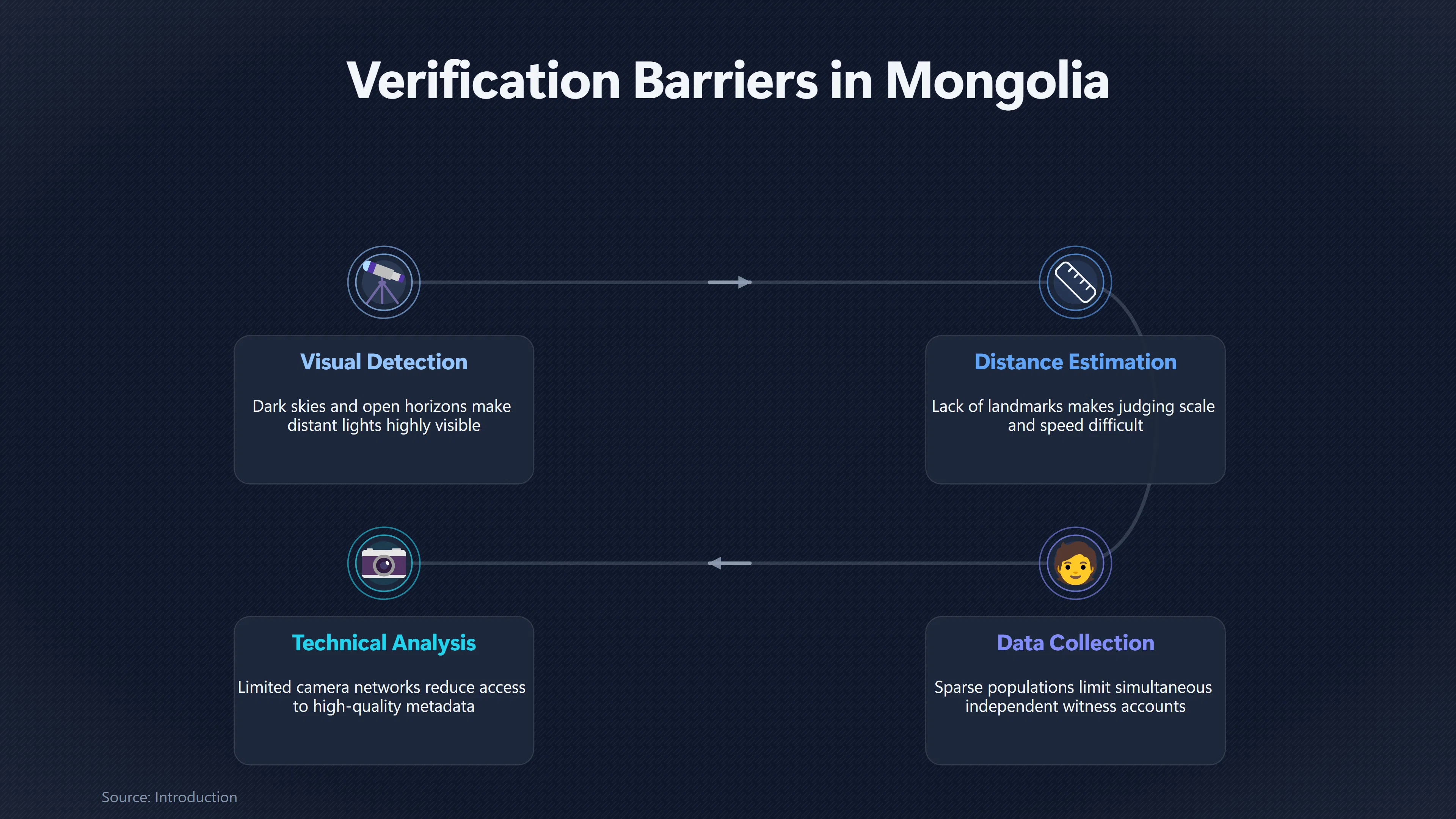
Mongolia’s reported UFO sightings are difficult to verify not because the country is especially prone to extraordinary aerial events, but because its geography creates an unusual combination of strengths and weaknesses for observation. Vast areas with exceptionally dark skies and long, unobstructed horizons make distant atmospheric and orbital phenomena highly visible. At the same time, the country’s very low population density, limited network of all-sky cameras, sparse scientific instrumentation outside major centres and relatively small reporting community mean that unusual lights are rarely documented from multiple calibrated viewpoints. The result is a landscape where genuine observations often remain poorly constrained rather than conclusively explained or confirmed. This pattern helps explain why Mongolia’s few widely discussed sightings tend to remain unresolved without providing strong evidence for extraordinary claims.[journal.num.edu.mn]journal.num.edu.mn25, 2026…
Dark skies make distant events easier to see
One of Mongolia’s defining characteristics is its exceptionally dark night sky over much of the country. Outside Ulaanbaatar and a handful of expanding mining centres, artificial light pollution remains comparatively low, allowing faint celestial objects, satellites, meteors and high-altitude atmospheric effects to be seen far more easily than in heavily urbanised regions. Researchers studying Mongolia’s night skies note that preserving these dark conditions has become an important scientific issue because they offer excellent astronomical observing opportunities.[journal.num.edu.mn]journal.num.edu.mn25, 2026…
Excellent visibility, however, should not be confused with better identification.
Dark skies increase the chance of noticing:
- high-altitude rocket exhaust illuminated by the Sun after sunset;
- bright satellites and satellite trains;
- meteors and fireballs;
- noctilucent clouds and other upper-atmosphere phenomena;
- unusually bright planets or stars under exceptional viewing conditions.
Many of these objects are genuinely striking to observers, especially when viewed against an exceptionally clear sky. Their appearance can also change rapidly because of atmospheric perspective, sunlight geometry or great viewing distance, making size, speed and altitude difficult to estimate accurately.
Broad horizons create distance-estimation problems
Mongolia’s open steppe, desert and mountain landscapes provide uninterrupted horizons extending for tens of kilometres. While this makes distant lights easy to detect, it removes many visual references that people normally use to judge distance and scale.
Without nearby buildings, trees or terrain features for comparison, witnesses often cannot reliably determine whether a light is:
- a few hundred metres away;
- tens of kilometres distant;
- or hundreds of kilometres away at high altitude.
Human observers are generally poor at estimating distance to isolated lights at night. Small errors in assumed distance produce very large errors in estimated speed or size. An object believed to be nearby may instead be a much more distant aircraft, meteor or orbital phenomenon.
This limitation is particularly important when evaluating dramatic witness descriptions of “instant acceleration” or “extreme speed”, since those estimates usually depend on an assumed distance that cannot be independently verified.
Sparse populations reduce independent confirmation
Mongolia has one of the world’s lowest population densities. Large regions contain very few permanent residents, meaning unusual aerial events often have only one or a handful of witnesses.
That creates several verification problems:
- few simultaneous observations from different locations;
- little opportunity to triangulate an object’s position;
- fewer photographs taken from different angles;
- reduced chances that trained observers happen to witness the same event.
Independent observations are among the strongest forms of corroboration in UFO investigations because they allow investigators to reconstruct an object’s apparent path and estimate altitude. In Mongolia, the physical geography often works against collecting that type of evidence.
The July 2020 spiral-shaped light illustrates this pattern. Reports from multiple provinces suggest that observers were viewing the same high-altitude event over a wide area rather than isolated local lights. However, the publicly available material lacks calibrated timing, original image files, precise viewing directions and instrument measurements needed to reconstruct the phenomenon rigorously. Consequently, the event remains a genuine observed occurrence without demonstrating an extraordinary object.[NUFORC]nuforc.org2020 Posts | NUFORCDecember 31, 2020…
Limited camera and instrument coverage
Countries with dense networks of security cameras, dashboard cameras, weather cameras, astronomical observatories and civilian all-sky monitoring systems can sometimes assemble multiple independent records of unusual sky events.
Much of rural Mongolia lacks this level of continuous monitoring.
Consequently, investigators often have access only to:
- mobile phone videos;
- compressed social-media uploads;
- eyewitness recollections;
- reposted footage without original metadata.
These limitations reduce the ability to determine:
- exact recording time;
- camera orientation;
- exposure settings;
- field of view;
- whether digital artefacts influenced the appearance.
Modern smartphones also perform aggressive image processing in low light, sometimes exaggerating brightness, colour and apparent motion of distant objects.
Reporting bias matters as much as observation
Verification depends not only on what is seen but also on how reports enter the public record.
Mongolia has no widely recognised national civilian UFO reporting infrastructure comparable to long-established reporting organisations elsewhere. As a result:
- many observations likely go unreported;
- others appear only on social media;
- reports may surface years after the event;
- documentation standards vary considerably.
International databases include only a small number of Mongolian reports, but this should not be interpreted as a reliable measure of how often unusual aerial observations actually occur. Reporting rates are influenced by language, public awareness, internet access and familiarity with international reporting systems, all of which can affect whether a sighting becomes part of searchable archives.[NUFORC]nuforc.org2020 Posts | NUFORCDecember 31, 2020…
Why regional “hotspots” remain unsupported
Claims occasionally appear suggesting that Mongolia’s deserts, mountains or remote regions are UFO hotspots. At present, publicly available evidence does not support that conclusion.
Several factors can create the illusion of geographic clustering:
- repeated sharing of the same incident;
- retrospective witness submissions;
- media attention following one unusual event;
- concentration of observers near settlements rather than true concentrations of unexplained phenomena.
Because the total number of documented cases is small, even a few reports from one province can appear statistically significant when they are not.
No publicly available dataset demonstrates a persistent concentration of high-quality, independently investigated unidentified aerial events in any specific Mongolian region.
What stronger evidence would look like
The main obstacle to evaluating Mongolian sightings is not necessarily the observations themselves but the lack of corroborating data.
A substantially stronger case would include several independent forms of evidence, such as:
- synchronised photographs from different locations;
- original image or video files with intact metadata;
- accurately recorded observation times;
- precise compass bearings and elevation angles;
- weather and astronomical conditions;
- radar, satellite or aviation data where available.
Until evidence of that quality becomes available, most Mongolian UFO reports remain best classified as observations with insufficient information for confident identification rather than confirmed anomalies.
The central lesson
Mongolia’s environment is unusually good at revealing distant objects in the night sky but comparatively poor at documenting them in ways that satisfy scientific investigation. Dark skies, broad horizons and exceptional visibility increase the likelihood of noticing uncommon atmospheric and orbital phenomena, while sparse populations, limited camera coverage and inconsistent reporting reduce opportunities for independent verification.
This combination explains why Mongolia can produce memorable UFO reports without producing equally compelling evidence. The country’s geography encourages genuine observation, but its observational infrastructure often falls short of what is needed to distinguish confidently between rare natural events, conventional human-made objects and truly unexplained phenomena.
Amazon book picks
Further Reading
Books and field guides related to Why Are Mongolia's UFO Sightings So Hard to Verify?. Use these as the next step if you want deeper reading beyond the article.
UFOs: Generals, Pilots, and Government Officials Go on the Re...
Provides comparison with stronger reports.
NightWatch: A Practical Guide to Viewing the Universe
Explains visibility of common sky objects.
eBay marketplace picks
Marketplace Samples
Live-tested eBay searches with available results related to this page.
Selected fromRoswell UFO patch oneBay.co.uk.



Endnotes
1.
Source: journal.num.edu.mn
Link:https://journal.num.edu.mn/physics/article/view/11017
Source snippet
25, 2026...
2.
Source: nuforc.org
Link:https://nuforc.org/2020posts/
Source snippet
2020 Posts | NUFORCDecember 31, 2020...
Published: December 31, 2020
3.
Source: journal.num.edu.mn
Link:https://journal.num.edu.mn/physics/gateway/plugin/WebFeedGatewayPlugin/rss2
Source snippet
June 25, 2026 — Their structure, morphology, and surface properties were characterized using X-ray diffraction (XRD), scanning electron m...
Published: June 25, 2026
4.
Source: nuforc.org
Link:https://nuforc.org/sighting/?id=193799
Source snippet
NUFORC UFO Sighting 193799November 4, 2025 — NUFORC UFO SIGHTING 193799 Occurred: 2007-04-30 08:30 Local Reported: 2025-11-03 22:13 Pacif...
Published: April 30, 2007
5.
Source: nuforc.org
Link:https://nuforc.org/subndx/?id=e202012
Source snippet
NUFORC Reports for Month 202012August 20, 2023 — NUFORC REPORTS FOR MONTH 202012 Link | Occurred | City | State | Country | Shape | Summa...
Published: August 20, 2023
6.
Source: nuforc.org
Link:https://nuforc.org/subndx/?id=e202008
Source snippet
NUFORC Reports for Month 202008August 20, 2023 — NUFORC REPORTS FOR MONTH 202008 [Input][Input] [Input] Link | Occurred | City | State |...
Published: August 20, 2023
7.
Source: nuforc.org
Link:https://nuforc.org/subndx/?id=e202005
8.
Source: nature.com
Title: Dark skies
Link:https://www.nature.com/collections/afigcadbja
Additional References
9.
Source: egusphere.copernicus.org
Title: egusphere 2026 2921
Link:https://egusphere.copernicus.org/preprints/2026/egusphere-2026-2921/
Source snippet
This work is distributed under the Creative Commons Attribution 4.0 License. [https://doi.org/10.5194/egusphere-2026-2921](https://doi.org/10.5194/egusphere-2026-2921) © Author(s) 2...
10.
Source: home.nps.gov
Link:https://home.nps.gov/subjects/nightskies/lightpollution.htm
Source snippet
National Park Service)March 31, 2025 — LIGHT POLLUTION Image New World Atlas map shows extent of light pollution across the globe. Falchi...
Published: March 31, 2025
11.
Source: nps.gov
Link:https://www.nps.gov/subjects/nightskies/NSQmetrics.html
12.
Source: youtube.com
Title: Huge Spiral Lit Up the Sky Over America, No One Could Explain It
Link:https://www.youtube.com/watch?v=QDAtd-RHAis
Source snippet
SpaceX launch creates glowing spiral over UK sky...
13.
Source: youtube.com
Title: Space X launch creates glowing spiral over UK sky
Link:https://www.youtube.com/watch?v=jOOcYtOjtQU
Source snippet
Mysterious blue spiral spotted across Europe caused by SpaceX rocket...
14.
Source: researchgate.net
Link:https://www.researchgate.net/publication/342113086_Introducing_the_Dark_Sky_Unit_for_multi-spectral_measurement_of_the_night_sky_quality_with_commercial_digital_cameras
15.
Source: darksky.org
Link:https://darksky.org/about/
16.
Source: darksky.org
Link:https://darksky.org/
17.
Source: sciencedirect.com
Link:https://www.sciencedirect.com/science/article/pii/S0022407319309653
18.
Source: darksky.org
Link:https://darksky.org/new-research-strengthens-ability-to-monitor-light-pollution-from-orbit/