Within Brazil UFO Files
What Brazil's UFO Archives Actually Prove
Official files document reports and investigations, but their presence in an archive does not validate every claim they contain.
On this page
- What the national collection contains
- How operational records differ from witness material
- A practical hierarchy for judging reliability
Page outline Jump by section
Introduction
Brazil’s UFO archive is one of the world’s largest publicly accessible collections of official records relating to unidentified aerial reports. Its importance lies not in proving extraterrestrial visitation, but in documenting how Brazilian authorities received, investigated, catalogued and preserved reports over more than six decades. The collection demonstrates that military and civilian agencies sometimes considered unusual aerial observations worthy of formal investigation, while also making clear that an archived report is not equivalent to a verified event. The most useful way to approach the archive is therefore as a historical dataset rather than a catalogue of confirmed mysteries. Serviços e Informações do Brasil[gov.br]gov.brServiços e Informações do BrasilConheça o fundo sobre OVNIs do Arquivo Nacional — Arquivo NacionalSeptember 13, 2018…
For readers researching Brazil’s best-known cases—including Operation Saucer (Colares), the 1986 “Official UFO Night”, and disputed photographic incidents—the archive is valuable because it preserves original documentation that can be compared against later books, documentaries and internet retellings. Reading those records critically often reveals where later narratives expanded beyond what contemporaneous documents actually recorded. Serviços e Informações do Brasil[gov.br]gov.brServiços e Informações do BrasilConheça o fundo sobre OVNIs do Arquivo Nacional — Arquivo NacionalSeptember 13, 2018…
What the national collection contains
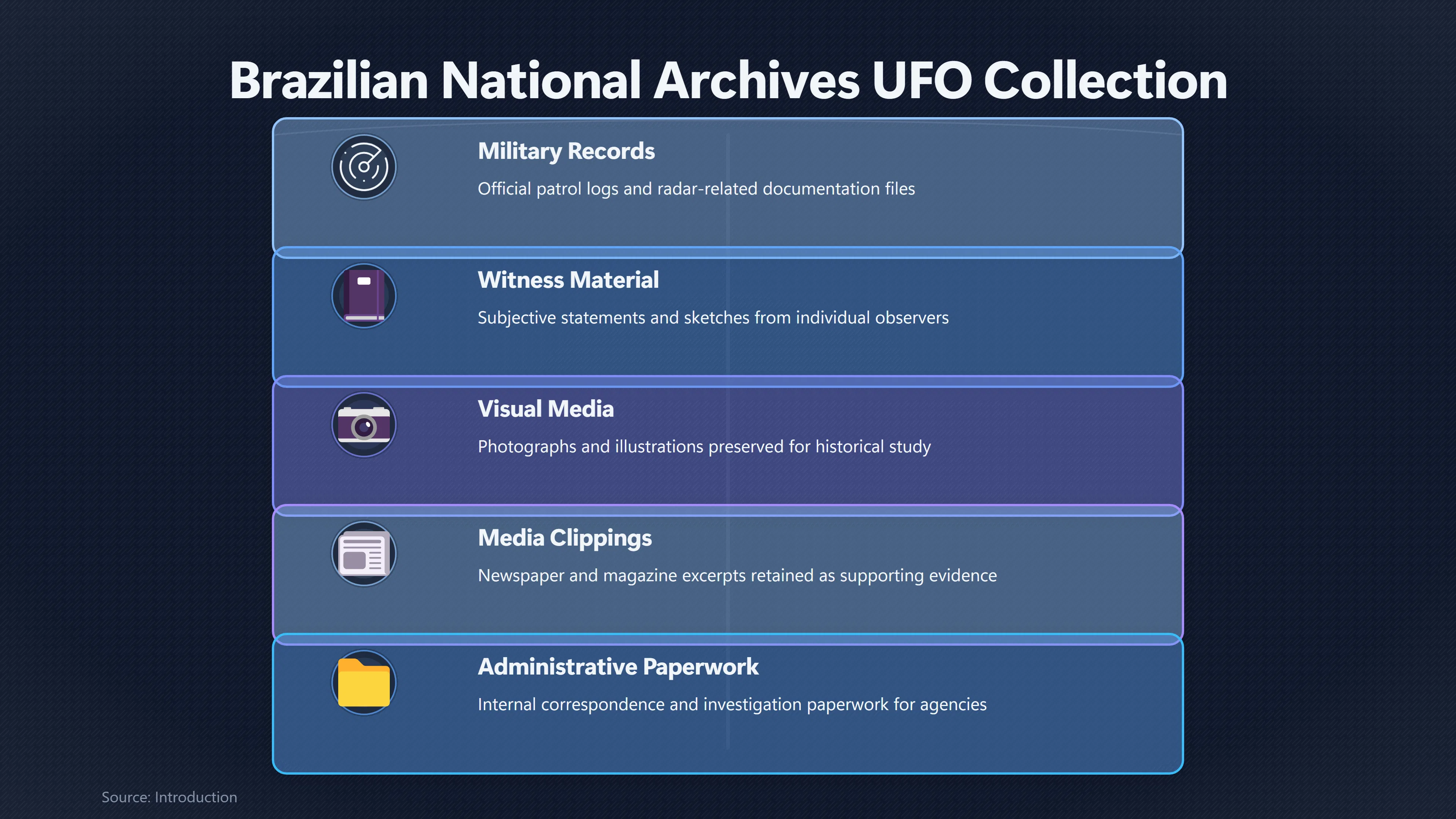
The Brazilian National Archives maintain a dedicated collection of UFO-related material produced primarily by the Brazilian Air Force and transferred for public preservation. According to the National Archives, the collection contains hundreds of individual records covering reports from 1952 onwards and includes:
- Military incident reports.
- Witness questionnaires.
- Official correspondence.
- Photographs and illustrations.
- Audio and video recordings where available.
- Newspaper and magazine clippings retained as supporting material.
- Administrative paperwork relating to investigations. Serviços e Informações do Brasil[gov.br]gov.brServiços e Informações do BrasilConheça o fundo sobre OVNIs do Arquivo Nacional — Arquivo NacionalSeptember 13, 2018…
These different document types do not carry equal evidential weight. An official archive preserves whatever agencies collected during an investigation, whether accurate, mistaken, speculative or unresolved. Preservation reflects administrative history, not official endorsement of every claim within the files. The National Archives explicitly note that an unidentified flying object simply means an object whose origin was not immediately identified and may ultimately prove to be a satellite, balloon, drone, atmospheric phenomenon or another conventional explanation. Serviços e Informações do Brasil[gov.br]gov.brServiços e Informações do BrasilConheça o fundo sobre OVNIs do Arquivo Nacional — Arquivo NacionalSeptember 13, 2018…
A useful distinction is therefore between:
Archive contentWhat it demonstratesMilitary reportsOfficials documented an event or investigation.Witness statementsSomeone reported an experience; accuracy remains to be evaluated.PhotographsImages existed and were preserved, not necessarily authenticated.Newspaper clippingsMedia coverage became part of the case file, not independent evidence.Administrative correspondenceGovernment agencies communicated about the incident.
How operational records differ from witness material
One of the most common mistakes when reading Brazil’s UFO archive is treating every document as equally authoritative.
Operational records generally have the highest historical value because they were created during official activity. These include patrol reports, observation logs, mission summaries, radar-related documentation, interview records prepared by investigators and internal memoranda. Such records establish that an investigation occurred and often provide precise dates, locations and timelines. They are usually less vulnerable to later memory changes because they were produced close to the reported events.[Brazilian UFO Archives]brazilianufoarchives.comBrazilian UFO Archives About – Brazilian UFO ArchivesBrazilian UFO Archives About – Brazilian UFO Archives
Witness material serves a different purpose. Statements, sketches and questionnaires capture what individuals believed they observed, but they remain subjective evidence. Multiple consistent witness accounts may strengthen confidence that an unusual event occurred, yet they do not automatically establish the nature of the phenomenon.
Supporting material deserves separate treatment again. Newspaper articles, magazine features and public correspondence illustrate how a case developed socially rather than physically. They can reveal how stories evolved, how rumours spread and how public expectations influenced later testimony.
Understanding these categories prevents a common logical error: assuming that because a witness statement appears inside an official archive, the government verified its contents.
A practical hierarchy for judging reliability
Readers can evaluate Brazilian archive material using a simple hierarchy that separates documentation quality from claim quality.
Highest confidence
- Records created during official operations.
- Documents written close to the event.
- Independent reports that agree on basic facts.
- Material supported by multiple forms of evidence, such as contemporaneous reports combined with radar records or pilot observations.
Moderate confidence
- Original witness interviews.
- Contemporary photographs with documented provenance.
- Technical diagrams prepared during investigations.
Lower confidence
- Recollections recorded many years later.
- Media summaries without underlying documentation.
- Anonymous testimony.
- Extraordinary interpretations unsupported by the original files.
This hierarchy does not determine whether an unexplained event occurred. Instead, it estimates how confidently researchers can reconstruct what was reported and investigated.
Reading famous cases without overstating them
Brazil’s archive contains several internationally known investigations, but each illustrates different strengths and limitations.
Operation Saucer (1977)
Operation Saucer is valuable because it includes official military documentation generated during an organised field investigation in Pará. The surviving files show that Air Force personnel interviewed witnesses, produced reports, photographed luminous phenomena and monitored ongoing reports.
Those documents establish that the operation was real and extensive. They do not, however, independently prove the cause of every reported light, injury or extraordinary claim later associated with the incident. Researchers should distinguish between documented military observations and later interpretations added in books or interviews decades afterwards.[Brazilian UFO Archives]brazilianufoarchives.comBrazilian UFO Archives About – Brazilian UFO ArchivesBrazilian UFO Archives About – Brazilian UFO Archives
The 1986 radar incidents
The archive surrounding the events of 19 May 1986 is stronger than many UFO cases because it combines several forms of operational evidence, including military reporting and accounts from pilots and controllers. Even here, however, researchers should separate the confirmed historical facts—that aircraft were scrambled and unusual aerial tracks were investigated—from conclusions about the objects’ identity, which remain disputed. Contemporary operational documents generally deserve greater weight than retrospective speculation.
Older photographic cases
Cases such as the Trindade Island photographs remain historically important because they generated official correspondence and enduring debate. Yet photographs alone rarely settle authenticity questions. Readers should pay attention to provenance, handling of negatives, witness independence and whether later technical analysis supports or challenges the original interpretation.
Common mistakes when using the archive
Several recurring errors lead readers to overestimate what the collection proves.
- Equating declassification with confirmation. Governments routinely declassify unresolved investigations without endorsing every conclusion.
- Ignoring document type. A newspaper clipping and a military report should not be treated as equivalent evidence.
- Reading backwards from famous stories. Popular accounts often incorporate details absent from the earliest records.
- Cherry-picking dramatic passages. Entire files frequently contain ordinary explanations, uncertainty and competing hypotheses alongside unusual observations.
- Confusing “unidentified” with “extraterrestrial”. Official terminology refers to temporary lack of identification rather than a specific explanation. Serviços e Informações do Brasil[gov.br]gov.brServiços e Informações do BrasilConheça o fundo sobre OVNIs do Arquivo Nacional — Arquivo NacionalSeptember 13, 2018…

Why the archive matters even without proving extraordinary claims
Brazil’s UFO archive remains historically significant regardless of one’s conclusions about individual sightings.
It documents how military institutions responded to reports from pilots, civilians and local authorities across changing political and technological eras. It preserves evidence that would otherwise have been lost, allowing historians to reconstruct investigations rather than relying solely on memoirs or popular books. It also enables sceptical analysis by making original records available for comparison with later retellings.
For researchers, the archive’s greatest strength is transparency. Because many original documents are publicly accessible, competing interpretations can be checked against the historical record instead of depending entirely on secondary accounts. That makes Brazil’s archive one of the most useful resources for studying how UFO reports were documented, investigated and remembered, while also illustrating the critical distinction between preserving evidence and validating the extraordinary claims that sometimes grew around it.
Amazon book picks
Further Reading
Books and field guides related to What Brazil's UFO Archives Actually Prove. Use these as the next step if you want deeper reading beyond the article.

UFOs and Government: A Historical Inquiry
Provides context for official archives and investigations.

UFOs: Generals, Pilots, and Government Officials Go on the Re...
Explains how official records should be interpreted.
eBay marketplace picks
Marketplace Samples
Live-tested eBay searches with available results related to this page.
Selected fromUFO memorabilia oneBay.co.uk.



Endnotes
1.
Source: gov.br
Link:https://www.gov.br/arquivonacional/pt-br/canais_atendimento/imprensa/noticias/conheca-o-fundo-sobre-ovnis-do-arquivo-nacional
Source snippet
Serviços e Informações do BrasilConheça o fundo sobre OVNIs do Arquivo Nacional — Arquivo NacionalSeptember 13, 2018...
Published: September 13, 2018
2.
Source: brazilianufoarchives.com
Title: Brazilian UFO Archives About – Brazilian UFO Archives
Link:https://brazilianufoarchives.com/the-guide/
3.
Source: nationalarchives.gov.uk
Title: The National Archives UFOs
Link:https://www.nationalarchives.gov.uk/help-with-your-research/research-guides/ufos/
Source snippet
The National ArchivesUFOs - The National Archives...
Additional References
4.
Source: youtube.com
Title: The Night of UFOs: new audios released by the Brazilian Air Force
Link:https://www.youtube.com/watch?v=WT881cH192c
Source snippet
UFO Night: Listen to audio recordings of Brazilian pilots during UFO sightings...
5.
Source: youtube.com
Title: UFO Night: Listen to audio recordings of Brazilian pilots during UFO sightings
Link:https://www.youtube.com/watch?v=0OEtRRvUAc0
Source snippet
Operation Saucer:Brazil`s Roswell[UFO Documentary]HD...
6.
Source: youtube.com
Title: Operation Saucer:Brazil`s Roswell[UFO Documentary]HD
Link:https://www.youtube.com/watch?v=jEWLANmVF-M
Source snippet
Strange Phenomenon in Brazil: Hundreds Attacked by UFOs, Mass Blood Sucking...
7.
Source: youtube.com
Link:https://www.youtube.com/watch?v=YrU6fy6QD8I
Source snippet
The Night of UFOs: new audios released by the Brazilian Air Force...
8.
Source: youtube.com
Title: Strange Phenomenon in Brazil: Hundreds Attacked by UFOs, Mass Blood Sucking
Link:https://www.youtube.com/watch?v=gLM0urVH_5s