Within Tonga UFOs
What Could Mimic a UFO Over Tonga?
Volcanoes, meteors, satellites, aircraft, and ocean-horizon effects can all produce convincing UFO-like sights around Tonga.
On this page
- Volcanic light, clouds, and lightning
- Meteors and satellite formations
- Aircraft and horizon misjudgments
Page outline Jump by section
Introduction
Most reported unidentified lights over Tonga can be explained without invoking exotic craft. The kingdom’s location on an active volcanic arc, its exceptionally dark skies, vast ocean horizons and exposure to both international aviation and satellites create ideal conditions for ordinary phenomena to appear unfamiliar. At the same time, the country’s small population, widely dispersed islands and limited observational infrastructure mean that many sightings cannot be reconstructed after the event. As a result, some reports remain unidentified simply because there is too little evidence—not because they demonstrate an extraordinary object.

For Tonga, the most useful question is therefore not whether unusual lights occur, but which natural or technological mechanisms are most likely to produce them. Several stand out as particularly relevant.
How Tonga’s environment creates convincing UFO-like displays
Tonga sits within one of the world’s most active volcanic regions. Combined with a maritime climate and minimal light pollution across much of the archipelago, this produces visual conditions that differ markedly from those experienced in densely populated countries.
Several environmental characteristics increase the likelihood of misidentification:
- Extremely dark skies make faint satellites, meteors and atmospheric phenomena highly visible.
- Long, unobstructed ocean horizons make distant lights difficult to judge for altitude and distance.
- Humid tropical air can scatter, refract and distort bright lights close to the horizon.
- Active volcanism occasionally generates dramatic atmospheric effects that are unfamiliar even to experienced observers.
These conditions do not eliminate the possibility of genuinely unexplained observations, but they substantially increase the range of conventional explanations that investigators should examine first.
Could volcanic activity produce UFO-like phenomena?
Volcanic lightning and illuminated ash clouds
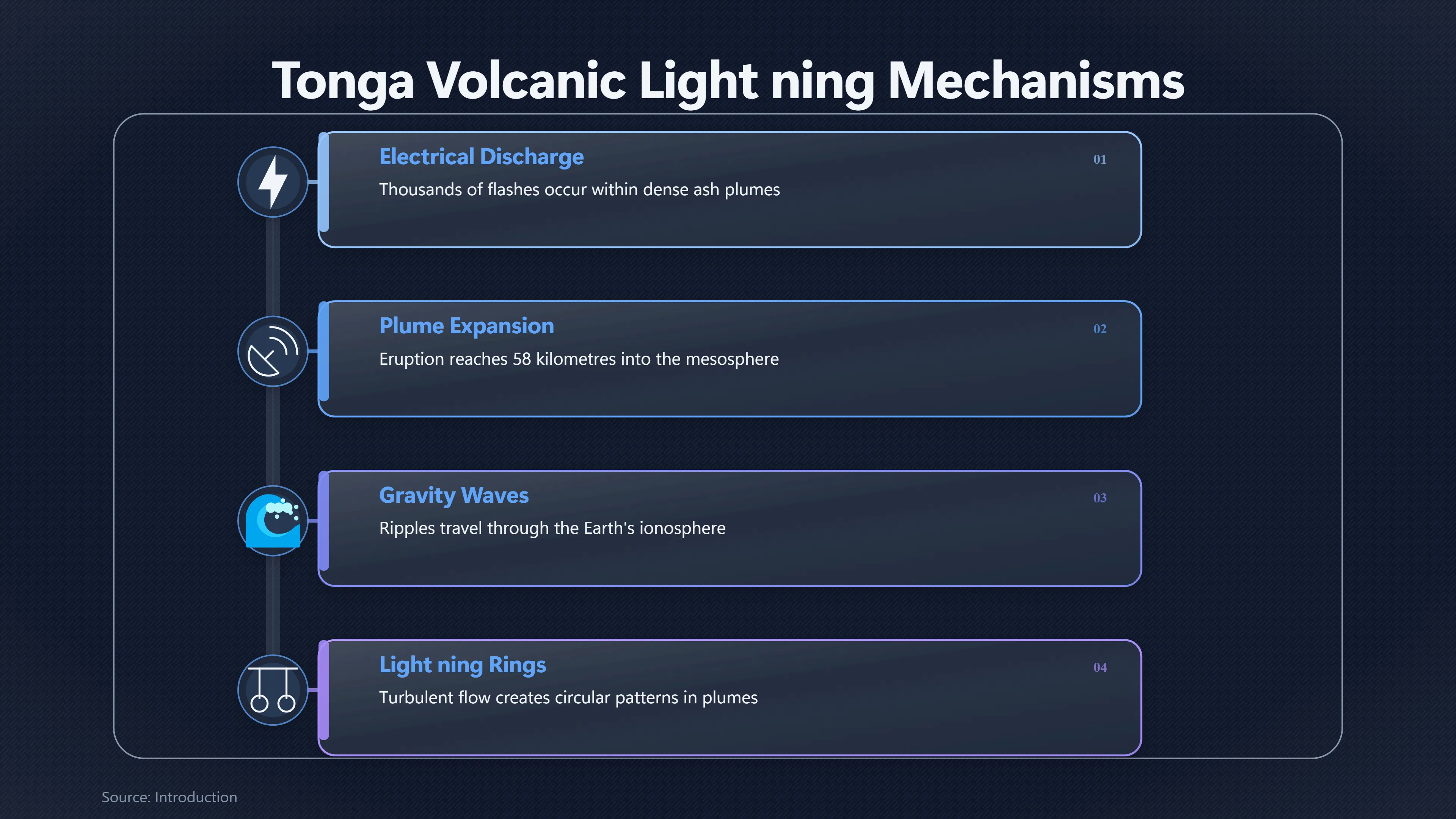
The January 2022 eruption of Hunga Tonga-Hunga Ha’apai demonstrated just how extraordinary volcanic displays can appear. The eruption generated the most intense volcanic lightning yet measured, with thousands of lightning flashes occurring within the ash plume. Scientists documented nearly 200,000 lightning flashes during the eruption, with peak rates exceeding 2,600 flashes per minute.[USGS]usgs.govTonga’s Hunga eruption produced the most intense lightning ever recorded | U.S. Geological SurveyJune 20, 2023…
To someone viewing such activity from another island or from offshore, these electrical discharges could appear as:
- rapidly moving luminous points;
- repeated flashes emerging from apparently clear sky;
- glowing clouds with internal illumination;
- brief bright objects disappearing behind ash.
Unlike ordinary thunderstorms, volcanic lightning may occur inside dense ash clouds and at unusual heights, making its appearance unfamiliar.
Massive eruption plumes
The 2022 eruption also produced the highest volcanic plume yet observed in the satellite era, reaching approximately 58 kilometres into the atmosphere. Satellite imagery showed expanding umbrella clouds, circular atmospheric waves and rapidly changing cloud structures unlike ordinary weather systems.[NASA Science]science.nasa.govScience Tonga Volcano Plume Reached the MesosphereNASA ScienceTonga Volcano Plume Reached the Mesosphere - NASA ScienceFebruary 17, 2022…
Large eruption plumes can create:
- unusually shaped clouds;
- glowing reflections during sunrise or sunset;
- apparent hovering objects when viewed from great distance;
- optical illusions as sunlight strikes ash at different angles.
Outside periods of active eruption these effects are uncommon, but they demonstrate that Tonga’s geology can occasionally generate spectacular aerial displays.
Why meteors are often mistaken for unusual craft
The South Pacific’s dark skies make meteor observations particularly impressive. Bright fireballs can illuminate the ocean, fragment into multiple pieces or leave glowing trails that remain visible for several seconds.
Several characteristics commonly lead witnesses to overestimate their mystery:
- fireballs can appear to change direction because of perspective;
- fragmentation may resemble multiple coordinated objects;
- persistent glowing trails may seem stationary after the meteor has disappeared;
- distant meteors over the ocean provide few landmarks for judging distance.
Because many meteors travel almost directly towards or away from an observer, they may appear surprisingly slow despite travelling at tens of kilometres per second.
Without photographs, multiple witnesses or precise timing, retrospective identification becomes difficult.
Satellites and space activity
Modern satellite traffic has become one of the most common explanations for reports of mysterious moving lights worldwide, and Tonga is no exception.
Visible satellites generally move steadily across the sky without flashing or making noise. Under favourable conditions they may suddenly brighten before fading from view as their reflective surfaces change orientation relative to the Sun.
Satellite constellations can be particularly confusing. Shortly after launch, groups of satellites may appear as evenly spaced lights travelling together across the sky. To observers unfamiliar with these deployments, such formations can resemble organised fleets of unidentified craft.
Because Tonga experiences very little urban light pollution outside its largest settlements, satellites that might be invisible elsewhere are often conspicuous.
Aircraft over the Pacific
Although Tonga is geographically isolated, commercial and military aircraft regularly cross parts of the South Pacific.
At long distances over open water:
- landing lights can remain visible for many minutes;
- aircraft may appear stationary while flying directly towards an observer;
- navigation lights can seem detached from any visible aircraft body;
- atmospheric haze may obscure the aircraft while leaving only its lights visible.
These effects become especially misleading at dusk or during night-time when the surrounding landscape provides few visual reference points.
The absence of nearby buildings, roads or mountains also makes estimating speed and altitude much harder than over land.
Why the ocean horizon changes perception
Open ocean observations present unique visual challenges.
A light close to the horizon may actually be:
- an aircraft many tens of kilometres away;
- a bright planet rising or setting;
- a distant vessel;
- a satellite viewed at a shallow angle.
Humidity, temperature inversions and layers of warm and cool air can bend light enough to distort apparent position. Under certain conditions, lights may shimmer, elongate, appear to hover or seem to jump vertically even though the source itself is behaving normally.
Because observers often lack fixed foreground references, the brain naturally fills gaps in distance and motion, making ordinary lights appear far more unusual.
Clouds, atmospheric optics and visual perception
Not every unusual sky report involves a discrete object.
Cloud formations illuminated by low-angle sunlight can resemble structured shapes. Lenticular clouds, unusual ash clouds and irregular cloud edges may suggest solid objects, particularly when photographed without wider context.
Tropical moisture also supports several optical effects:
- bright halos around the Moon;
- illuminated cloud edges;
- crepuscular rays appearing to converge;
- colour changes caused by atmospheric scattering.
These effects become especially striking over the ocean, where the horizon is uncluttered and dramatic lighting conditions are common.
Human perception adds another layer of complexity. People naturally recognise familiar shapes in random patterns—a psychological effect known as pareidolia. This mechanism offers a straightforward explanation for reports in which clouds appear to depict figures or structured objects rather than actual aircraft.
Why many Tongan sightings remain unresolved
An unresolved report is not necessarily an inexplicable one.
Most historical Tonga reports suffer from one or more missing pieces of information:
- no exact observation location;
- uncertain date or time;
- absence of photographs or video;
- only a single witness;
- reports submitted years or decades later.
Without these details, investigators cannot reliably compare observations with satellite passes, meteor records, volcanic activity, aviation data or astronomical conditions.
Consequently, the most evidence-based interpretation of Tonga’s UFO record is that many reports are best viewed as unidentified because documentation is insufficient rather than because they resist all conventional explanation. The country’s volcanic setting, dark skies, extensive ocean horizons and exposure to meteors, satellites and aircraft together provide a broad range of realistic mechanisms capable of producing convincing UFO-like sightings, with volcanic eruptions representing the most dramatic—but comparatively rare—natural example.
Amazon book picks
Further Reading
Books and field guides related to What Could Mimic a UFO Over Tonga?. Use these as the next step if you want deeper reading beyond the article.
NightWatch: A Practical Guide to Viewing the Universe
A practical guide to viewing the universe.
eBay marketplace picks
Marketplace Samples
Live-tested eBay searches with available results related to this page.
Selected fromUFO poster oneBay.co.uk.

Current eBay listing
I Want To Believe UFO Poster Giclée Fine Art Heavyweight Print


Current eBay listing
VINTAGE UFO FLYING SAUCERS COMIC ADVERTISING A2 POSTER PRINT
Endnotes
1.
Source: usgs.gov
Link:https://www.usgs.gov/news/science-snippet/tongas-hunga-eruption-produced-most-intense-lightning-ever-recorded
Source snippet
Tonga’s Hunga eruption produced the most intense lightning ever recorded | U.S. Geological SurveyJune 20, 2023...
Published: June 20, 2023
2.
Source: usgs.gov
Title: lightning rings and gravity waves insights giant eruption plumefrom tongas hunga
Link:https://www.usgs.gov/publications/lightning-rings-and-gravity-waves-insights-giant-eruption-plumefrom-tongas-hunga
Source snippet
Geological SurveyJune 20, 2023 — LIGHTNING RINGS AND GRAVITY WAVES: INSIGHTS INTO THE GIANT ERUPTION PLUMEFROM TONGA’S HUNGA VOLCANO ON 1...
Published: June 20, 2023
3.
Source: science.nasa.gov
Title: Science Tonga Volcano Plume Reached the Mesosphere
Link:https://science.nasa.gov/earth/earth-observatory/tonga-volcano-plume-reached-the-mesosphere-149474/
Source snippet
NASA ScienceTonga Volcano Plume Reached the Mesosphere - NASA ScienceFebruary 17, 2022...
Published: February 17, 2022
4.
Source: science.nasa.gov
Title: Science Hunga Tonga-Hunga Ha‘apai Erupts
Link:https://science.nasa.gov/earth/earth-observatory/hunga-tonga-hunga-haapai-erupts-149347/
Source snippet
NASA ScienceHunga Tonga-Hunga Ha‘apai Erupts - NASA Science...
5.
Source: nature.com
Link:https://www.nature.com/articles/s43247-023-01074-z
Source snippet
Multiphase turbulent flow explains lightning rings in volcanic plumes | Communications Earth & EnvironmentNovember 15, 2023 — * Atmospher...
Published: November 15, 2023
6.
Source: pubs.usgs.gov
Title: Van Eaton, Jeff Lapierre, Sonja A. B
Link:https://pubs.usgs.gov/publication/70245422
Source snippet
rings and gravity waves: Insights into the giant eruption plumefrom Tonga’s Hunga Volcano on 15 January 2022June 20, 2023 — LIGHTNING RIN...
Published: June 20, 2023
7.
Source: space.com
Link:https://www.space.com/tonga-undersea-volcano-eruption-record-breaking-lightning
8.
Source: nasa.gov
Title: NAS A Mission Finds Tonga Volcanic Eruption Effects Reached Space
Link:https://www.nasa.gov/missions/icon/nasa-mission-finds-tonga-volcanic-eruption-effects-reached-space/
9.
Source: disasters.nasa.gov
Title: tonga eruption sent ripples through earths ionosphere
Link:https://disasters.nasa.gov/our-impact/news/tonga-eruption-sent-ripples-through-earths-ionosphere
10.
Source: jpl.nasa.gov
Title: tonga eruption sent ripples through earths ionosphere
Link:https://www.jpl.nasa.gov/news/tonga-eruption-sent-ripples-through-earths-ionosphere/
11.
Source: science.nasa.gov
Title: tonga eruption atmospheric wave
Link:https://science.nasa.gov/photojournal/tonga-eruption-atmospheric-wave/
12.
Source: jpl.nasa.gov
Title: pia24905 tonga eruption atmospheric wave
Link:https://www.jpl.nasa.gov/images/pia24905-tonga-eruption-atmospheric-wave/
13.
Source: science.nasa.gov
Title: aura measurements of an underwater volcano eruption
Link:https://science.nasa.gov/mission/aura/aura-measurements-of-an-underwater-volcano-eruption/
14.
Source: weather.gov.hk
Link:https://www.weather.gov.hk/en/blog/tonga-volcanic-eruption-2022.html
Additional References
15.
Source: doi.org
Link:https://doi.org/10.1029/2022GL102341
Source snippet
Lightning Rings and Gravity Waves: Insights Into the Giant Eruption Plume From Tonga's Hunga Volcano on 15 January 2022 - Van Eaton - 202...
Published: January 2022
16.
Source: youtube.com
Link:https://www.youtube.com/watch?v=TwAccizYHzg
Source snippet
Tonga volcano: ash, smoke and lightning seen before eruption...
17.
Source: youtube.com
Title: Tonga eruption sets lightning record
Link:https://www.youtube.com/watch?v=gePblL4lsOs
Source snippet
StarLink creates train of satellites across night sky...
18.
Source: nesdis.noaa.gov
Title: the hunga tonga hunga haapai eruption multi hazard event
Link:https://www.nesdis.noaa.gov/news/the-hunga-tonga-hunga-haapai-eruption-multi-hazard-event
19.
Source: youtube.com
Title: Tonga volcano: ash, smoke and lightning seen before eruption
Link:https://www.youtube.com/watch?v=TewQm8Zxew4
Source snippet
Tonga eruption sets lightning record...
20.
Source: youtube.com
Title: Star Link creates train of satellites across night sky
Link:https://www.youtube.com/watch?v=OJSYBIkDuh8
Source snippet
Space Junk Reentering Earths Atmosphere...
21.
Source: youtube.com
Title: Space Junk Reentering Earths Atmosphere
Link:https://www.youtube.com/watch?v=mARdK9quZQk
22.
Source: repository.library.noaa.gov
Link:https://repository.library.noaa.gov/view/noaa/54932
23.
Source: repository.library.noaa.gov
Link:https://repository.library.noaa.gov/view/noaa/55226