Within Djibouti UFO Files
What Could Solve Future Djibouti UAP Cases?
Better data sharing and independent analysis could help determine whether future Djibouti reports remain unresolved or become explained.
On this page
- Need for better sensor data
- Role of independent analysis
- Future reporting standards
Page outline Jump by section
Introduction
Future Djibouti UAP research is most likely to advance through better records, stronger sensor data, and independent analysis rather than through a search for unexplained objects alone. Djibouti has a limited publicly documented UAP record, but its strategic location near major air and maritime routes and its concentration of military activity make accurate data collection particularly important. Future cases will be easier to assess if investigators can combine reliable sensor information, aviation records, environmental data, and transparent review processes.
The main challenge is not simply finding more reports. It is improving the quality of the evidence behind each report. International scientific and government reviews of UAP research have repeatedly identified incomplete data, missing sensor details, and inconsistent reporting as major barriers to understanding unidentified observations. NASA’s independent UAP study concluded that better data collection, improved calibration, and wider scientific participation are necessary before strong conclusions can be drawn.[NASA Science]science.nasa.govScience UAPNASA ScienceUAP - NASA ScienceFebruary 23, 2026… For Djibouti, where publicly available cases are scarce and often linked to military environments, these improvements would determine whether future reports remain unresolved or become explainable.
What Could Solve Future Djibouti UAP Cases?
Future Djibouti UAP investigations would benefit from treating each report as a data-quality problem. An unidentified observation is not automatically an extraordinary event; it is an observation where available information has not yet produced a confirmed identification. The key question for researchers is therefore whether enough reliable evidence exists to distinguish aircraft, drones, satellites, atmospheric effects, sensor errors, or other ordinary explanations from genuinely unresolved events.
Djibouti’s environment creates both opportunities and difficulties. The country’s airspace and surrounding waters are monitored by military and commercial systems, meaning future reports may involve advanced sensors rather than only eyewitness accounts. However, many of the most valuable details in such cases may also be restricted because they involve defence equipment or operational information. A transparent research approach would need to protect sensitive capabilities while still releasing enough technical information for independent evaluation.
The strongest future cases would likely share several characteristics:
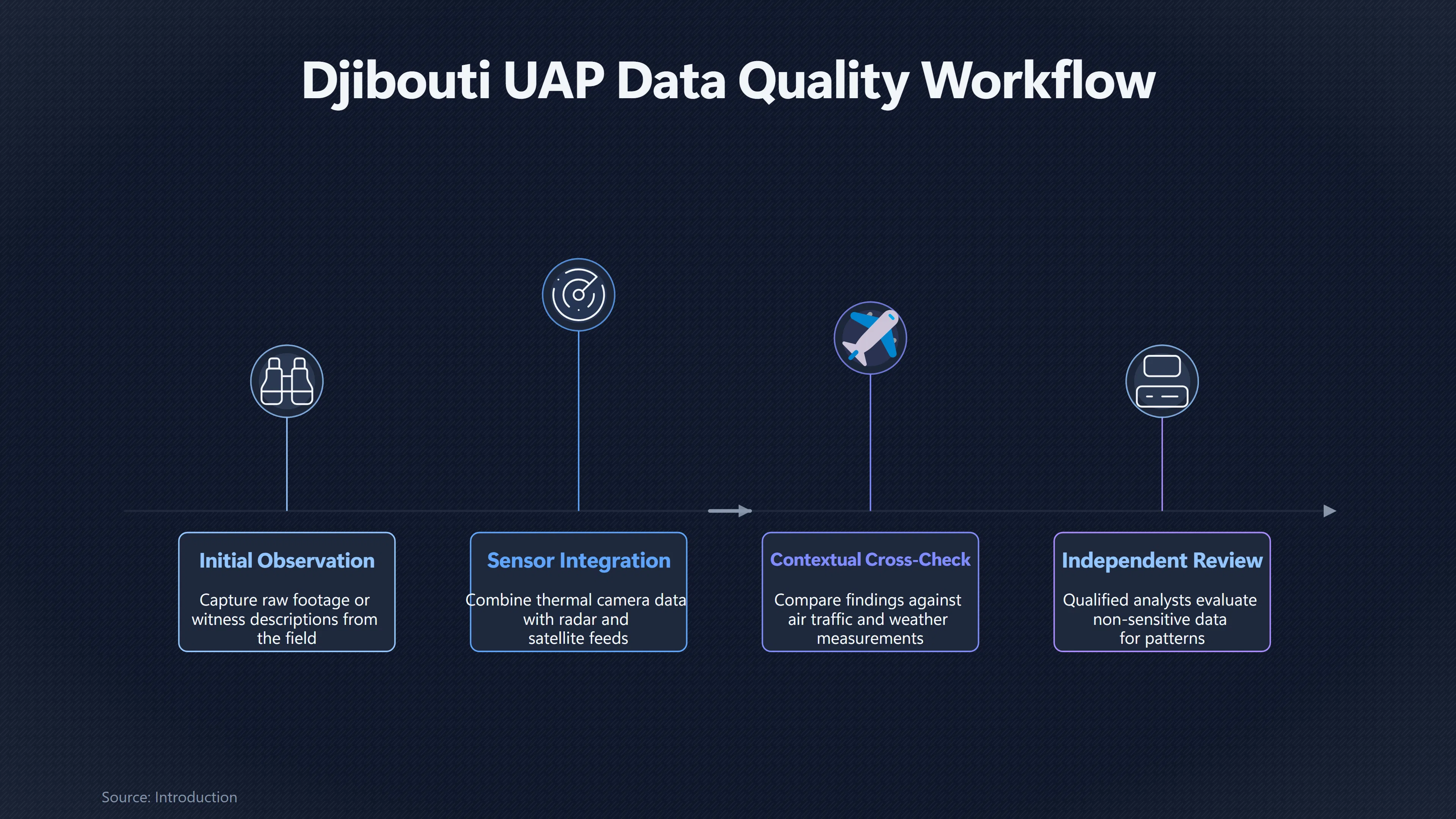
- Multiple independent observations: A thermal camera recording supported by radar, visual confirmation, satellite information, or flight-tracking data would be far more valuable than a single isolated recording.
- Complete sensor information: Researchers need details such as camera settings, calibration data, viewing angle, environmental conditions, and time stamps to judge whether an apparent anomaly reflects a real object or a measurement effect.
- Clear chains of custody: Records should show when data was collected, who analysed it, and whether the original files were preserved.
- Open explanations of uncertainty: A case can remain unresolved without implying an unusual origin. Publishing why a case cannot yet be identified is part of scientific transparency.
Need for Better Sensor Data
The most important improvement for Djibouti would be a stronger technical foundation for collecting and preserving observations. Short video clips or witness descriptions rarely provide enough information to determine what an object was. Modern UAP analysis increasingly focuses on combining different forms of measurement rather than relying on a single image or account.
NASA’s UAP study highlighted the importance of using reliable scientific methods, including improved data collection, better use of existing datasets, and stronger analytical frameworks. The agency noted that the limited number of high-quality observations currently prevents firm scientific conclusions about UAP.[NASA]nasa.govUPDATE: NASA Shares UAP Independent Study Report; Names DirectorUPDATE: NASA Shares UAP Independent Study Report; Names Director - NASA…
For Djibouti, a future research framework could include cooperation between aviation authorities, scientific institutions, maritime monitoring organisations, and independent researchers. Useful data sources could include:
- air traffic records showing known aircraft movements;
- weather and atmospheric measurements;
- maritime tracking information;
- satellite imagery where available;
- calibrated optical and infrared sensor recordings;
- drone and balloon activity records.
This approach would be especially important because Djibouti’s location creates a high likelihood of confusing ordinary activity with unusual events. Military aircraft, surveillance systems, commercial aviation, maritime operations, and unmanned systems can all produce observations that appear unusual without requiring unknown technology.

Role of Independent Analysis
Independent review would help separate unresolved cases from exaggerated claims. A major weakness in many historical UFO investigations has been that evidence is often interpreted within closed groups, leaving outside researchers unable to reproduce conclusions or examine the original data.
A stronger Djibouti research model would allow qualified independent analysts to review non-sensitive information. This does not require releasing classified military capabilities. Instead, authorities could publish controlled datasets, technical summaries, and explanations of investigative methods.
The approach reflects broader changes in UAP research. NASA’s independent study recommended greater scientific involvement, improved data systems, and the use of advanced analytical tools such as artificial intelligence and machine learning to examine large collections of observations.[NASA]nasa.govUPDATE: NASA Shares UAP Independent Study Report; Names DirectorUPDATE: NASA Shares UAP Independent Study Report; Names Director - NASA… The goal is not to assume that unexplained reports represent unknown technology, but to create methods capable of identifying patterns and reducing mistakes.
For Djibouti specifically, independent analysis could be valuable because the public record is currently small. With fewer documented cases, each well-recorded incident carries greater importance. A transparent review process would make it easier to understand whether future reports represent ordinary aviation activity, sensor limitations, security concerns, or genuinely unresolved phenomena.
Future Reporting Standards
A clearer reporting system would be one of the most practical ways to improve Djibouti’s future UAP record. Many reports become difficult to analyse because essential information is missing at the moment of observation. A standard reporting format could prevent this problem.
Future reports should ideally record:
- When and where the observation occurred
Precise time, location, altitude estimates, and viewing conditions allow comparison with aviation and environmental data.
- What equipment recorded the event
Investigators need to know whether information came from a camera, radar system, satellite source, or human observation.
- What was checked before classification as unresolved
A useful report should explain which ordinary explanations were considered and why they were accepted or rejected.
- What information remains unavailable
Transparency includes clearly identifying gaps rather than presenting uncertainty as a mystery.
The public value of such standards is that they improve both accountability and credibility. A transparent system can show when a case has a normal explanation, when evidence is insufficient, and when additional investigation is justified.
Transparency Without Overstatement
Future Djibouti UAP research will depend on maintaining a balance between openness and caution. Too little transparency can create distrust, while unsupported claims can reduce serious research to speculation. The most useful outcome is a record that allows researchers and the public to understand what was observed, what was tested, and what remains unknown.
International UAP research efforts increasingly emphasise this distinction. Official programmes such as the All-domain Anomaly Resolution Office (AARO) maintain public records and information papers intended to improve access to historical and current UAP material while recognising that unresolved cases are not automatically evidence of extraordinary explanations.[AARO]aaro.milUAP RecordsAARO UAP RecordsFebruary 13, 2026…
For Djibouti, the path forward is therefore not a larger catalogue of mysterious reports, but a better-quality evidence base. Improved sensors, independent review, and consistent reporting standards would allow future cases to move from uncertainty toward explanation wherever the evidence permits. Where a case remains unresolved, transparent methods would make that conclusion more meaningful and scientifically useful.
Amazon book picks
Further Reading
Books and field guides related to What Could Solve Future Djibouti UAP Cases?. Use these as the next step if you want deeper reading beyond the article.

UFOs and Government: A Historical Inquiry
Demonstrates historical research approaches.
eBay marketplace picks
Marketplace Samples
Live-tested eBay searches with available results related to this page.
Selected fromUFO UAP patch oneBay.co.uk.



Endnotes
1.
Source: science.nasa.gov
Title: Science UAP
Link:https://science.nasa.gov/uap/
Source snippet
NASA ScienceUAP - NASA ScienceFebruary 23, 2026...
Published: February 23, 2026
2.
Source: nasa.gov
Title: UPDATE: NASA Shares UAP Independent Study Report; Names Director
Link:https://www.nasa.gov/news-release/update-nasa-shares-uap-independent-study-report-names-director/
Source snippet
UPDATE: NASA Shares UAP Independent Study Report; Names Director - NASA...
3.
Source: nasa.gov
Title: to Release, Discuss Unidentified Anomalous Phenomena Report
Link:https://www.nasa.gov/news-release/nasa-to-release-discuss-unidentified-anomalous-phenomena-report/
Source snippet
NASA to Release, Discuss Unidentified Anomalous Phenomena Report - NASA...
4.
Source: aaro.mil
Title: UAP Records
Link:https://www.aaro.mil/UAP-Records/-1/
Source snippet
AARO UAP RecordsFebruary 13, 2026...
Published: February 13, 2026
5.
Source: aaro.mil
Link:https://www.aaro.mil/Next-AARO-Home-redesign/Next-Parent/Next-AARO-UAP-Imagery-Acc-Table/
Source snippet
AARO UAP Imagery Acc TableMay 8, 2026 — UAP Imagery Release Date | Title | DVIDS Page | Description | Imagery --- | --- | --- | --- |...
Published: May 8, 2026
6.
Source: aaro.mil
Link:https://www.aaro.mil/Next-AARO-Home-redesign/Next-Parent/Presidential-UAP-Transparency-Initiative/
7.
Source: nasa.gov
Title: NAS A Provides Coverage of Unidentified Anomalous Phenomena Meeting
Link:https://www.nasa.gov/news-release/nasa-provides-coverage-of-unidentified-anomalous-phenomena-meeting/
8.
Source: nasa.gov
Title: NAS A Announces Unidentified Aerial Phenomena Study Team Members
Link:https://www.nasa.gov/general/nasa-announces-unidentified-aerial-phenomena-study-team-members/
9.
Source: aaro.mil
Link:https://www.aaro.mil/Next-AARO-Home-redesign/Inactive-Parent/Next-AARO-UAP-DT-Records/
10.
Source: aaro.mil
Link:https://www.aaro.mil/Next-AARO-Home-redesign/Next-Parent/Next-Index/
11.
Source: aaro.mil
Link:https://www.aaro.mil/Next-AARO-Home-redesign/Next-Parent/Next-UAP-Report-Documents/
12.
Source: aaro.mil
Link:https://www.aaro.mil/
13.
Source: aaro.mil
Link:https://www.aaro.mil/FAQ/
Additional References
14.
Source: disclosure.org
Link:https://disclosure.org/research
Source snippet
Research & Policy | Disclosure FoundationJune 30, 2026 — RESEARCH & POLICY Briefs, reports, and recommendations on oversight, transparenc...
Published: June 30, 2026
15.
Source: ufouap.net
Title: NAS A and UAP: what the independent study actually said | Global UFO Archive
Link:https://www.ufouap.net/en/explainers/nasa-uap-study
Source snippet
NASA and UAP: what the independent study actually said | Global UFO ArchiveJune 21, 2026 — Science / Updated 2026-06-21 / 6 min read NASA...
Published: June 21, 2026
16.
Source: disclosedufo.com
Title: DISCLOSE D — Declassified UFO & UAP Files Archive
Link:https://www.disclosedufo.com/
Source snippet
DISCLOSED — Declassified UFO & UAP Files ArchiveJune 13, 2026 — [Button: Read more ▾] DOW-UAP-D007 Department of War Undated N/A DECLASSI...
Published: June 13, 2026
17.
Source: youtube.com
Title: UAP Independent Study Event Post-Meeting Media Teleconference (
Link:https://www.youtube.com/watch?v=C3uXUfgSadU
Source snippet
UFO hearing live: Pentagon office testifies in Senate emerging threats committee amid UAP report...
Published: May 31, 2023
18.
Source: youtube.com
Link:https://www.youtube.com/watch?v=mpki2gtcHLY
Source snippet
Director overseeing UAP sighting analysis testifies at hearing | The Hill...
19.
Source: youtube.com
Title: Replay! NASA’s Release of the Unidentified Anomalous Phenomena Report
Link:https://www.youtube.com/watch?v=nuBMnluJfs0
Source snippet
UAP Independent Study Event Post-Meeting Media Teleconference (May 31, 2023)...
Published: May 31, 2023
20.
Source: youtube.com
Title: UAP FILES
Link:https://www.youtube.com/watch?v=rhP8VdCIz9A
Source snippet
Replay! NASA's Release of the Unidentified Anomalous Phenomena Report...
21.
Source: archives.gov
Link:https://www.archives.gov/records-mgmt/uap-guidance
22.
Source: uap-archive.org
Link:https://uap-archive.org/uap/records/aaro-historical-record-report-vol1/
23.
Source: uapcaucus.com
Link:https://www.uapcaucus.com/dodig2024