The Stories Behind New Zealand's UFO Reputation
New Zealand has a long record of reported unidentified flying objects, but the evidence is uneven.
Page outline Jump by section
Introduction
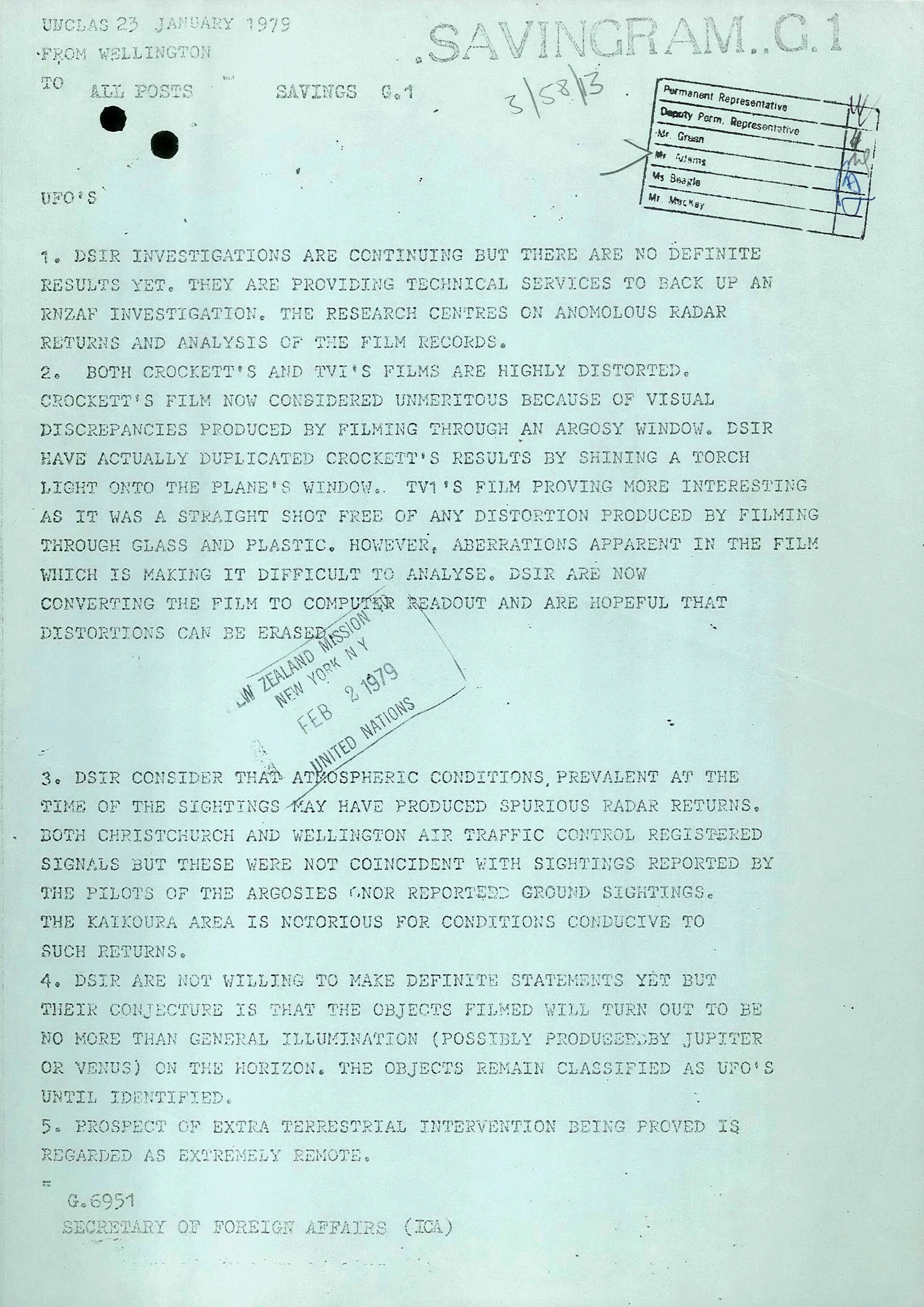
The central case is the 1978 Kaikōura lights, where aircrew observations, radar returns, recorded conversations and 16 mm film created an unusually rich but still disputed record. New Zealand’s wider history is less conclusive: many cases are isolated lights with no calibrated imagery, physical trace or recoverable object. Official interest has also changed. The New Zealand Defence Force released historical files in 2010 but now says it neither investigates nor maintains UFO or unidentified anomalous phenomenon records.[govt.nz]natlib.govt.nzNational Library of New ZealandUnidentified flying objects (UFO) files: copies for release…These copied and redacted files of corresp…
How the national record developed
New Zealand’s surviving official UFO material begins in the early 1950s, during the international “flying saucer” wave. The National Library catalogue describes copied and redacted correspondence covering 1952–2009, including civilian and military reports, government investigations, newspaper cuttings and letters from people claiming contact with alien beings. The variety matters: the archive is not a collection of validated incidents but a record of what government agencies received, discussed or retained.[National Library of New Zealand]natlib.govt.nzNational Library of New ZealandUnidentified flying objects (UFO) files: copies for release…These copied and redacted files of corresp…
Early reports show the pattern that would recur for decades: an initially puzzling observation followed by an attempt to match it with a conventional source. In 1955, for example, the captain of a National Airways Corporation aircraft reported a light that appeared to move and change colour and intensity. The Director of Intelligence at Carter Observatory concluded that the object was Venus rising in the night sky. A 1959 Blenheim-area account, by contrast, included claims of a craft and figures in silvery clothing, but lacked the independent measurements or physical evidence needed to test such details.[Wikipedia]WikipediaUFO sightings in New ZealandUFO sightings in New Zealand
Civilian organisations helped preserve material that might otherwise have disappeared. During the 1950s, Civilian Saucer Investigation in New Zealand published a journal carrying domestic and overseas reports. Later groups gathered witness accounts, corresponded with officials and promoted particular interpretations. This contribution is historically useful, but private archives require source-by-source scrutiny because they often mix first-hand testimony, newspaper retellings, speculative material and cases that were never independently checked.[nzgeo.com]nzgeo.comCrowded skiesNew Zealanders have reported their shore of crop circles, visitations by flying saucers and encounters with aliens. During t…
The national archive expanded through overlapping channels rather than a single permanent investigation office. Reports reached the Royal New Zealand Air Force, Defence officials, police, civil aviation authorities, observatories, newspapers and UFO organisations. That fragmented system explains both the breadth of the surviving files and their inconsistency: some incidents have dates, flight information and correspondence; others survive only as brief summaries or press clippings.[National Library of New Zealand]natlib.govt.nzNational Library of New ZealandUnidentified flying objects (UFO) files: copies for release…These copied and redacted files of corresp…
Why the Kaikōura lights remain the defining case
On 21 December 1978, the crew of a Safe Air cargo aircraft travelling between Blenheim and Christchurch reported unusual lights near the north-eastern South Island. Air-traffic controllers in Wellington also observed unexplained radar returns. Further flights followed, and on 30–31 December an Australian television crew filmed bright objects from another Safe Air aircraft while conversations between the crew and radar controllers were recorded.[Wikipedia]WikipediaKaikōura lightsKaikōura lights
The case stands apart because several evidence streams existed at roughly the same time:
- multiple airborne witnesses;
- ground and aircraft radar reports;
- recorded radio communications;
- 16 mm colour film;
- repeated observations over more than one night;
- subsequent examination by Defence, police, Carter Observatory and the Department of Scientific and Industrial Research.
That combination makes Kaikōura more valuable than a lone visual sighting. It does not, however, mean that every light, radar return and filmed image represented the same object. One of the enduring analytical problems is the tendency to combine separate observations into a single event even when their positions, timings and evidential quality differ.[Wikipedia]WikipediaKaikōura lightsKaikōura lights
The case for something genuinely unidentified
Optical physicist Bruce Maccabee studied the television footage, interviewed witnesses and argued that at least one recorded light was too bright and apparently too large to fit ordinary explanations. He concluded that the observations involved unknown objects or phenomena in the literal sense: they had not been satisfactorily identified. Supporters also emphasise that apparent radar contacts occurred alongside visual reports, reducing the likelihood that the whole episode was simply a misidentified planet.[Wikipedia]WikipediaKaikōura lightsKaikōura lights
Declassified summaries likewise treated the case as unusually well documented. The combination of witness recollections, recordings, radar indications and film was recognised as exceptional among civilian UFO reports. Yet “unidentified” in these records did not mean “extraterrestrial”. A contemporary scientific briefing reportedly considered alien intervention extremely unlikely even while leaving parts of the incident unresolved.[Wikipedia]WikipediaKaikōura lightsKaikōura lights
The case for several ordinary causes
Government and sceptical explanations did not settle on one universal answer. Suggested sources included Venus, meteors, vehicle or train lights, radar propagation effects and powerful lamps used by squid-fishing vessels. This multi-cause model is plausible because the Kaikōura label covers different nights, viewing directions, films and radar events. A planet might explain one stable light but not a transient radar return; a fishing vessel might explain a filmed light near the sea but not every report near the ranges.[Wikipedia]WikipediaKaikōura lightsKaikōura lights
Former Department of Scientific and Industrial Research scientist William Ireland later argued that parts of the film were consistent with rows of squid-boat lamps seen at long range. On this interpretation, zoom, aircraft motion, defocus and filming through an aircraft window made fixed surface lights appear larger, more diffuse and more mobile than they were. Disagreement with Maccabee partly concerns photographic assumptions, including focal length, distance and whether the image represented one object or several closely spaced lights.[Wikipedia]WikipediaKaikōura lightsKaikōura lights
Radar evidence is also less decisive than it first appears. Radar can record aircraft, weather, sea clutter, anomalous propagation and other transient returns. To establish that a radar target matched a witnessed object, investigators need synchronised timing, bearing, range, altitude and equipment records. The Kaikōura material is stronger than an unsupported radar anecdote, but the public record has not produced a complete reconstruction accepted by all sides.
The most defensible judgement is therefore narrower than either extreme. Kaikōura was a real sequence of unusual observations, not an invented incident. Several components probably had conventional causes, while parts remain contested because the available measurements do not permit a unique reconstruction. Nothing publicly released demonstrates an extraterrestrial vehicle.
What the files reveal—and what they do not
The 2010 release placed fifteen volumes of accumulated correspondence in public libraries, covering reports from 1952 to 2009. The material is significant as a social and administrative record: it shows what witnesses described, how agencies reacted and which explanations officials considered. It is not a database in which each entry has passed a common evidential threshold.[NZDF]nzdf.mil.nzOpen source on mil.nz.
A useful way to read the archive is to separate three categories.
Explained or strongly identified reports include cases where the direction, timing and appearance match a known astronomical or human source. The 1955 airline observation attributed to Venus is a clear example. Such cases demonstrate that experienced observers can still misjudge distance or motion when a bright object is seen without a visible frame of reference.[Wikipedia]WikipediaUFO sightings in New ZealandUFO sightings in New Zealand
Contested reports contain more information but support competing reconstructions. Kaikōura belongs here. The witnesses, recordings and images are genuine evidence, yet arguments over optical distortion, fishing lights and radar interpretation prevent a single agreed explanation.
Unresolved reports are often less impressive than contested ones. A file may remain “unidentified” simply because it lacks a precise time, direction, duration, weather record, original photograph or follow-up interview. In evidential terms, absence of identification is not positive evidence for an extraordinary craft.
The archive also contains highly elaborate contact claims and speculative correspondence. Their inclusion shows that officials received them, not that officials endorsed them. Treating every page in a government file as a government finding is one of the most common errors in popular summaries of the release. The National Library description itself makes clear that the files combine investigations with press material and unsolicited letters.[National Library of New Zealand]natlib.govt.nzNational Library of New ZealandUnidentified flying objects (UFO) files: copies for release…These copied and redacted files of corresp…
Where reports occur across New Zealand
Sightings have been reported throughout both main islands, but the record does not support a reliable map of “UFO hotspots”. Apparent clusters can reflect population, media attention, active local researchers, aviation routes and access to dark skies rather than a higher underlying rate of anomalous events.
The upper South Island and Kaikōura coast dominate national memory because of the 1978 case. The geography is relevant: aircraft flew a regular coastal route, bright fishing operations occurred offshore, and observers faced a mixture of sea, mountains and night sky in which distance could be difficult to judge.
Canterbury and Christchurch recur in later reports, including coloured or apparently moving lights recorded on consumer cameras. Such footage often attracts attention because digital zoom and autofocus can make stars or planets pulse, change colour and appear to move. Without original files, camera settings and astronomical checks, dramatic visual behaviour in a compressed video remains weak evidence.[Wikipedia]WikipediaUFO sightings in New ZealandUFO sightings in New Zealand
Taranaki and Waikato have produced reports of fireball-like or luminous objects, including a group of 2011 observations around Hāwera. These cases illustrate a recurring classification problem: a bright atmospheric entry, lantern, aircraft light or out-of-focus celestial object may look structured when recorded briefly on a phone.[Wikipedia]WikipediaUFO sightings in New ZealandUFO sightings in New Zealand
Auckland and the west coast generate many modern reports simply because a large population is looking across busy airspace, coastal approaches and open ocean. A 2019 Karekare account described multiple coloured lights and rapid movements, but the publicly available evidence is mainly witness testimony rather than instrumented data.[Wikipedia]WikipediaUFO sightings in New ZealandUFO sightings in New Zealand
Nelson and Tasman Bay appear in Civil Aviation Authority material released during the 2010s. One report described a falling light judged by the observer to be too fast for an aircraft and too slow for a meteor. That wording records the witness’s uncertainty; it does not exclude fragments, re-entry debris, perspective effects or an incorrectly estimated speed.[The Hits]thehits.co.nz10 ufo sightings in nz since 201010 ufo sightings in nz since 2010
Regional comparisons should therefore be treated cautiously. New Zealand has no continuously maintained, publicly accessible national UFO dataset with standardised observation fields and exposure controls. Raw report counts cannot show whether one region experiences more unexplained phenomena than another.
Who investigates reports now?
The historical files can create the impression that New Zealand maintains a standing military UFO programme. Current official statements say otherwise. In a July 2023 Official Information Act response, the New Zealand Defence Force said it was not conducting UAP research or programmes, had no responsibility for UFO reports and referred reports it received to the Civil Aviation Authority. It also stated that it neither investigated nor maintained records relating to such sightings.[NZDF]nzdf.mil.nzOpen source on mil.nz.
The same position appeared in a May 2024 response concerning reports in New Zealand airspace: the Defence Force said it held no relevant information, while the request had also been transferred to the Civil Aviation Authority. A further response later in 2024 said the Defence Force’s position had not changed.[NZDF]nzdf.mil.nzOpen source on mil.nz.
There has nevertheless been limited international contact. A 2024 Defence Force response confirmed that a New Zealand representative had attended a briefing by the then head of the United States All-domain Anomaly Resolution Office. Information supplied for that briefing was withheld as classified and provided in confidence. The same response said New Zealand had not been asked to assist the United States with UAP data collection and analysis, and that the Defence Force had no dedicated role or relevant programme.[NZDF]nzdf.mil.nzOpen source on mil.nz.
This distinction is important. Attendance at an allied briefing shows awareness of an international defence issue; it does not establish a New Zealand investigation unit, hidden retrieval programme or confirmed anomalous technology.
Civilian research is led principally by private groups and individual investigators. UFocus New Zealand collects contemporary accounts and publishes historical case material, including regional and school-related reports. Its work can preserve testimony and identify repeat witnesses, but it is not an official adjudicating body, and its case descriptions should be checked against aviation, astronomical, meteorological and original-record sources wherever possible.[ufocusnz.org.nz]ufocusnz.org.nzOpen source on ufocusnz.org.nz.

How to judge a New Zealand sighting
A credible assessment begins with information that can be independently checked. The most useful reports provide an exact date and time, location, viewing direction, angular height, duration, apparent path, weather conditions and the original unedited image or video. Aviation transponder data, radar logs, satellite passes and astronomical positions can then be compared with the account.
Several warning signs reduce evidential value:
- the object’s size or distance is stated without a known reference;
- a zoomed light is described as a structured craft solely because it changes shape;
- only edited social-media footage survives;
- witness estimates become more precise with each retelling;
- separate lights, radar returns and photographs are assumed to depict one object without synchronised data;
- “unexplained” is treated as equivalent to “alien”.
Conversely, multiple independent observers are valuable only when their accounts are genuinely independent. Witnesses who discuss an event before being interviewed can unintentionally align their descriptions. The Kaikōura case remains important because it contains more than memory alone, but it also demonstrates why multiple evidence types must be correlated rather than simply accumulated.
The evidence balance
New Zealand’s UFO history is substantial as an archive of observation, official uncertainty and public belief. It includes explained astronomical sightings, weak reports that cannot now be tested, disputed photographic and radar cases, and a small number of incidents that remain unresolved in a limited sense.
The confirmed findings are modest but clear: people have observed unfamiliar aerial lights; government agencies kept records; some reports involved pilots and radar personnel; and the Kaikōura episode generated genuine film, recordings and investigation. The contested findings concern whether conventional explanations account for every component of that episode. The unsupported leap is the claim that the archive proves extraterrestrial visitation.
New Zealand’s files are most revealing when read neither as a disclosure of alien craft nor as a catalogue of foolish mistakes. They show how difficult night-sky identification can be, how institutional records preserve uncertainty and how an unresolved label can survive long after the available evidence has ceased to be capable of resolving it.
Amazon book picks
Further Reading
Books and field guides related to What Really Happened in New Zealand's Skies?. Use these as the next step if you want deeper reading beyond the article.

UFOs: Generals, Pilots, and Government Officials Go on the Re...
Fits New Zealand's aviation-focused history.

eBay marketplace picks
Marketplace Samples
Live-tested eBay searches with available results related to this page.
Selected fromUFO poster oneBay.co.uk.

Current eBay listing
I Want To Believe UFO Poster Giclée Fine Art Heavyweight Print


Current eBay listing
VINTAGE UFO FLYING SAUCERS COMIC ADVERTISING A2 POSTER PRINT
Endnotes
1.
Source: nzdf.mil.nz
Link:https://www.nzdf.mil.nz/assets/Uploads/DocumentLibrary/OIA-2023-4763_UAP-UFO-USO.pdf
2.
Source: nzdf.mil.nz
Link:https://www.nzdf.mil.nz/assets/Uploads/DocumentLibrary/OIA-2024-5048-UAP-and-UFOs.pdf
3.
Source: archive.org
Link:https://archive.org/stream/NewZealandUFO/AIR-244-10-1-Volume-1-1959-1983_djvu.txt
Source snippet
See other formats. Copy /if of 36 NEW ZEALAND DEFENCE FORCE UNIDENTIFIED FLYING OBJECTS (UFO) FILES...Read more...
4.
Source: Wikipedia
Title: UFO sightings in New Zealand
Link:https://en.wikipedia.org/wiki/UFO_sightings_in_New_Zealand
5.
Source: nzgeo.com
Link:https://www.nzgeo.com/stories/crowded-skies-the-ufo-experience-in-new-zealand/
Source snippet
Crowded skiesNew Zealanders have reported their shore of crop circles, visitations by flying saucers and encounters with aliens. During t...
6.
Source: Wikipedia
Title: Kaikōura lights
Link:https://en.wikipedia.org/wiki/Kaik%C5%8Dura_lights
7.
Source: Wikipedia
Title: Lumières de Kaikōura
Link:https://fr.wikipedia.org/wiki/Lumi%C3%A8res_de_Kaik%C5%8Dura
8.
Source: nzdf.mil.nz
Link:https://www.nzdf.mil.nz/assets/Uploads/DocumentLibrary/OIA-2024-5199-UFO-and-UAP-Reporting.pdf
9.
Source: nzdf.mil.nz
Link:https://www.nzdf.mil.nz/assets/Uploads/DocumentLibrary/OIA-2024-5114_Unidentified-Anomalous-Phenomena.pdf
10.
Source: ufocusnz.org.nz
Link:https://ufocusnz.org.nz/
11.
Source: Wikipedia
Link:https://en.wikipedia.org/wiki/Kaik%C5%8Dura
12.
Source: archive.org
Link:https://archive.org/stream/NewZealandUFO/AIR-39-3-3-Volume-1-Parts-1-and-2-1952-1955_djvu.txt
13.
Source: archive.org
Link:https://archive.org/stream/NewZealandUFO/AIR-1080-6-897-Volume-1-1978-1981_djvu.txt
14.
Source: archive.org
Title: New Zealand UFO
Link:https://archive.org/details/NewZealandUFO
15.
Source: natlib.govt.nz
Link:https://natlib.govt.nz/records/22979464
Source snippet
National Library of New ZealandUnidentified flying objects (UFO) files: copies for release...These copied and redacted files of corresp...
16.
Source: thehits.co.nz
Title: 10 ufo sightings in nz since 2010
Link:https://www.thehits.co.nz/news/10-ufo-sightings-in-nz-since-2010/
17.
Source: natlib.govt.nz
Link:https://natlib.govt.nz/records/22618365
18.
Source: paperspast.natlib.govt.nz
Title: natlib.govt.nz Newspapers Home
Link:https://paperspast.natlib.govt.nz/newspapers?items_per_page=25&page=4&query=Maheno+town&sort_by=byDA.rev
19.
Source: paperspast.natlib.govt.nz
Title: natlib.govt.nz Newspapers Home
Link:https://paperspast.natlib.govt.nz/newspapers?items_per_page=50&page=2&query=Maheno+town&sort_by=byDA.rev
20.
Source: paperspast.natlib.govt.nz
Title: natlib.govt.nz Newspapers Home
Link:https://paperspast.natlib.govt.nz/newspapers?items_per_page=100&page=12&query=ANCIENT+UNEXPLAINED&sort_by=byDA
21.
Source: paperspast.natlib.govt.nz
Title: natlib.govt.nz Newspapers Home
Link:https://paperspast.natlib.govt.nz/newspapers?items_per_page=100&page=24&query=medieval&snippet=true&sort_by=byDA.rev
22.
Source: archives.govt.nz
Link:https://www.archives.govt.nz/research-guidance/research-guides/citizenship-and-migration/citizenship
23.
Source: archives.govt.nz
Title: world war two
Link:https://www.archives.govt.nz/research-guidance/research-guides/war-records/world-war-two
24.
Source: archives.govt.nz
Title: world war one 1914 1918
Link:https://www.archives.govt.nz/research-guidance/research-guides/war-records/world-war-one
25.
Source: archives.govt.nz
Link:https://www.archives.govt.nz/
26.
Source: collections.archives.govt.nz
Title: archives.govt.nz Home | Kāinga
Link:https://collections.archives.govt.nz/web/arena
27.
Source: archives.govt.nz
Title: life events
Link:https://www.archives.govt.nz/research-guidance/research-guides/identity/life-events
28.
Source: archives.govt.nz
Link:https://www.archives.govt.nz/discover-our-stories/chinese-portraits
29.
Source: archives.govt.nz
Title: digitisation at our regional offices april to june 2024
Link:https://www.archives.govt.nz/about-us/whats-new/digitisation-at-our-regional-offices-april-to-june-2024
Published: june 2024
30.
Source: archives.govt.nz
Link:https://www.archives.govt.nz/research-guidance/research-guides/citizenship-and-migration
31.
Source: collections.archives.govt.nz
Title: archives.govt.nz Search
Link:https://collections.archives.govt.nz/web/arena/search
32.
Source: archives.govt.nz
Title: searching passenger lists
Link:https://www.archives.govt.nz/research-guidance/research-guides/citizenship-and-migration/searching-passenger-lists
33.
Source: archives.govt.nz
Title: the definition of a woman in 1893
Link:https://www.archives.govt.nz/discover-our-stories/the-definition-of-a-woman-in-1893
34.
Source: nzdf.mil.nz
Title: Search our libraries
Link:https://www.nzdf.mil.nz/media-centre/search-our-libraries/documents/?start=360
35.
Source: nzdf.mil.nz
Title: Search our libraries
Link:https://www.nzdf.mil.nz/media-centre/search-our-libraries/documents/?document-type=Official+information&sort=relevance&start=250
36.
Source: nzdf.mil.nz
Title: Search our libraries
Link:https://www.nzdf.mil.nz/media-centre/search-our-libraries/documents/?sort=date&start=800
37.
Source: nzdf.mil.nz
Title: Search our libraries
Link:https://www.nzdf.mil.nz/media-centre/search-our-libraries/documents/?search=%2A&sort=date&start=830
38.
Source: nzdf.mil.nz
Title: OIA 2023 4837 Historic activity in Antartica
Link:https://www.nzdf.mil.nz/assets/Uploads/DocumentLibrary/OIA-2023-4837-Historic-activity-in-Antartica.pdf
39.
Source: nzdf.mil.nz
Title: Search Results
Link:https://www.nzdf.mil.nz/search/?start=180
40.
Source: nzdf.mil.nz
Title: OIA 2025 5333 Manawanui movements and crew OIAs v2
Link:https://www.nzdf.mil.nz/assets/Uploads/DocumentLibrary/OIA-2025-5333_Manawanui-movements-and-crew-OIAs-v2.pdf
41.
Source: digitalnz.org
Link:https://digitalnz.org/records/36568965
42.
Source: [kaikoura]({{ ‘kaikoura/’ | relative_url }}). govt.nz
Link:https://www.kaikoura.govt.nz/
Additional References
43.
Source: facebook.com
Title: the rnzafs orions were called to help in a variety of missions over the years bu
Link:https://www.facebook.com/AirForceMuseumofNewZealand/posts/the-rnzafs-orions-were-called-to-help-in-a-variety-of-missions-over-the-years-bu/745880247571085/
Source snippet
The RNZAF's Orions were called to help...In late December 1978 New Zealand was gripped by UFO fever after a series of unexplaine...
Published: December 1978
44.
Source: aetherius.org.nz
Title: ufo sightings in new zealand
Link:https://www.aetherius.org.nz/ufo-sightings-in-new-zealand/
Source snippet
The Aetherius SocietyUFO sightings in New ZealandThe NZ Defence Force UFO Files released in 2010 contain reported sightings from three so...
45.
Source: youtube.com
Title: Caught on Camera and Radar | Kaikoura UFO Lights Incident, New Zealand
Link:https://www.youtube.com/watch?v=j9iyUHmHaEo
Source snippet
The 1978 New Zealand UFO Footage (Season 5) | The Proof Is Out There...
46.
Source: youtube.com
Link:https://www.youtube.com/watch?v=lqHKN56ajKs
Source snippet
New Zealand military declassifies UFO files...
47.
Source: facebook.com
Link:https://www.facebook.com/nzherald.co.nz/posts/alien-invasion-taranaki-residents-were-treated-to-a-rare-if-alarming-cloud-displ/919966080168716/
48.
Source: digitalnz.org
Link:https://digitalnz.org/records/22746872
49.
Source: kaikoura.co.nz
Link:https://www.kaikoura.co.nz/
50.
Source: facebook.com
Link:https://www.facebook.com/nzonscreen/posts/today-is-world-ufo-day-the-perfect-excuse-to-revisit-a-few-strange-signals-from-/1880203323411865/
51.
Source: sbs.com.au
Link:https://www.sbs.com.au/news/article/new-zealand-military-releases-ufo-files/hknryeche
52.
Source: facebook.com
Link:https://www.facebook.com/taranakidailynews/posts/the-headlines-in-taranaki-50-years-ago-including-the-one-about-the-ufo/10162639535880471/