Which Argentina UFO Cases Still Resist Explanation?
Argentina has a rich UFO history, but its evidential record is uneven. The country has produced enduring cases involving airline crews, rural witnesses and alleged landing traces, while Córdoba’s Uritorco region has turned UFO folklore into a significant cultural and tourism industry.
Page outline Jump by section
Introduction
The central distinction is therefore between an object that was unidentified to a witness and one that remains unexplained after investigation. Argentina has many examples of the former, but far fewer well-documented examples of the latter. Historical incidents such as Trancas and Bariloche remain contested because their testimony is interesting but their surviving measurements are incomplete. Modern cases are usually easier to resolve because investigators can examine digital metadata, orbital predictions and complete video sequences.
How Argentina’s UFO record developed
Argentine UFO reporting emerged within the international “flying saucer” culture of the post-war period, but it acquired distinctive national centres. Reports accumulated around Buenos Aires and other populous areas, in the rural north-west, across Patagonia and near places later marketed as anomalous destinations.
One of the earliest famous episodes occurred near Trancas in Tucumán Province on 23 October 1963. Members of the Moreno family described intense lights and several luminous objects around their rural property, including beams that appeared to illuminate the railway area. The story attracted international UFO interest and continues to be retold through the recollections of surviving witnesses. However, the case rests largely on testimony reconstructed after the event. No instrument-quality photographs, radar data or securely preserved physical samples establish the identity, distance or behaviour of the reported objects. Trancas is therefore historically important but evidentially unresolved rather than confirmed as an extraordinary craft.[radiostucuman.com.ar]radiostucuman.com.arovnis que sucedio en el caso trancas de 1963Ovnis: qué sucedió en el caso Trancas de 196321 May 2025 — Paranormal analiza el impactante suceso que protagonizó la familia Moreno y qu…
From the late 1970s and 1980s, Argentina also developed an active network of private investigators and publications. Groups collected witness accounts, issued newsletters and debated investigative standards; some were sympathetic to extraterrestrial interpretations, while others increasingly emphasised perceptual error, media amplification and inadequate documentation. Argentine journalist and investigator Alejandro Agostinelli, for example, moved from early UFO organisations into sceptical reporting, illustrating how the country’s research community never represented a single position.[Wikipedia]WikipediaAlejandro AgostinelliAlejandro Agostinelli
The most important institutional change came in 2011, when the Argentine Air Force created the Commission for the Study of Aerospace Phenomena. In 2019 it was reorganised as the Aerospace Identification Centre, or CIAE. Its broader purpose is to analyse events and objects of aerospace interest, while its public-facing secondary role is to examine civilian sighting reports and publish annual conclusions. The centre explicitly asks for both testimony and supporting evidence; accounts without adequate photographs, video or contextual information may not be accepted for full analysis.[Argentina]argentina.gob.arArgentina Centro de Identificación Aeroespacial | Argentina.gob.arArgentina Centro de Identificación Aeroespacial | Argentina.gob.ar
The cases that shaped public memory
Bariloche: strong witnesses, weak measurements
Argentina’s best-known aviation case occurred on 31 July 1995, as an Aerolíneas Argentinas Boeing 727 approached San Carlos de Bariloche. Captain Jorge Polanco and other witnesses reported unusual lights near the aircraft during a period that also involved disruption to airport lighting and electrical service. The involvement of professional aircrew and air-traffic personnel gives the report greater testimonial weight than an isolated sighting by an unknown observer.
Documents released by Argentina’s Ministry of Defence in 2020 included correspondence, witness statements and transcripts of communications with the control tower. Their release demonstrated that the incident had received official attention; it did not establish that the lights were extraterrestrial or technologically anomalous.[Página|12]pagina12.com.arOpen source on com.ar.
Bariloche remains contested because the central observations were not supported by sufficiently precise range, bearing and altitude measurements. Witnesses can accurately report that a light was present while misjudging its distance or relationship to an aircraft, especially at night and over dark terrain. The contemporaneous testimony makes the case difficult to dismiss as invention, but the surviving record does not permit a reliable reconstruction of the object’s trajectory or prove a connection between the lights and the power interruption.
The sound conclusion is narrower than either popular extreme. Something unusual was genuinely reported by several witnesses in an aviation setting, but the evidence does not identify what it was. “Unresolved” here means that the surviving information cannot discriminate confidently among competing explanations; it does not mean that an exotic origin has been established.
Uritorco: when a sighting became a regional identity
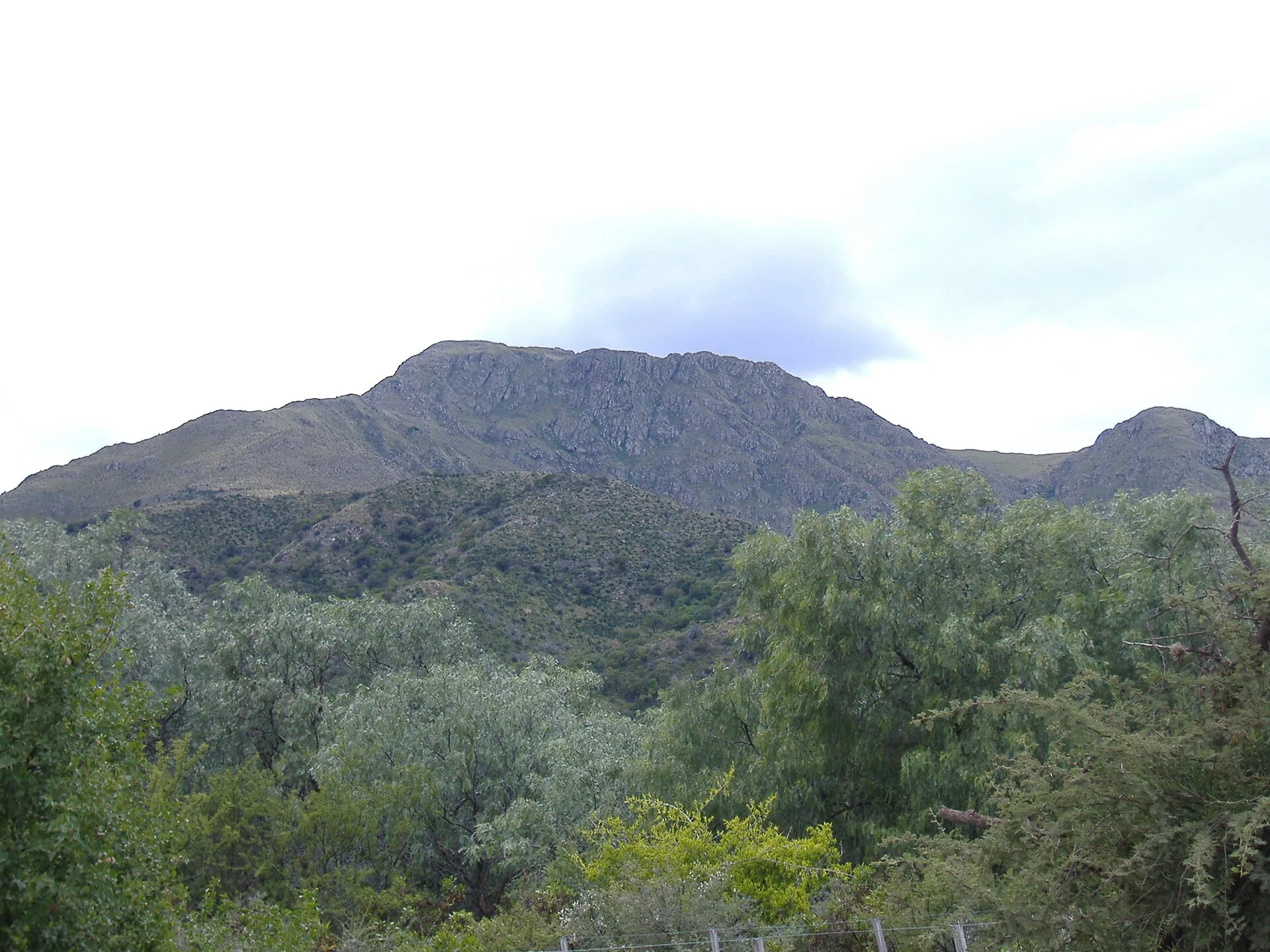
The Uritorco area around Capilla del Monte in Córdoba became Argentina’s best-known UFO destination after a large mark appeared on the nearby Pajarillo hills in January 1986. Promotional accounts attributed the discoloured or burnt vegetation to the landing of an unknown object. Television coverage helped transform the alleged trace into a national story and associated the region with mysterious lights, underground beings and other esoteric claims.
Later examination undermined the landing interpretation. Critics argued that the burn pattern was more consistent with fire spreading uphill through vegetation than with heat projected downwards by a hovering craft. No recovered device, unusual alloy, independently verified radiation signature or other diagnostic material linked the mark to an aerial vehicle. The Pajarillo trace is therefore better treated as a debunked or poorly substantiated physical-evidence claim, even though the mythology it generated remains culturally influential.[Chequeado]chequeado.comNuevediario y el mito del Cerro UritorcoNuevediario y el mito del Cerro UritorcoDecember 23, 2010 — 23 Dec 2010 — Solo los registros o evidencias en el tiempo pueden pr…
Uritorco matters because UFO belief there became more than a sequence of reports. Ethnographic research describes the region as a centre of mystical and esoteric tourism, where landscape, spiritual practice, local commerce and stories of anomalous lights reinforce one another. That does not show that witnesses are dishonest. It shows that expectations can influence which lights receive attention, how ambiguous experiences are interpreted and which narratives circulate most successfully.[RBTUR]rbtur.org.brOpen source on rbtur.org.br.
The resulting regional reputation creates a feedback loop: visitors arrive expecting unusual phenomena; aircraft, satellites, stars, distant vehicles and camera artefacts are observed within that interpretive frame; new stories then strengthen the destination’s identity. Uritorco is thus one of Argentina’s clearest examples of the difference between the social reality of a UFO tradition and proof of an extraordinary aerial cause.
What the official reports actually find
The CIAE’s annual reports constitute Argentina’s most consistent public UFO archive. The Air Force website provides reports from 2015 onwards, allowing readers to inspect individual images, methods and conclusions rather than relying solely on press summaries.[Argentina]argentina.gob.arArgentina Centro de Identificación Aeroespacial | Argentina.gob.arArgentina Centro de Identificación Aeroespacial | Argentina.gob.ar
Across the published series, the centre has investigated hundreds of civilian submissions. Available annual totals include 40 reports in 2016, 76 in 2020, 45 in 2021, 68 in 2022, 82 in 2023 and 36 accepted cases in 2024. The reports consistently conclude that the analysed incidents were produced by known causes. These figures should not be interpreted as the annual number of UFO sightings in Argentina: they represent cases submitted to the centre, meeting its evidential requirements and completed within a particular reporting cycle.[UFO Transparency]ufotransparency.comUFO Transparency Argentina files · 01 Disclosures · UFO TransparencyUFO Transparency Argentina files · 01 Disclosures · UFO Transparency
The 2024 report is especially useful because it explains the selection and classification process. Thirty-six cases met the requirement of testimony plus evidence; nine additional submissions were rejected because necessary information was missing. The centre classified conclusions as Type A when identification was considered definitive and Type B when the evidence strongly supported a conventional explanation without proving every detail. It also stated that resolved cases could be reconsidered if stronger evidence or a better-supported hypothesis emerged.[Argentina]argentina.gob.arOpen source on gob.ar.
That distinction matters. Some official findings identify a precise aircraft, astronomical object or satellite passage. Others establish compatibility with an ordinary class of object—such as a drone or an insect near a camera—without determining the exact model or specimen. A Type B conclusion is therefore a reasoned explanation, not necessarily a frame-by-frame reconstruction of everything that occurred.
Recurring causes include:
- Insects, birds and airborne debris: nearby objects appear large, fast and luminous when blurred, out of focus or illuminated by infrared security cameras.
- Optical reflections: internal lens reflections and glare can create bright shapes that move in relation to a light source rather than to the landscape.
- Aircraft and drones: navigation lights, hovering behaviour and unfamiliar flight profiles are easily misinterpreted at night.
- Satellites: orbital trains, re-entry events and short-lived solar reflections can resemble formations or objects that suddenly brighten and disappear.
- Astronomical objects: bright planets and stars can seem to change colour or move because of atmospheric turbulence, camera shake and loss of visual reference.
- Balloons and launched objects: distance and scale are difficult to judge against an empty sky.
A 2024 Misiones case illustrates the advantage of modern records. A witness photographed several brief lights moving through a limited portion of the sky. Investigators compared the time and direction with an astronomical simulation and found Starlink satellites positioned to reflect sunlight towards the observer. Because the predicted satellite geometry matched the observation, the case was classified as definitively explained.[Argentina]argentina.gob.arOpen source on gob.ar.
Other cases show the limits of photographic evidence. A light apparently rising from a swimming pool was attributed to insects passing through a security camera’s illuminated field. Another multicoloured object was judged compatible with a commercial drone because of its movement and pattern of red, green and white lights, although the body of the device was not visible clearly enough for an exact identification.[Argentina]argentina.gob.arOpen source on gob.ar.
The reports’ principal strength is transparency: they publish the submitted material, explain analytical steps and distinguish stronger from weaker resolutions. Their principal limitation is sampling. The archive contains cases voluntarily reported to one institution and supported by evidence that the institution considered adequate. It cannot show how sightings are distributed across the whole population, nor does resolving the submitted sample prove that every Argentine UFO report has a conventional explanation.
Why reports vary across Argentina
Argentina’s apparent UFO geography reflects population, environment, technology and local storytelling more than a demonstrated concentration of unknown craft.
Buenos Aires Province and the metropolitan region appear frequently in official reports partly because they contain a large share of the national population and an abundance of mobile phones, security cameras, aircraft and artificial lighting. The high reporting volume is therefore unsurprising. It should not be read automatically as an anomalous “hotspot”. The 2024 index alone includes cases from Morón, Tres de Febrero, Bernal, Castelar, Tigre, Bahía Blanca, San Isidro and other locations in the province.[Argentina]argentina.gob.arOpen source on gob.ar.
Patagonia supplies a different observational setting. Dark skies, long sightlines and sparsely populated terrain can make lights more conspicuous while depriving witnesses of familiar distance cues. Bariloche’s aviation history has given the region a particularly strong place in national UFO memory, but modern reports from Río Negro, Neuquén, Santa Cruz and adjoining provinces also involve satellites, reflections and distant lights.
In the north-west, mountains, dry air and clear skies favour astronomical observation but can also complicate estimates of scale and range. Trancas anchors Tucumán’s historical narrative, while reports from Salta and Jujuy often occur along roads or beneath exceptionally clear night skies. None of these environmental features is evidence of exotic activity; they affect what can be seen and how easily it can be misinterpreted.
Córdoba differs because Uritorco provides a ready-made cultural explanation. A light seen near Capilla del Monte is more likely to be reported as a UFO than an equivalent light over a place without the same reputation. Entre Ríos has developed a comparable, though smaller, tradition around Victoria and the work of private organisations such as Visión Ovni. These regional clusters are therefore partly clusters of attention, identity and reporting infrastructure.
Archives, campaigners and source reliability
Argentina’s UFO record is divided among official publications, released defence documents, private collections, local newspapers and oral testimony. Each source type answers a different question.
The CIAE archive is the strongest source for recent submitted cases because it provides dates, images, proposed causes and explicit conclusions. Its reports are primary institutional documents, although readers should still assess whether a Type B explanation is fully demonstrated or merely the best available fit.
Defence files are valuable for establishing that a report was received, discussed or investigated. Declassification is not itself validation of the underlying claim. A file can prove that officials recorded a sighting without proving that the sighting represented an extraordinary vehicle. The 2020 Bariloche release is a good example: historically important documentation increased transparency but did not settle the object’s identity.[Página|12]pagina12.com.arOpen source on com.ar.
Private organisations have played an important role in preserving testimony and pressing for disclosure. The Commission for the Study of the UFO Phenomenon in the Argentine Republic, generally known as CEFORA, brought together researchers seeking the release of government material. Such advocacy can uncover records that might otherwise remain inaccessible, but campaign organisations may also begin from assumptions more favourable to anomalous interpretations. Their claims are most useful when linked to original documents rather than presented as conclusions on their own.
Local journalism is indispensable for reconstructing cases such as Trancas and Uritorco, especially where witnesses and community history are involved. Its reliability varies sharply. Contemporaneous reporting, named witnesses and reproduced documents carry more weight than anniversary features that repeat earlier stories without tracing their sources. Television programmes and tourism material are particularly prone to compressing ambiguity into mystery.
Sceptical investigations supply an essential counterweight by testing whether alleged traces, photographs and extraordinary narratives survive ordinary explanations. Their best work examines geometry, chronology, photographic artefacts and physical context. Scepticism is weakest when it merely dismisses witnesses; advocacy is weakest when it treats inability to identify an object as evidence of extraterrestrial origin.
Claims, explanations and evidence in Argentina’s UFO record
A practical reading of Argentina’s record produces three broad categories.
Confirmed identifications include cases in which photographs, video metadata, astronomical simulations or flight characteristics match satellites, drones, aircraft, insects, reflections or other known sources. This category contains the overwhelming majority of modern cases published by the Air Force.
Contested incidents include Bariloche and Trancas. These reports have credible or multiple witnesses and remain historically significant, but lack the calibrated sensor data needed to establish distance, speed and physical nature. They are neither proven extraterrestrial encounters nor simple fabrications on the available evidence.
Debunked or substantially weakened claims include many camera artefacts and the interpretation of the Pajarillo burn mark as an alien landing trace. In such cases, the alleged extraordinary evidence can be reproduced or better explained through familiar photographic, environmental or human causes.
This framework prevents two common mistakes. The first is to assume that every unresolved report represents something beyond current science. The second is to assume that a conventional explanation for many cases proves that every witness in every period saw the same kind of object. Argentina’s record supports neither conclusion.
What would make an Argentine case genuinely strong?
A persuasive future case would require more than a compelling video or sincere witness. It would need independent observations from separated locations, exact time and position data, original uncompressed files, reliable estimates of range, and comparison with aircraft, satellite and meteorological records. Radar or other calibrated sensors would greatly improve the evidence, especially if their data could be synchronised with imagery.
Physical material would have to possess a documented chain of custody and characteristics that could not be accounted for by ordinary aerospace debris, industrial metal or contamination. Argentina’s recent work on fallen space hardware demonstrates why laboratory analysis matters: unfamiliar-looking fragments can be examined metallurgically rather than judged by appearance or folklore. In 2025, the CIAE recorded field investigations and laboratory coordination concerning suspected space debris in Santa Fe and Chaco, reflecting its expanded role in identifying objects within the national aerospace environment.[Argentina]argentina.gob.arhistorial de actividades 2025historial de actividades 2025
The main lesson from Argentina is not that nothing unusual is ever seen. It is that unusual appearance and extraordinary origin are different propositions. The historical cases remain compelling stories because some questions can no longer be answered. The modern archive is more decisive because digital evidence can be checked against an increasingly detailed record of what occupies the sky. Taken as a whole, Argentina’s UFO history is best understood as a mixture of honest misidentification, regional mythology, media influence, serious archival work and a small residue of incidents whose original evidence is too incomplete to resolve.
Amazon book picks
Further Reading
Books and field guides related to Which Argentina UFO Cases Still Resist Explanation?. Use these as the next step if you want deeper reading beyond the article.

UFOs: Generals, Pilots, and Government Officials Go on the Re...
Covers notable international military and aviation UFO cases relevant to Argentina.
Passport to Magonia
Places famous national UFO traditions into a broader historical framework.

eBay marketplace picks
Marketplace Samples
Live-tested eBay searches with available results related to this page.
Selected fromUFO poster oneBay.co.uk.

Current eBay listing
VINTAGE UFO FLYING SAUCERS COMIC ADVERTISING A2 POSTER PRINT

Current eBay listing
I Want To Believe UFO Poster Giclée Fine Art Heavyweight Print


Endnotes
1.
Source: radiostucuman.com.ar
Title: ovnis que sucedio en el caso trancas de 1963
Link:https://radiostucuman.com.ar/nota/167496/ovnis-que-sucedio-en-el-caso-trancas-de-1963
Source snippet
Ovnis: qué sucedió en el caso Trancas de 196321 May 2025 — Paranormal analiza el impactante suceso que protagonizó la familia Moreno y qu...
Published: May 2025
2.
Source: Wikipedia
Title: Alejandro Agostinelli
Link:https://es.wikipedia.org/wiki/Alejandro_Agostinelli
3.
Source: chequeado.com
Title: Nuevediario y el mito del Cerro Uritorco
Link:https://chequeado.com/mitos-y-enganos/nuevediario-y-el-mito-del-cerro-uritorco/
Source snippet
Nuevediario y el mito del Cerro UritorcoDecember 23, 2010 — 23 Dec 2010 — Solo los registros o evidencias en el tiempo pueden pr...
Published: December 23, 2010
4.
Source: rbtur.org.br
Link:https://rbtur.org.br/rbtur/article/view/101/100
5.
Source: argentina.gob.ar
Link:https://www.argentina.gob.ar/sites/default/files/2018/11/informe-ciae-2024.pdf
6.
Source: Wikipedia
Title: UFO sightings in Argentina
Link:https://en.wikipedia.org/wiki/UFO_sightings_in_Argentina
7.
Source: Wikipedia
Title: List of reported UFO sightings
Link:https://en.wikipedia.org/wiki/List_of_reported_UFO_sightings
8.
Source: Wikipedia
Title: Alejandro Agostinelli
Link:https://en.wikipedia.org/wiki/Alejandro_Agostinelli
9.
Source: first.contact
Link:https://first.contact/blog/international-uap-disclosure/
10.
Source: archives.gov
Title: Project BLUE BOOK
Link:https://www.archives.gov/research/military/air-force/ufos
11.
Source: archives.gov
Link:https://www.archives.gov/research/topics/uaps
12.
Source: archive.org
Link:https://archive.org/stream/DIAUFO/DIA%20UFO%20Files%201_djvu.txt
13.
Source: argentina.gob.ar
Title: Argentina Centro de Identificación Aeroespacial | Argentina.gob.ar
Link:https://www.argentina.gob.ar/fuerzaaerea/centro-de-identificacion-aeroespacial
14.
Source: pagina12.com.ar
Link:https://www.pagina12.com.ar/292872-el-ministerio-de-defensa-desclasifico-por-primera-vez-docume/
15.
Source: ufotransparency.com
Title: UFO Transparency Argentina files · 01 Disclosures · UFO Transparency
Link:https://ufotransparency.com/international/files/ar
16.
Source: argentina.gob.ar
Title: historial de actividades 2025
Link:https://www.argentina.gob.ar/fuerzaaerea/centro-de-identificacion-aeroespacial/historial-de-actividades-2025
17.
Source: ufotransparency.com
Link:https://ufotransparency.com/international/findings/ar
18.
Source: ufotransparency.com
Link:https://ufotransparency.com/lore/files/lt-bariloche-1995
19.
Source: ufotransparency.com
Title: Bariloche Airport Incident
Link:https://ufotransparency.com/lore/encounters/lt-bariloche-1995
20.
Source: argentina.gob.ar
Title: centro de identificacion aeroespacial
Link:https://www.argentina.gob.ar/fuerzaaerea/centro-de-identificacion-aeroespacial/2016
21.
Source: argentina.gob.ar
Link:https://www.argentina.gob.ar/buscar?f%5B0%5D=sm_og_group_ref%3Anode%3A105939&searchphrase=all&searchword=vih
22.
Source: argentina.gob.ar
Title: historial de actividades 2020
Link:https://www.argentina.gob.ar/centro-de-identificacion-aeroespacial/historial-de-actividades-2020
23.
Source: argentina.gob.ar
Link:https://www.argentina.gob.ar/buscar?f%5B0%5D=sm_og_group_ref%3Anode%3A105939&searchphrase=all&searchword=rcp
24.
Source: argentina.gob.ar
Title: centro de identificacion aeroespacial
Link:https://www.argentina.gob.ar/fuerzaaerea/centro-de-identificacion-aeroespacial/2018
25.
Source: argentina.gob.ar
Link:https://www.argentina.gob.ar/buscar?f%5B0%5D=sm_og_group_ref%3Anode%3A105939&f%5B1%5D=bundle%3Abook&searchphrase=all&searchword=pnc
26.
Source: argentina.gob.ar
Title: centro de identificacion aeroespacial
Link:https://www.argentina.gob.ar/fuerzaaerea/centro-de-identificacion-aeroespacial/2017
27.
Source: argentina.gob.ar
Title: ix brigada aerea ejercicio romeo i 0
Link:https://www.argentina.gob.ar/noticias/ix-brigada-aerea-ejercicio-romeo-i-0
28.
Source: argentina.gob.ar
Link:https://www.argentina.gob.ar/fuerzaaerea/direccion-de-estudios-historicos/junio
29.
Source: facebook.com
Link:https://www.facebook.com/groups/1560864333940443/posts/2973451696015026/
30.
Source: academia.edu
Title: Argentina Desclasificacion OVNI UFO Declassification
Link:https://www.academia.edu/43711706/Argentina_Desclasificacion_OVNI_UFO_Declassification
31.
Source: myufophotos.com
Title: Argentina UFO files (disclosure documents)
Link:https://myufophotos.com/ufo-archives/argentina-ufo-files-disclosure-documents/
32.
Source: countdowntodisclosure.com
Title: argentina launches cefae in 2011 military academic uap investigation begins
Link:https://countdowntodisclosure.com/articles/argentina-launches-cefae-in-2011-military-academic-uap-investigation-begins/
Additional References
33.
Source: lavoz.com.ar
Link:https://www.lavoz.com.ar/ciudadanos/ovnis-en-argentina-defensa-desclasifico-un-documento-del-caso-bariloche_0_gNghsukvE2.html
Source snippet
La VozDefensa desclasificó un documento del “caso Bariloche”18 Sept 2020 — Los archivos desclasificados incluyen intercambios de cartas...
34.
Source: lagaceta.com.ar
Title: caso trancas unica testigo viva recuerda ovnis
Link:https://www.lagaceta.com.ar/nota/1010882/sociedad/caso-trancas-unica-testigo-viva-recuerda-ovnis.html
Source snippet
La GacetaCaso Trancas: la única testigo viva recuerda los ovnis22 Oct 2023 — La experiencia que atravesó la familia Moreno en octubre de...
35.
Source: youtube.com
Link:https://www.youtube.com/watch?v=Ous75fxPnis
Source snippet
Did Men In Black Frame A Potential UFO As A Meteorite Crash In 1995? | Contact...
36.
Source: books.google.com
Link:https://books.google.com/books/about/Invasores.html?id=cR2JOqpac6wC
Source snippet
Front Cover. Alejandro Agostinelli. Penguin Random House Grupo Editorial Argentina, May 1, 2012...Read more...
Published: May 1, 2012
37.
Source: youtube.com
Title: UFOs and aliens bringing tourists to Argentina
Link:https://www.youtube.com/watch?v=SeRoDzTo06E
Source snippet
Specialists May Have Found A Link Between UFO Sightings And Nuclear Missile Sites | Alien Contact...
38.
Source: cia.gov
Link:https://www.cia.gov/readingroom/collection/ufos-fact-or-fiction
39.
Source: facebook.com
Link:https://www.facebook.com/respiracordoba/posts/uritorco-mito-o-posta-alguien-vio-un-ovni-subiendo-el-cerro-en-capilla-del-monte/1648867223910932/
40.
Source: noticiasnet.com.ar
Link:https://www.noticiasnet.com.ar/noticias/2026/05/12/201963-ovnis-en-bariloche-el-caso-de-aerolineas-figura-en-los-archivos-desclasificados-de-estados-unidos
41.
Source: newsflare.com
Link:https://www.newsflare.com/video/650345/air-traffic-controller-records-ufo-close-encounter-in-argentina?origin=ufo
42.
Source: reddit.com
Link:https://www.reddit.com/r/UFOs/comments/1df8tq6/answers_to_the_most_common_skeptical_statements/