Within Belgian UFOs
Did Belgian F 16 s Really Chase an Impossible Craft?
Belgian fighters were launched in March 1990, but intermittent radar returns never became a continuous track of a visible craft.
On this page
- Why the fighters were launched
- What the pilots and radar systems recorded
- Why the extreme speed claim remains unproven
Page outline Jump by section
Introduction
The Belgian Air Force scramble on the night of 30–31 March 1990 is the single most important military episode of the Belgian UFO wave. It is also the source of some of the strongest—and most disputed—claims that modern military radar tracked an object performing impossible manoeuvres. What unquestionably happened is that Belgian F-16 fighters were launched after ground radar operators and multiple witnesses reported unusual aerial activity. What remains disputed is whether the radar data demonstrated an extraordinary craft or reflected intermittent, ambiguous radar returns that were later overinterpreted.
The distinction matters. The scramble produced genuine military records rather than second-hand stories, yet the most dramatic claims about extreme acceleration and impossible flight have been challenged by later technical reviews. The event therefore illustrates both the value and the limitations of radar evidence in the wider Belgian UFO case.
Why the fighters were launched
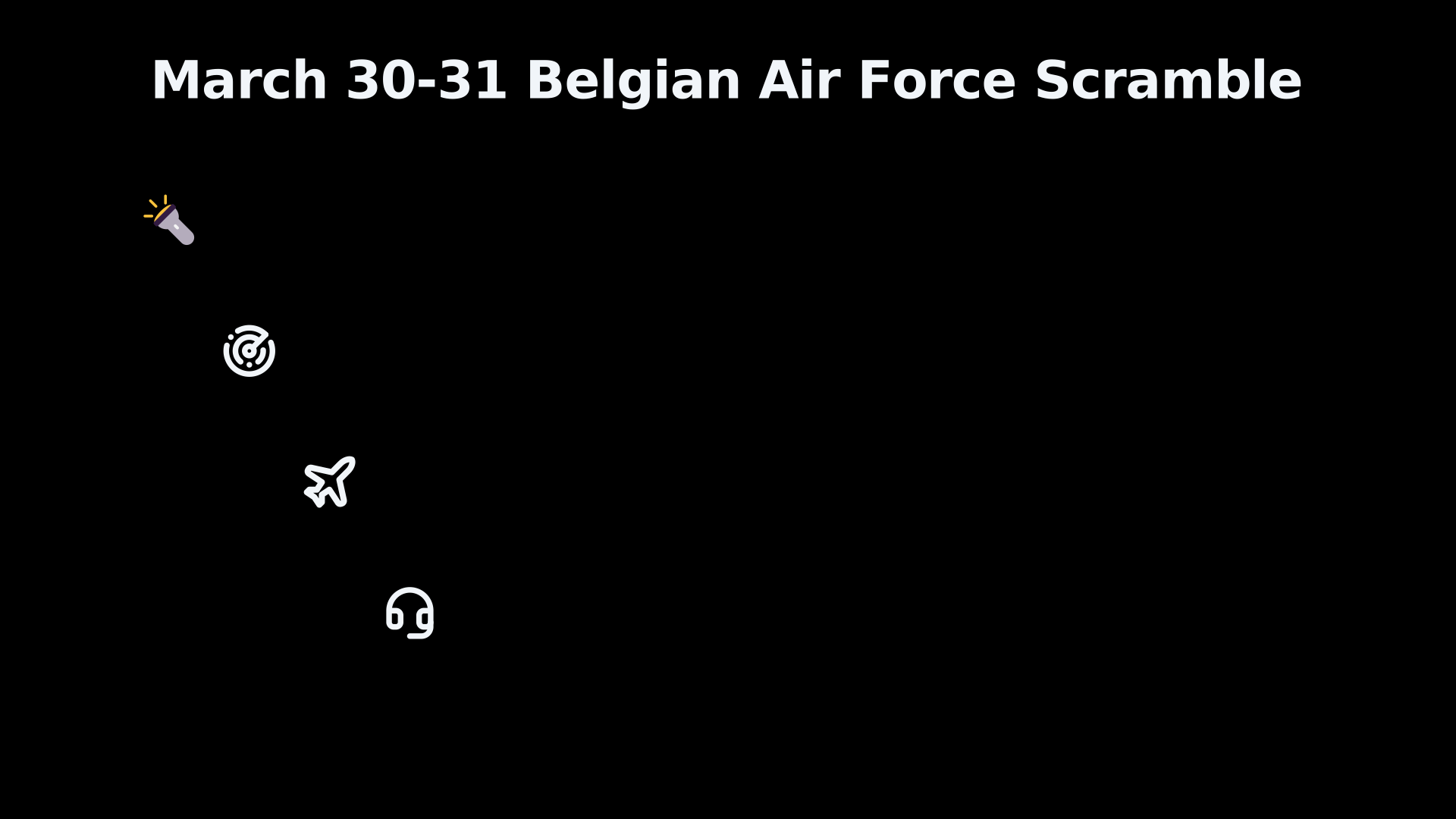
The scramble occurred near the end of the most active phase of Belgium’s 1989–1990 UFO wave. During the evening of 30 March, civilians and police officers around the Wavre and Ramillies areas reported unusual lights. At the same time, military radar operators at the NATO Control and Reporting Centre (CRC) at Glons and personnel at Semmerzake detected intermittent unidentified radar returns that did not correspond to a known aircraft transponder signal.[UFO Transparency]ufotransparency.comintl be salmon radar report rapport lt col salmon f16 radarUFO TransparencyLt. Col. Salmon F-16 Radar Trace Report, Night of 30–31 March 1990, Belgian Air Force (Force Aérienne Belge) · 1990 · UFO…
Because both witness reports and radar detections appeared to coincide, the Belgian Air Force treated the situation seriously enough to order an interception. Around midnight, two armed F-16s were scrambled from Beauvechain Air Base and directed towards the reported targets. This decision is significant because it demonstrates that the military considered the situation operationally unusual, not because it had already identified an extraordinary object.[UFO Transparency]ufotransparency.comintl be salmon radar report rapport lt col salmon f16 radarUFO TransparencyLt. Col. Salmon F-16 Radar Trace Report, Night of 30–31 March 1990, Belgian Air Force (Force Aérienne Belge) · 1990 · UFO…
Unlike many later retellings, the official sequence did not involve pilots visually pursuing a clearly observed triangular craft. The aircraft were launched to investigate uncertain radar contacts whose nature was still unknown.
What the pilots and radar systems recorded
The interception lasted roughly an hour. During that period the F-16s attempted multiple radar interceptions while receiving guidance from ground controllers.
According to Belgian Air Force presentations released later in 1990:[disclosdex.com]disclosdex.comBelgian Air Force Reports | DisclosdexBelgian Air Force Reports | Disclosdex
- the fighters attempted several interceptions;
- onboard radar achieved several brief target lock-ons;
- individual locks typically lasted only seconds before disappearing;
- pilots never established continuous radar tracking;
- neither crew obtained a confirmed visual sighting of the object being tracked.[UFO Transparency]ufotransparency.comintl be f16 radar charts 1990 f16radarnx1UFO TransparencyBelgian F-16 Radar Trace Charts, March 30–31, 1990 Eupen/Wavre Interception (part 2), Belgian Air Force / Force Aérienne…
The absence of a visual confirmation is often overlooked. Although the airborne radar occasionally indicated a target, the pilots themselves reported seeing nothing corresponding to the radar returns despite weather conditions that generally allowed reasonable visibility.[UFO Transparency]ufotransparency.comintl be f16 radar charts 1990 meessen f16 radar analysis belgium 1990UFO TransparencyBelgian F-16 Radar Trace Charts, March 30–31, 1990 Eupen/Wavre Interception (part 1), Belgian Air Force / Force Aérienne…
The radar data also differed from what investigators would normally hope to obtain during an interception. Rather than one uninterrupted track showing a single aircraft’s position and motion over time, the evidence consisted of a series of short-lived contacts that repeatedly appeared and disappeared. This distinction became central to later debate.
Where the dramatic performance figures came from
The Belgian Air Force’s public briefing highlighted several radar sequences that appeared remarkable. During some brief lock-ons, calculations suggested rapid changes in speed and altitude, including accelerations from a few hundred kilometres per hour to well above 1,000 km/h within seconds and equally abrupt altitude changes. These figures quickly became the most famous technical evidence associated with the Belgian wave.[UFO Transparency]ufotransparency.comintl be f16 radar charts 1990 f16radarnx1UFO TransparencyBelgian F-16 Radar Trace Charts, March 30–31, 1990 Eupen/Wavre Interception (part 2), Belgian Air Force / Force Aérienne…
Supporters of the UFO hypothesis argued that:
- multiple radar systems detected something unusual;
- onboard fighter radar independently acquired targets;
- the apparent flight profile exceeded known aircraft performance;
- the repeated loss of lock suggested deliberate evasive manoeuvres rather than ordinary aircraft behaviour.
These claims gave the Belgian case unusual credibility compared with many UFO reports that relied solely on eyewitness testimony.
However, the extraordinary manoeuvres were never observed directly by the pilots. They were derived from very short radar measurements that depended on the radar maintaining an accurate track throughout each brief contact.
Why the extreme-speed claim remains unproven
Subsequent technical analysis substantially altered how many researchers interpret the radar evidence.
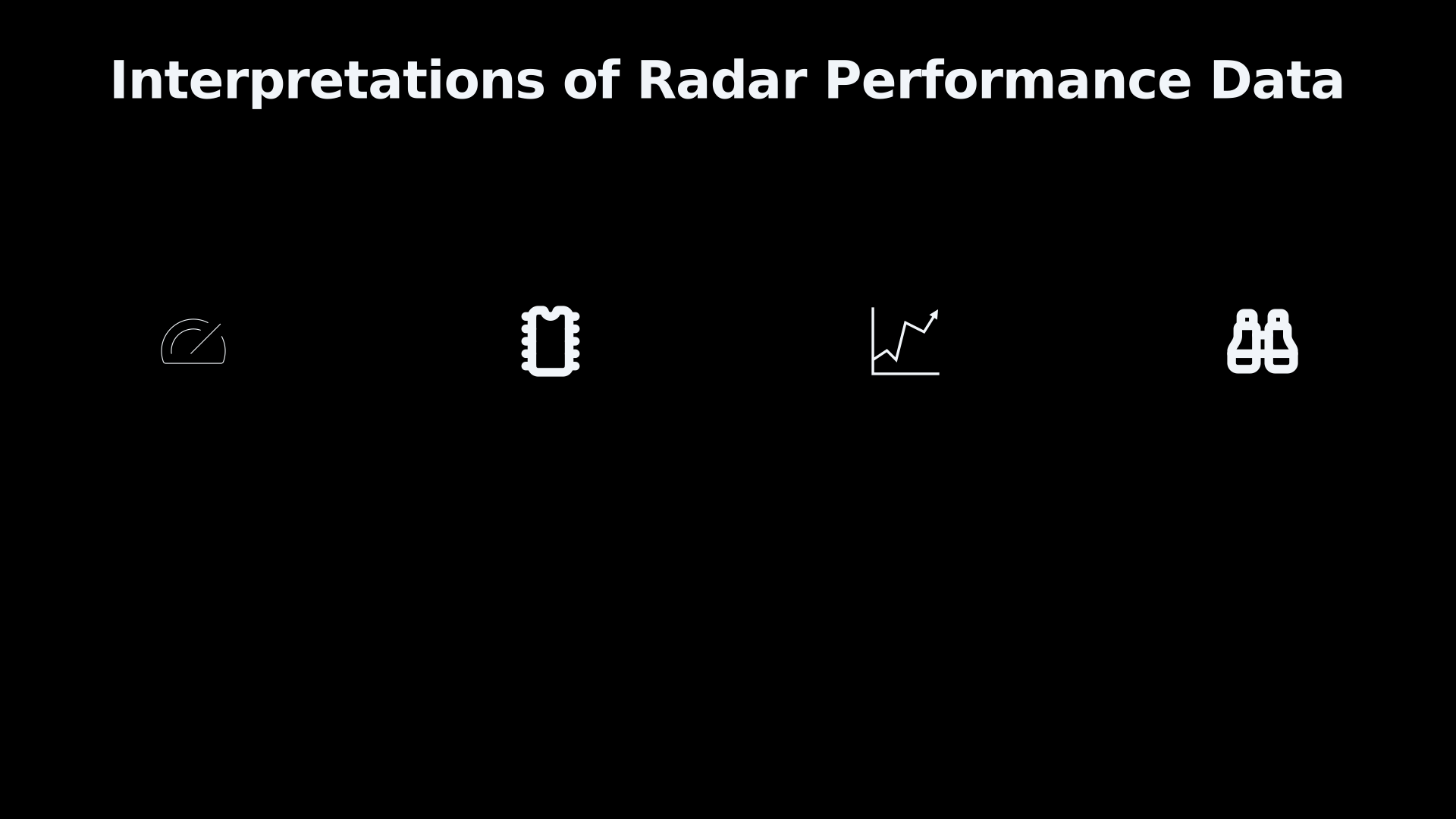
A detailed engineering review commissioned within the Belgian Air Force concluded that the apparent extreme manoeuvres could be reproduced by characteristics of the F-16’s radar tracking system itself rather than requiring an object capable of impossible acceleration. The analysis focused on how the radar’s tracking filters behaved when trying to maintain lock on weak, unstable or intermittent returns. Small tracking errors could generate calculated jumps in speed and altitude far greater than any real target motion.[UFO Transparency]ufotransparency.comintl be salmon radar report rapport lt col salmon f16 radarUFO TransparencyLt. Col. Salmon F-16 Radar Trace Report, Night of 30–31 March 1990, Belgian Air Force (Force Aérienne Belge) · 1990 · UFO…
This explanation addresses one of the central misconceptions about the case. The reported accelerations were not direct measurements of an object’s physical movement. They were mathematical outputs produced by the radar tracking system after processing imperfect returns. If the radar briefly shifted between different reflectors or partially lost the target, the derived flight path could become unrealistic.
The engineering review therefore argued that the dramatic figures should not be treated as proof that a craft actually executed those manoeuvres.[UFO Transparency]ufotransparency.comintl be salmon radar report rapport lt col salmon f16 radarUFO TransparencyLt. Col. Salmon F-16 Radar Trace Report, Night of 30–31 March 1990, Belgian Air Force (Force Aérienne Belge) · 1990 · UFO…
Importantly, this does not automatically explain every unidentified radar return recorded that night. It instead narrows the claim: while something may have generated intermittent detections, the radar evidence does not reliably establish extraordinary flight performance.
What remains unexplained—and what does not
The March 1990 scramble leaves several facts that are generally accepted:
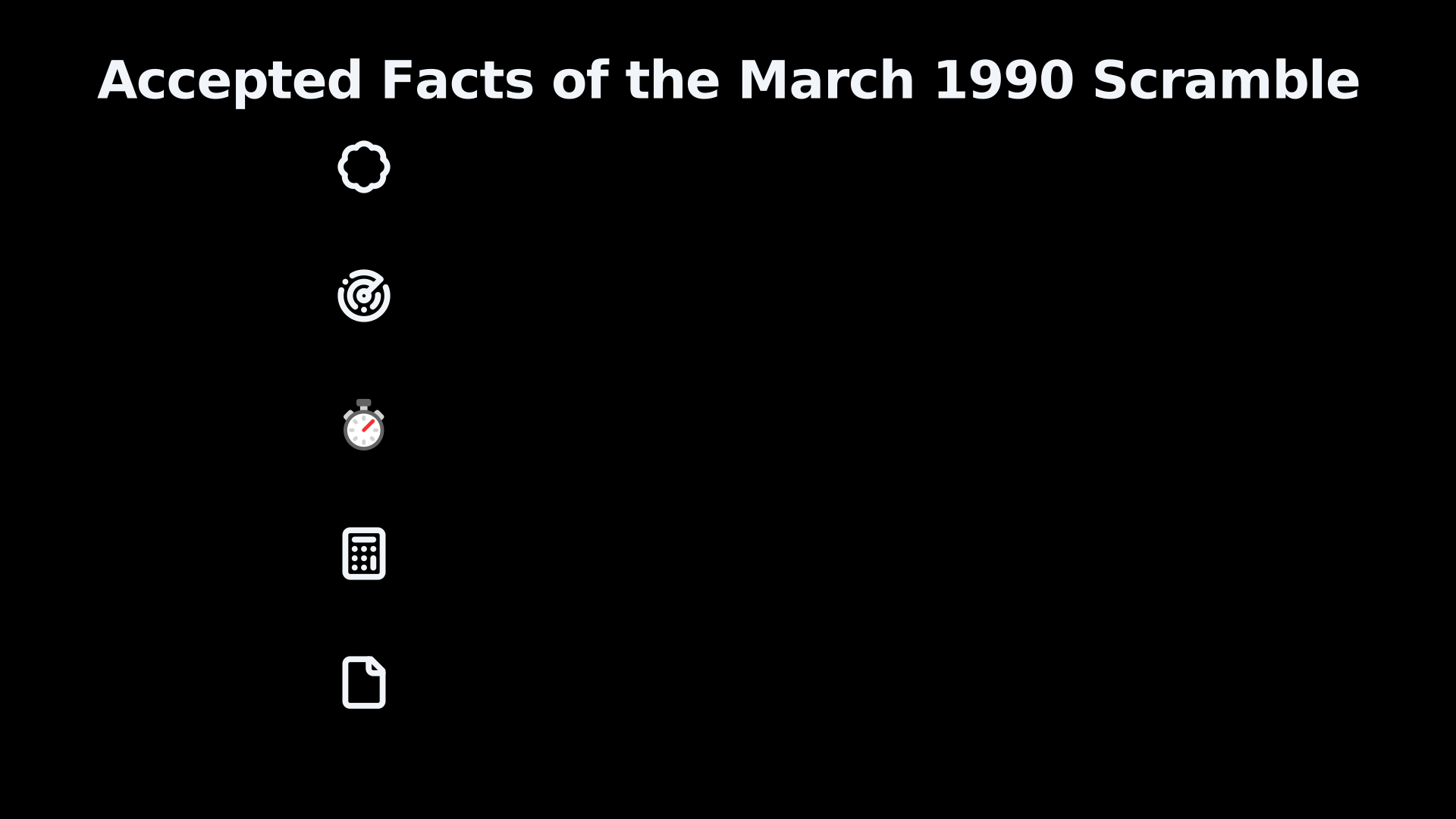
- Belgian authorities genuinely launched interceptor aircraft.
- Ground radar operators reported intermittent unidentified returns.
- F-16 radars briefly obtained several target locks.
- Pilots never visually identified the target.
- No continuous radar track documented one object performing impossible manoeuvres.[UFO Transparency]ufotransparency.comintl be salmon radar report rapport lt col salmon f16 radarUFO TransparencyLt. Col. Salmon F-16 Radar Trace Report, Night of 30–31 March 1990, Belgian Air Force (Force Aérienne Belge) · 1990 · UFO…
What remains uncertain is the identity of whatever produced the radar contacts. Proposed explanations have included radar propagation effects, tracking artefacts, multiple unrelated targets, atmospheric conditions and unidentified conventional aircraft, while UFO proponents continue to argue that the combination of witnesses and radar deserves greater weight.
The available evidence does not conclusively distinguish among these possibilities.
How the scramble fits into the wider Belgian wave
The F-16 interception remains the Belgian UFO wave’s strongest military episode because it combines eyewitness testimony, operational military response and preserved technical records. At the same time, it demonstrates why sensor evidence must be interpreted cautiously.
The event is often summarised as proof that fighter aircraft chased an object performing impossible manoeuvres. That is not supported by the surviving record. A more accurate description is that Belgian fighters investigated unusual reports, obtained several brief and disputed radar contacts, failed to achieve visual identification, and produced data that later generated both extraordinary claims and equally substantial technical criticism.
For the broader study of the Belgian wave, the scramble is therefore less significant as evidence of an exotic craft than as a case study in how military radar, human observation and later interpretation can diverge. It remains an important chapter in Belgium’s UFO history precisely because the records are detailed enough to permit continuing technical debate rather than simple acceptance or dismissal.
Amazon book picks
Further Reading
Books and field guides related to Did Belgian F-16s Really Chase an Impossible Craft?. Use these as the next step if you want deeper reading beyond the article.

UFOs: Generals, Pilots, and Government Officials Go on the Re...
Strong fit for military radar and pilot evidence.
In Plain Sight: an Investigation Into UFOs and Impossible Sci...
Places military UFO reports in a wider narrative.

eBay marketplace picks
Marketplace Samples
Live-tested eBay searches with available results related to this page.
Selected fromUFO flying saucer patch oneBay.co.uk.



Endnotes
1.
Source: ufotransparency.com
Title: intl be salmon radar report rapport lt col salmon f16 radar 1990 03 31
Link:https://ufotransparency.com/files/intl-be-salmon-radar-report-rapport-lt-col-salmon-f16-radar
Source snippet
UFO TransparencyLt. Col. Salmon F-16 Radar Trace Report, Night of 30–31 March 1990, Belgian Air Force (Force Aérienne Belge) · 1990 · UFO...
Published: March 1990
2.
Source: ufotransparency.com
Title: intl be f16 radar charts 1990 meessen f16 radar analysis belgium 1990
Link:https://ufotransparency.com/files/intl-be-f16-radar-charts-1990-meessen-f16-radar-analysis-belgium-1990
Source snippet
UFO TransparencyBelgian F-16 Radar Trace Charts, March 30–31, 1990 Eupen/Wavre Interception (part 1), Belgian Air Force / Force Aérienne...
3.
Source: ufotransparency.com
Title: intl be f16 radar charts 1990 f16radarnx1
Link:https://ufotransparency.com/files/intl-be-f16-radar-charts-1990-f16radarnx1
Source snippet
UFO TransparencyBelgian F-16 Radar Trace Charts, March 30–31, 1990 Eupen/Wavre Interception (part 2), Belgian Air Force / Force Aérienne...
4.
Source: ufotransparency.com
Title: intl be f16 radar charts 1990 f16radarnx2
Link:https://ufotransparency.com/files/intl-be-f16-radar-charts-1990-f16radarnx2
Source snippet
UFO TransparencyBelgian F-16 Radar Trace Charts, March 30–31, 1990 Eupen/Wavre Interception (part 3), Belgian Air Force / Force Aérienne...
5.
Source: ufotransparency.com
Title: * SOBEPS re
Link:https://ufotransparency.com/files/intl-be-sobeps-vague-ovni-volume-1-sobeps-vague-ovni-belge-volume-1
Source snippet
SOBEPS Vague d'OVNI sur la Belgique, Volume 1 (1989–1991), SOBEPS (Société Belge d'Étude des Phénomènes Spatiaux) · 1991 · UFO Transparen...
6.
Source: ufotransparency.com
Title: intl be f16 radar charts 1990 f16radarnx3
Link:https://ufotransparency.com/files/intl-be-f16-radar-charts-1990-f16radarnx3
Source snippet
Wilfried De Brouwer) · 1990 · UFO TransparencyJuly 11, 1990 — [Button: ✕]← FilesDisclosure Index/01 DISCLOSURES/INTERNATIONAL RECORDS/FIL...
Published: July 11, 1990
Additional References
7.
Source: doczz.net
Title: Apparent trajectory of the UFO, from the technical G
Link:https://doczz.net/doc/1605367/unidentified-flying-objects-briefing-document
Source snippet
unidentified flying objects briefing document - air forceDecember 15, 1995 — Montage of radar-visual incident in Belgium on the night of...
Published: December 15, 1995
8.
Source: decur.org
Title: SOBEP S Belgian UFO Wave Investigation Report
Link:https://decur.org/documents/sobeps-belgian-ufo-wave-1991
Source snippet
SOBEPS Belgian UFO Wave Investigation Report - DECURJanuary 1, 1991 — SOBEPS BELGIAN UFO WAVE INVESTIGATION REPORT Confirmed Authentic In...
Published: January 1, 1991
9.
Source: youtube.com
Title: The Belgium UFO That Defied Physics (S4) | The Proof Is Out There | History
Link:http://www.youtube.com/watch?v=aWbo0x1lJAk
Source snippet
F-16 pilot Yves Meelbergs and other credible witnesses talk about the Belgian UFO wave, 1989-1990...
10.
Source: youtube.com
Link:http://www.youtube.com/watch?v=GBUULtF0TGw
Source snippet
13,500 People SAW It. Two F-16s CHASED It. It Won. | EP19...
11.
Source: youtube.com
Link:http://www.youtube.com/watch?v=Z0jt9VpN9eY
Source snippet
Belgian UFO wave 1990 F-16 radar analysis The Belgium UFO That Defied Physics (S4) | The Proof Is Out There | History HISTORY...
12.
Source: youtube.com
Title: 13,500 People SAW It. Two F-16s CHASED It. It Won. | EP19
Link:http://www.youtube.com/watch?v=qxtfFlmGxvQ
Source snippet
F-16 Pilots Chased This For Hours And Nobody Knows Why #UFO #Aviation...
13.
Source: skepsis.nl
Link:https://skepsis.nl/belgie/
14.
Source: youtube.com
Title: F-16 Pilots Chased This For Hours And Nobody Knows Why #UFO #Aviation
Link:http://www.youtube.com/watch?v=i9v13DLFs6c
Source snippet
FILE 1990 — The Belgian Wave (BGW90)...
15.
Source: disclosdex.com
Title: Belgian Air Force Reports | Disclosdex
Link:https://disclosdex.com/documents/1990-belgian-air-force-reports
16.
Source: worldofthestrange.com
Link:https://worldofthestrange.com/close_encounters/ce_1990_03_30belgiumwavre.htm