Within Congo UFO Files
How Strong Is the Katanga UFO Story?
The famous Katanga report is vivid and historically important, but its dramatic claims rest on a thin and indirect source trail.
On this page
- What the original report claimed
- Missing witnesses, records, and measurements
- Why the uranium setting shaped later retellings
Page outline Jump by section
Introduction
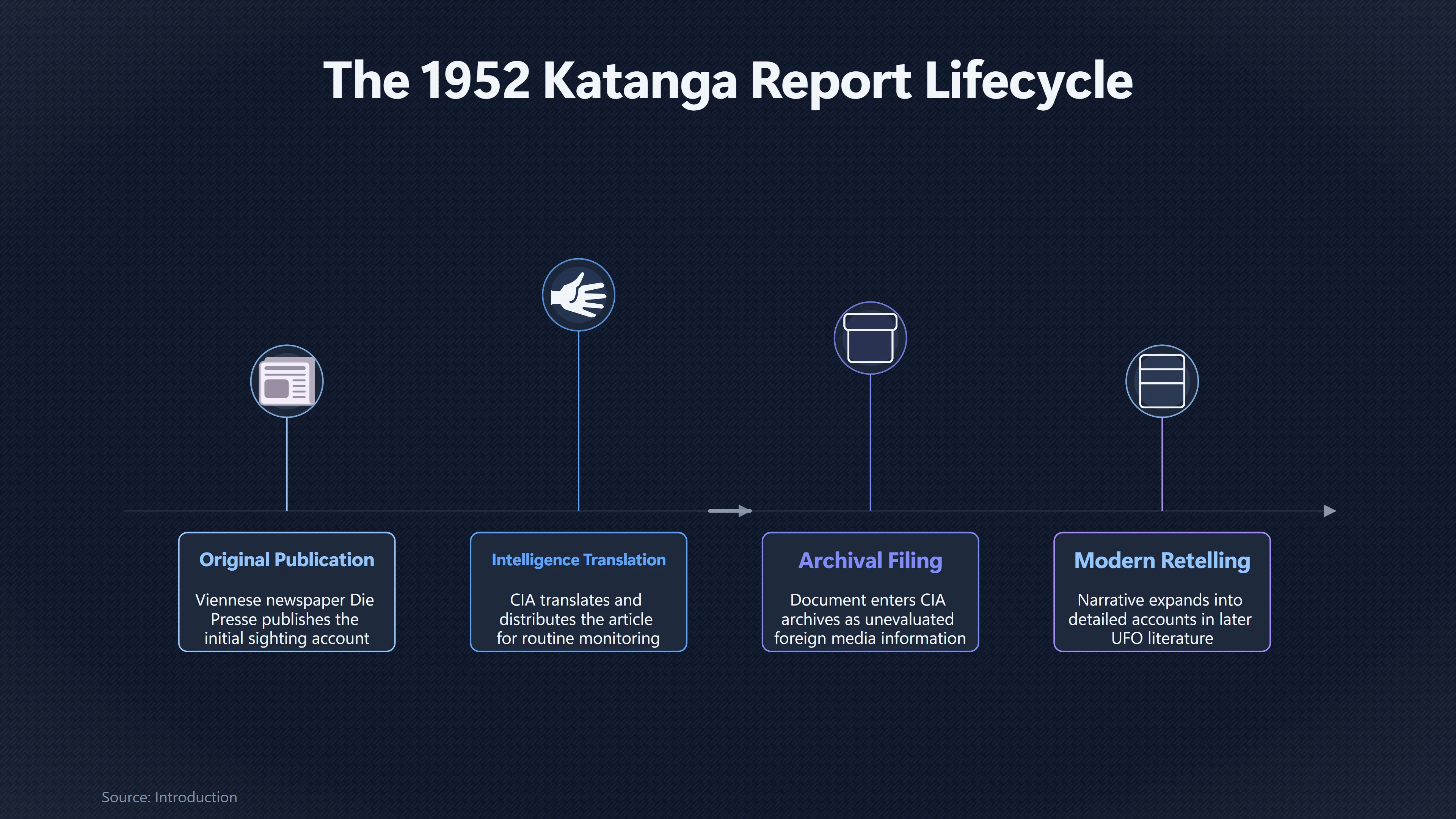
The 1952 Katanga UFO case is the best-known historical UFO report associated with what is now the Democratic Republic of the Congo. It has endured because it combines dramatic elements—a fighter pilot pursuit, alleged close observation of disc-shaped objects and a setting near strategically important uranium mines—with an official-looking CIA document. Yet a closer examination shows that the story’s historical importance is not matched by equally strong evidence. The surviving documentation is remarkably thin, resting primarily on a translated newspaper article preserved in a CIA archive rather than on a contemporaneous military investigation, flight log or official Belgian colonial record. The case therefore remains historically significant as a Cold War-era UFO narrative, but its evidential value is substantially weaker than many later retellings suggest.[Wikisource]en.wikisource.orgFlying saucers over Belgian Congo uranium minesFlying saucers over Belgian Congo uranium mines - Wikisource, the free online libraryMarch 29, 1952…
What the original report claimed
The account entered the historical record through an article published in the Viennese newspaper Die Presse on 29 March 1952. Several months later, the CIA translated and distributed the article as part of its routine monitoring of foreign publications. Crucially, the document is explicitly labelled “This is unevaluated information”, indicating that it was a translation of foreign press reporting rather than an authenticated intelligence assessment.[Wikisource]en.wikisource.orgFlying saucers over Belgian Congo uranium minesFlying saucers over Belgian Congo uranium mines - Wikisource, the free online libraryMarch 29, 1952…
According to the report:
- Two fiery, luminous discs appeared over uranium mining territory in the Elisabethville (now Lubumbashi) district of colonial Katanga.
- Witnesses reportedly observed the objects changing apparent shape as they manoeuvred, sometimes resembling discs, ovals or narrow lines depending on their orientation.
- The objects allegedly hovered before accelerating away in a zigzag pattern.
- A loud hissing or buzzing sound was reportedly heard from the ground.
- The entire event supposedly lasted around ten to twelve minutes.[Wikisource]en.wikisource.orgFlying saucers over Belgian Congo uranium minesFlying saucers over Belgian Congo uranium mines - Wikisource, the free online libraryMarch 29, 1952…
The article further claimed that a pilot identified only as “Commander Pierre” took off from Elisabethville in pursuit. According to the story, he approached one object to within approximately 120 metres, estimating it to be around 12–15 metres in diameter with a stationary central section surrounded by a rapidly rotating luminous rim. The report attributed remarkable performance to the objects, including abrupt vertical climbs, sudden changes in direction and an estimated top speed of roughly 1,500 km/h before they disappeared towards Lake Tanganyika.[Wikisource]en.wikisource.orgFlying saucers over Belgian Congo uranium minesFlying saucers over Belgian Congo uranium mines - Wikisource, the free online libraryMarch 29, 1952…
These details have become the foundation for nearly every later retelling of the Katanga incident.
Why the surviving evidence is much weaker than the story
The strongest reason for treating the case cautiously is not that the reported observations are impossible, but that the evidential chain is unusually fragile.
The CIA document is often misunderstood as evidence that the Agency investigated or endorsed the incident. In reality, it is a translated foreign-media summary prepared through the CIA’s Foreign Documents Division. During the early Cold War, the Agency routinely collected newspaper reports on subjects ranging from aviation to military developments and unusual phenomena. Inclusion in the archive reflects intelligence interest, not authentication.[Wikisource]en.wikisource.orgFlying saucers over Belgian Congo uranium minesFlying saucers over Belgian Congo uranium mines - Wikisource, the free online libraryMarch 29, 1952…
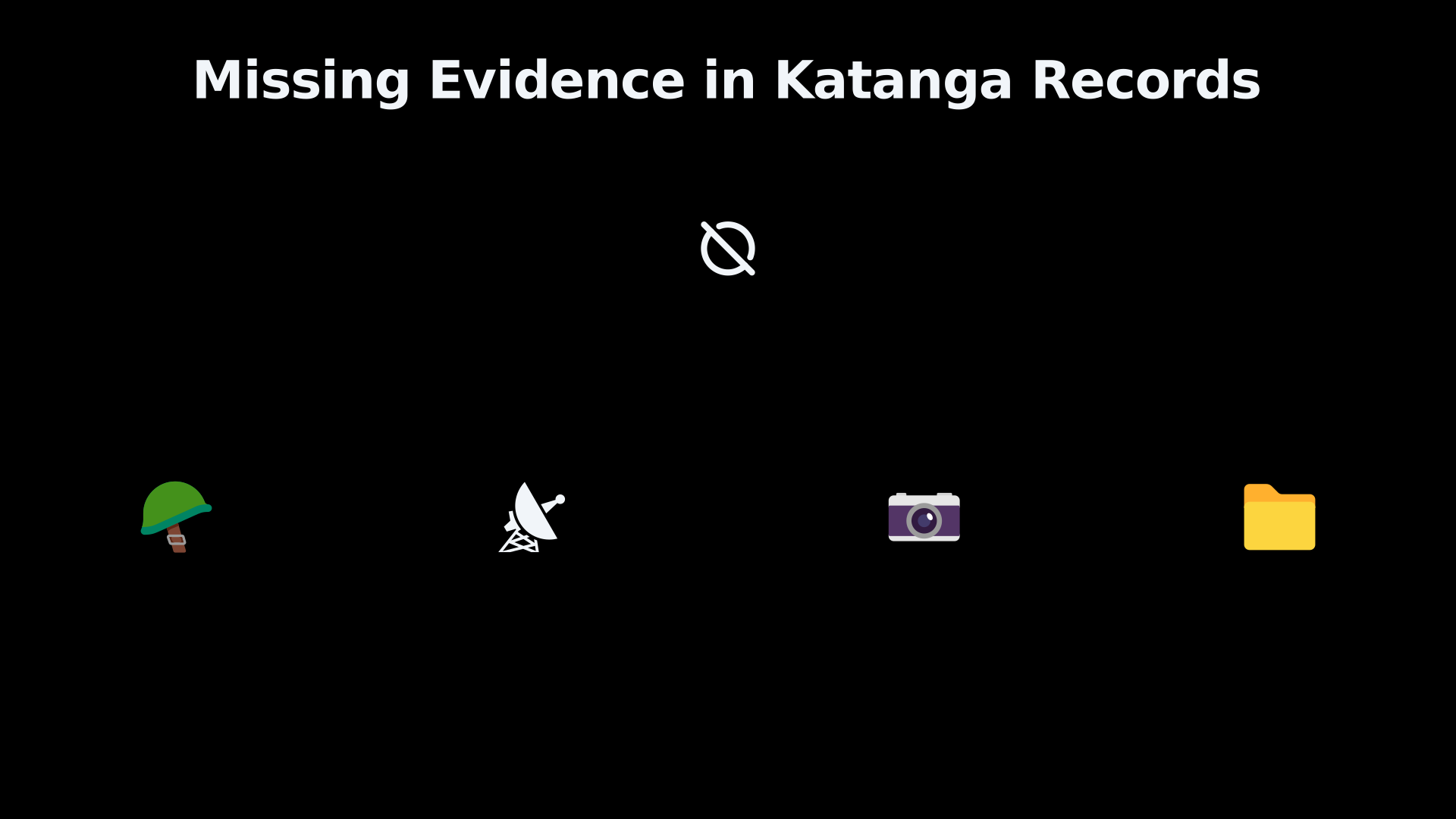
Even more importantly, the original article itself provides little verifiable information about how the claims were gathered. It does not identify:
- the ground witnesses;
- the military unit involved;
- the aircraft flown;
- any official Belgian investigation;[ovniarchive.com]ovniarchive.comSource details in endnotes.
- weather observations;
- radar data;
- photographs;
- physical evidence; or
- independently recorded flight documentation.[Wikisource]en.wikisource.orgFlying saucers over Belgian Congo uranium minesFlying saucers over Belgian Congo uranium mines - Wikisource, the free online libraryMarch 29, 1952…
The pilot’s identity presents another problem. “Commander Pierre” appears without surname or service identification, making independent verification difficult. No widely cited Belgian Air Force or colonial aviation record has emerged confirming either his existence in this context or the alleged interception.
As a result, historians cannot independently reconstruct the encounter beyond what appears in the newspaper story itself.
The missing witnesses, records and measurements
The evidential gaps become more significant when examined individually.
First, there is no known surviving colonial investigation comparable to later military UFO inquiries conducted elsewhere. Belgian colonial administrative records available to researchers have not produced a matching technical report describing the incident.
Second, the impressive numerical details—including altitude changes, distance estimates and the claimed speed of 1,500 km/h—should be treated carefully. The article provides no explanation of how these figures were calculated. Without radar tracking, instrument readings or measured timing, they are best regarded as witness estimates rather than established measurements.[Wikisource]en.wikisource.orgFlying saucers over Belgian Congo uranium minesFlying saucers over Belgian Congo uranium mines - Wikisource, the free online libraryMarch 29, 1952…
Third, later versions of the story often become progressively more detailed than the original source. Modern retellings sometimes present the encounter as if it were supported by multiple official reports or extensive military documentation. The available documentary record does not support that impression. Nearly all specific technical details trace back to the same translated newspaper account.[Wikisource]en.wikisource.orgFlying saucers over Belgian Congo uranium minesFlying saucers over Belgian Congo uranium mines - Wikisource, the free online libraryMarch 29, 1952…
This does not prove the witnesses fabricated the event. Instead, it means historians cannot confidently separate direct observation from journalistic embellishment, translation choices or later repetition.

Why the uranium setting shaped later retellings
The incident’s association with Katanga’s uranium industry has played a major role in its enduring reputation.
The mines of southern Katanga occupied an exceptional place in twentieth-century history. Uranium extracted from the region supplied the Manhattan Project during the Second World War, making the area strategically important well into the Cold War.
Because of that historical context, the phrase “flying saucers over Belgian Congo uranium mines” immediately attracts attention. It combines two powerful Cold War themes: unidentified aerial phenomena and nuclear materials.
There is a reasonable explanation for why intelligence organisations preserved the newspaper report. During the early 1950s, governments were actively collecting information about unusual aerial sightings, particularly where they appeared to involve sensitive military or strategic locations. Filing such reports did not imply belief in extraterrestrial spacecraft; it reflected routine intelligence collection during a period of widespread concern about unidentified aircraft and possible foreign technologies.[Wikisource]en.wikisource.orgFlying saucers over Belgian Congo uranium minesFlying saucers over Belgian Congo uranium mines - Wikisource, the free online libraryMarch 29, 1952…
Over subsequent decades, however, many discussions reversed this relationship. Instead of concluding that intelligence agencies archived an interesting newspaper story, some writers interpreted the existence of the archive itself as evidence that the underlying event had been officially confirmed.
The surviving documentation does not justify that conclusion.
How historians and sceptics assess the case
Most evidence-based assessments reach a similar overall position.
The case is recognised as:
- an authentic historical newspaper report;
- genuinely preserved within declassified CIA files;
- representative of the intense international UFO reporting wave of 1952; but
- unsupported by sufficient independent evidence to verify the extraordinary aspects of the account.[Wikisource]en.wikisource.orgFlying saucers over Belgian Congo uranium minesFlying saucers over Belgian Congo uranium mines - Wikisource, the free online libraryMarch 29, 1952…
Unlike modern investigations that may include radar records, multiple independent witnesses, digital imagery or recovered physical evidence, the Katanga story depends almost entirely upon a single published narrative transmitted through translation.
This leaves several possibilities open:
- the witnesses accurately described an unusual but unidentified phenomenon;
- the observations contained errors of perception amplified during reporting;
- journalistic embellishment entered the story before it reached international circulation; or
- some combination of these factors occurred.
The available evidence is insufficient to distinguish confidently among these explanations.
What the Katanga case contributes to DR Congo’s UFO history
Within the broader history of alleged UFO incidents in the Democratic Republic of the Congo, the Katanga report remains important because it is one of the few historical cases with surviving contemporary documentation. However, its significance lies more in its cultural and historical influence than in the strength of its evidential foundation.
The case illustrates how Cold War intelligence collection, strategic mining infrastructure and international newspaper reporting combined to create a story that has endured for more than seventy years. It also demonstrates why provenance matters. A declassified intelligence document can preserve a historical claim without validating it, and a widely repeated account can remain difficult to verify if its original evidence consists of only a single indirect source.
For researchers examining UFO reports from the Democratic Republic of the Congo, the Katanga incident is therefore best understood as an important historical document whose reputation exceeds the certainty of the evidence that survives.
Amazon book picks
Further Reading
Books and field guides related to How Strong Is the Katanga UFO Story?. Use these as the next step if you want deeper reading beyond the article.

UFOs: Generals, Pilots, and Government Officials Go on the Re...
Provides context for evaluating military and pilot UFO reports, making it directly relevant to assessing historical cases like Katanga.
Passport to Magonia
Places famous UFO reports into a broader historical and cultural framework, useful for understanding enduring narratives.
The UFO Enigma
Helps readers compare well-documented cases with reports that rely on limited historical documentation, such as Katanga.
The Demon-Haunted World
Offers tools for evaluating extraordinary historical claims and separating evidence from legend.
eBay marketplace picks
Marketplace Samples
Live-tested eBay searches with available results related to this page.
Selected fromvintage UFO poster oneBay.co.uk.


Current eBay listing
VINTAGE UFO FLYING SAUCERS COMIC ADVERTISING A2 POSTER PRINT

Current eBay listing
VINTAGE UFO FLYING SAUCERS COMIC ADVERTISING A4 POSTER PRINT
Endnotes
1.
Source: en.wikisource.org
Title: Flying saucers over Belgian Congo uranium mines
Link:https://en.wikisource.org/wiki/Flying_saucers_over_Belgian_Congo_uranium_mines
Source snippet
Flying saucers over Belgian Congo uranium mines - Wikisource, the free online libraryMarch 29, 1952...
Published: March 29, 1952
2.
Source: cia.gov
Title: Take a Peek Into Our “X-Files”
Link:https://www.cia.gov/stories/story/take-a-peek-into-our-x-files/
Source snippet
Take a Peek Into Our "X-Files" - CIA...
3.
Source: en.wikisource.org
Title: Chapter 14
Link:https://en.wikisource.org/wiki/The_Report_on_Unidentified_Flying_Objects/Chapter_14
Source snippet
Report on Unidentified Flying Objects/Chapter 14 - Wikisource, the free online libraryFebruary 1, 2023 — THE REPORT ON UNIDENTIFIED FLYIN...
Published: February 1, 2023
4.
Source: en.wikisource.org
Title: Page:Flying saucers over Belgian Congo uranium mines, CIA report
Link:https://en.wikisource.org/wiki/Page%3AFlying_saucers_over_Belgian_Congo_uranium_mines%2C_CIA_report.pdf/2
Source snippet
wikisource.orgPage:Flying saucers over Belgian Congo uranium mines, CIA report.pdf/2 - Wikisource, the free online libraryAugust 1, 2020...
Published: August 1, 2020
5.
Source: en.wikisource.org
Title: Index:Flying saucers over Belgian Congo uranium mines, CIA report
Link:https://en.wikisource.org/wiki/Index%3AFlying_saucers_over_Belgian_Congo_uranium_mines%2C_CIA_report.pdf
6.
Source: cia.gov
Title: PROPOSE D STUDY ON THE “FLYING SAUCERS” PHENOMENA | CIA FOIA (foia.cia.gov)
Link:https://www.cia.gov/readingroom/document/0005516214
7.
Source: cia.gov
Title: FLYIN G SAUCERS | CIA FOIA (foia.cia.gov)
Link:https://www.cia.gov/readingroom/document/0000015343
8.
Source: en.wikisource.org
Title: Page:Flying Saucers in East Germany, CIA Report
Link:https://en.wikisource.org/wiki/Page%3AFlying_Saucers_in_East_Germany%2C_CIA_Report.pdf/1
9.
Source: en.wikisource.org
Title: Flying Saucers in East Germany
Link:https://en.wikisource.org/wiki/Flying_Saucers_in_East_Germany
10.
Source: en.wikisource.org
Title: File:Flying Saucers in East Germany, CIA Report
Link:https://en.wikisource.org/wiki/File%3AFlying_Saucers_in_East_Germany%2C_CIA_Report.pdf
11.
Source: en.wikisource.org
Title: Page:Flying saucers over Belgian Congo uranium mines, CIA report
Link:https://en.wikisource.org/wiki/Page%3AFlying_saucers_over_Belgian_Congo_uranium_mines%2C_CIA_report.pdf/1
12.
Source: ufologie.patrickgross.org
Link:https://www.ufologie.patrickgross.org/htm/foia72.htm
Source snippet
ufo - UFOs at close sight: FOIA - Flying saucers over Belgian Congo uranium mines, 1952...
Additional References
13.
Source: ufoinsight.com
Title: The Karnes City Uranium Mine UFO Sighting
Link:https://www.ufoinsight.com/ufos/close-encounters/karnes-city-uranium-mine-ufo
Source snippet
UFO InsightOctober 11, 2019 — THE 1952 BELGIAN CONGO MINES INCIDENT Perhaps one of the strangest and most intriguing sightings of UFOs ov...
Published: October 11, 2019
14.
Source: youtube.com
Link:https://www.youtube.com/watch?v=azW33jxaHPs
Source snippet
UFOs Watching Nuclear Bases? | Unidentified: Inside America's UFO Investigation (S2, E3)...
15.
Source: uaplogbook.com
Title: belgian congo uranium mines cia ufo
Link:https://uaplogbook.com/belgian-congo-uranium-mines-cia-ufo/
Source snippet
Belgian Congo uranium mines and the 1952 CIA flying saucer fileJuly 5, 2026 — News / Jul 05, 2026 THE CONGO URANIUM MINE SAUCERS ENTERED...
Published: July 5, 2026
16.
Source: youtube.com
Title: What’s Inside CIA’s Declassified UFO Files
Link:https://www.youtube.com/watch?v=-ZXqwRULAVE
Source snippet
Images of UAPs: Objects Discovered Same Day UFOs Flew Over D.C. in 1952 with Beatriz Villarroel...
17.
Source: academic.oup.com
Title: Supplement 1
Link:https://academic.oup.com/occmed/article/74/Supplement_1/0/7706805
Source snippet
oup.comSS29-03 NATURAL RESOURCES EXPLOITATION AND OCCUPATIONAL ILLNESS AND INJURY UNDER COLONIAL RULE: THE PARADIGM OF THE BELGIAN CONGO...
18.
Source: ovniarchive.com
Link:https://ovniarchive.com/doc/293?lang=en
19.
Source: researchportal.unamur.be
Link:https://researchportal.unamur.be/en/publications/sims-u-pb-dating-of-uranium-mineralization-in-the-katanga-copperb/
20.
Source: popups.uliege.be
Link:https://popups.uliege.be/0037-9395/index.php?id=6023&lang=nl
21.
Source: youtube.com
Title: What we learnt about the CIA’s declassified UFO files
Link:https://www.youtube.com/watch?v=wGltl0F_qgA
Source snippet
What's Inside CIA's Declassified UFO Files...
22.
Source: youtube.com
Link:https://www.youtube.com/watch?v=nv9SN5OPuNY