Within Bahamas UFOs
Where Is the Bahamas UFO Record?
The national UFO story must be reconstructed from scattered archives, voluntary reports and later retellings rather than one official case system.
On this page
- What official and civilian archives contain
- Why missing data leaves cases unresolved
- How to judge reports without original files
Page outline Jump by section
Introduction
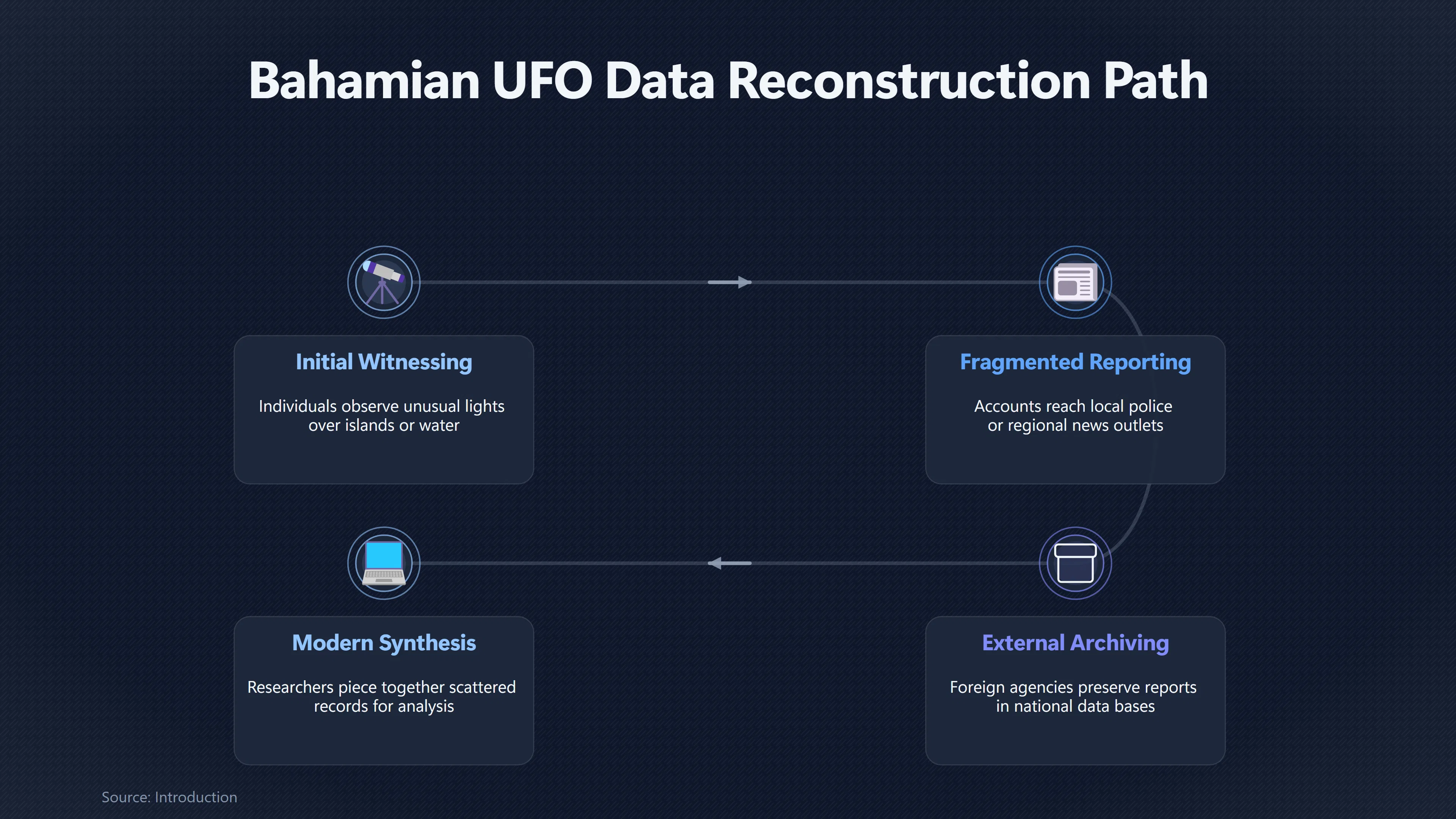
Anyone looking for an official national archive of UFO reports in The Bahamas quickly encounters the same problem: there is no known public, centralised Bahamian repository comparable to the United States’ former Project Blue Book or the United Kingdom’s released Ministry of Defence UFO files. Instead, the country’s UFO history has to be reconstructed from scattered witness reports, foreign archives, civilian reporting databases, newspaper coverage and later retellings. That missing official record is one of the defining features of Bahamian UFO research. It explains why many stories remain unresolved—not necessarily because they are extraordinary, but because the original documentation either was never created, was never preserved in a public archive, or cannot now be located.
For researchers, the central question is therefore not simply whether unusual events occurred, but what evidence survives to evaluate them.
What official and civilian archives actually contain
The absence of a public Bahamian UFO archive does not mean there are no records at all. It means the surviving material is dispersed across multiple organisations with different purposes and standards.
The principal sources include:
- Foreign government archives, particularly declassified United States records.
- Civilian reporting organisations, where witnesses voluntarily submit accounts.
- Local and regional newspapers, which occasionally reported unusual aerial events.
- Later books, documentaries and internet discussions, which frequently recycle earlier claims without reproducing original documentation.
No publicly available evidence indicates that the Government of The Bahamas established a long-running national investigation programme dedicated to unidentified flying objects or unidentified anomalous phenomena (UAP). Nor is there a publicly searchable archive comparable to official collections maintained elsewhere. Searches of modern U.S. National Archives holdings relating to UFOs similarly reveal no substantial body of Bahamian government investigative files.[National Archives]archives.govNational ArchivesRecords Related to Unidentified Flying Objects (UFOs) and Unidentified Anomalous Phenomena (UAPs) at the National Archiv…
This means that even well-known Bahamian stories usually cannot be traced through a continuous documentary chain from initial report to official conclusion.
Why the official record is so fragmented
Several factors help explain why the historical record is incomplete.
First, The Bahamas has a relatively small population spread across numerous islands. A witness observing an unusual object often had no dedicated authority to contact beyond local police, airport personnel or the media. Even when reports reached officials, there is little evidence they were collected into a permanent national archive.
Second, many sightings occurred over water. Events witnessed from beaches, boats or aircraft frequently lacked multiple independent observers, radar records or recoverable physical evidence. Without those supporting data, later investigators have little to work with.
Third, much of the available material originated outside the country. American military researchers, civilian UFO organisations and later internet databases preserved some reports, but they generally relied upon voluntary submissions rather than official Bahamian investigations.
The result is an historical record with numerous isolated accounts but relatively few cases supported by original photographs, contemporaneous interviews, meteorological data or official investigative files.
What foreign archives contribute—and what they do not
Researchers often begin with United States records because of the country’s long-standing military presence in parts of the wider Caribbean and its historical UFO investigation programmes.
Project Blue Book
Project Blue Book investigated more than 12,000 UFO reports between 1952 and 1969 before concluding that it had found no evidence that investigated sightings represented extraterrestrial vehicles or posed a national security threat. Its complete records are now available through the U.S. National Archives.[National Archives]archives.govNational Archives Project BLUE BOOKNational ArchivesProject BLUE BOOK - Unidentified Flying Objects | National ArchivesJune 25, 2024…
However, Blue Book should not be mistaken for a comprehensive Caribbean archive.[archives.gov]archives.govProject BLUE BOOKProject BLUE BOOK
A search of publicly available Blue Book material does not reveal a substantial catalogue of Bahamian investigations comparable to those documented in parts of the continental United States. That absence does not prove that no reports originated from The Bahamas. Rather, it reflects how the programme operated:
- reports generally entered through U.S. military or governmental channels;
- investigations depended upon available personnel and documentation;
- many overseas observations never entered the system.
Consequently, the lack of Blue Book case files cannot be treated as evidence that unusual events never occurred in Bahamian airspace.
Modern U.S. archival collections
Recent National Archives initiatives have expanded access to historical UAP collections by consolidating records from multiple agencies. These collections improve transparency regarding U.S. investigations but do not fill the documentary gap for The Bahamas, because they primarily preserve American federal records rather than Bahamian governmental files.[National Archives]archives.govNational ArchivesRecords Related to Unidentified Flying Objects (UFOs) and Unidentified Anomalous Phenomena (UAPs) at the National Archiv…
Civilian databases fill gaps—but introduce new uncertainties
Because official documentation is sparse, civilian reporting databases have become disproportionately important.
Organisations such as the National UFO Reporting Center (NUFORC) accept reports directly from witnesses. These databases include entries attributed to Nassau and other Bahamian locations across different years.
Their value lies in preserving accounts that might otherwise disappear entirely.
Their limitations are equally important:
- reports are largely self-submitted;
- witness identities may remain anonymous;
- supporting evidence varies enormously;
- independent investigation is inconsistent;
- duplicate reports can appear across different databases.
A database entry therefore establishes that someone reported an event—not that the reported interpretation was correct.
For countries without central government archives, these voluntary collections become historical starting points rather than definitive evidence.

Why missing documentation leaves many cases unresolved
The phrase “unidentified” often creates the impression that investigators ruled out every ordinary explanation.
In reality, many Bahamian reports remain unresolved because critical information is missing.
Common gaps include:
- exact observation times;
- viewing direction;
- weather conditions;
- duration;
- angular size;
- witness interviews;
- photographs with original metadata;
- radar information;
- aviation records.
Without these details, investigators frequently cannot distinguish among possibilities such as:
- aircraft viewed under unusual lighting;
- satellites;
- meteors;
- atmospheric optical effects;
- military activity;
- genuine but unidentifiable observations.
An unresolved case therefore reflects incomplete evidence rather than proof of an extraordinary phenomenon.
The influence of AUTEC and restricted military activity
One reason Bahamian UFO stories continue to attract attention is the presence of the U.S. Navy’s Atlantic Undersea Test and Evaluation Center (AUTEC) near Andros Island.
Because AUTEC conducts sophisticated underwater and maritime testing within restricted operating areas, it naturally encourages speculation whenever unusual lights or aircraft are observed nearby.
Yet the existence of a classified or restricted military facility does not itself validate claims involving extraterrestrial craft.
The documentary problem is especially evident here. Many stories linking AUTEC with UFOs originate decades after the alleged events, often without contemporaneous reports, official documents or identifiable witnesses. As a result, separating folklore from verifiable history becomes extremely difficult.
How to judge Bahamian UFO reports without original files
The absence of a national archive makes source evaluation more important than in countries with extensive official records.
Useful questions include:
- Is there an original report? Contemporary documents carry greater weight than stories repeated decades later.
- Can the event be independently dated? Newspaper coverage, weather records and aviation information help establish chronology.
- Are multiple independent witnesses available? Separate accounts are generally more valuable than repeated retellings of one story.
- Has the report changed over time? Expanding narratives may indicate embellishment rather than new evidence.
- Were conventional explanations investigated? Aircraft movements, astronomical events and rocket launches should be considered before extraordinary conclusions.
- Can the claimed documents actually be located? Assertions about “classified files” should be distinguished from files that are publicly identifiable and verifiable.
These questions often provide more insight than attempting to classify the object itself.
What the missing record means for understanding Bahamian UFO history
The defining characteristic of the Bahamian UFO record is not an abundance of extraordinary cases but the scarcity of preserved documentation.
This has several consequences.
First, many incidents cannot now be conclusively explained because too little primary evidence survives.
Second, dramatic later narratives often receive more public attention than modest contemporary reports, creating an impression that the historical record is richer than it actually is.
Third, the country’s UFO history must be assembled from fragments spread across civilian databases, foreign archives and local media rather than a single authoritative collection.
For researchers, that makes The Bahamas an instructive example of how archival absence shapes public understanding. The country’s unresolved cases illustrate not only the challenge of identifying unusual aerial observations but also the equally important challenge of reconstructing history when no comprehensive official record was ever created or preserved.
Amazon book picks
Further Reading
Books and field guides related to Where Is the Bahamas UFO Record?. Use these as the next step if you want deeper reading beyond the article.

UFOs and Government: A Historical Inquiry
Covers the evolution of official UFO reporting and archives.

UFOs: Generals, Pilots, and Government Officials Go on the Re...
Provides context for evaluating historical international cases.
The Report on Unidentified Flying Objects
Directly relevant to Project Blue Book investigations.
eBay marketplace picks
Marketplace Samples
Live-tested eBay searches with available results related to this page.
Selected fromUFO poster oneBay.co.uk.


Current eBay listing
VINTAGE UFO FLYING SAUCERS COMIC ADVERTISING A2 POSTER PRINT
Current eBay listing
I Want To Believe UFO Poster Giclée Fine Art Heavyweight Print
Endnotes
1.
Source: archives.gov
Link:https://www.archives.gov/research/topics/uaps/rg-collections
Source snippet
National ArchivesRecords Related to Unidentified Flying Objects (UFOs) and Unidentified Anomalous Phenomena (UAPs) at the National Archiv...
2.
Source: archives.gov
Link:https://www.archives.gov/research/topics/uaps/textual-and-microfilm
Source snippet
Records Related to Unidentified Flying Objects (UFOs) and Unidentified Anomalous Phenomena (UAPs) at the National Archives: Textual and M...
3.
Source: archives.gov
Title: National Archives Project BLUE BOOK
Link:https://www.archives.gov/research/military/air-force/ufos
Source snippet
National ArchivesProject BLUE BOOK - Unidentified Flying Objects | National ArchivesJune 25, 2024...
Published: June 25, 2024
4.
Source: archives.gov
Link:https://www.archives.gov/news/articles/project-blue-book-50th-anniversary
5.
Source: archives.gov
Link:https://www.archives.gov/research/catalog/catalog-bulk-downloads/uap-bulk-download
Source snippet
Bulk Downloads for Records Related to Unidentified Anomalous Phenomena (UAPs) | National ArchivesApril 24, 2025 — BULK DOWNLOADS FOR RECO...
Published: April 24, 2025
6.
Source: archives.gov
Link:https://www.archives.gov/research/topics/uaps/rg-615
Source snippet
May 22, 2026 — RECORD GROUP 615: UNIDENTIFIED ANOMALOUS PHENOMENA RECORDS COLLECTION The National Archives “Unidentified Anomalous Phenom...
Published: May 22, 2026
7.
Source: archives.gov
Link:https://www.archives.gov/research/topics/uaps%3E
Source snippet
hivesApril 24, 2025 — RECORDS RELATED TO UNIDENTIFIED FLYING OBJECTS (UFOS) AND UNIDENTIFIED ANOMALOUS PHENOMENA (UAPS) AT THE NATIONAL A...
Published: April 24, 2025
8.
Source: archives.gov
Link:https://www.archives.gov/research/topics/uaps/photographs
9.
Source: archives.gov
Link:https://www.archives.gov/research/topics/uaps/faqs
10.
Source: nuforc.org
Title: NUFOR C Reports for Country Bahamas
Link:https://nuforc.org/subndx/?id=cBahamas
11.
Source: nuforc.org
Title: Data Bank | NUFORC
Link:https://nuforc.org/databank/
12.
Source: visit.archives.gov
Title: gov50 Years Ago: Government Stops Investigating UFOs | National Archives Museum
Link:https://visit.archives.gov/whats-on/explore-exhibits/50-years-ago-government-stops-investigating-ufos
13.
Source: prologue.blogs.archives.gov
Title: ufos natural explanations
Link:https://prologue.blogs.archives.gov/2018/04/16/ufos-natural-explanations/
14.
Source: archives.gov
Title: Do Records Show Proof of UFOs? | National Archives
Link:https://www.archives.gov/news/articles/do-records-show-proof-of-ufos
15.
Source: archives.gov
Title: Project BLUE BOOK
Link:https://www.archives.gov/foia/ufos.html
16.
Source: media.nationalarchives.gov.uk
Title: nationalarchives.gov.uk The Cold War and UFOs | The National Archives
Link:https://media.nationalarchives.gov.uk/index.php/cold-war-ufos/
17.
Source: media.nationalarchives.gov.uk
Link:https://media.nationalarchives.gov.uk/index.php/ufo-files-national-archives/
18.
Source: media.nationalarchives.gov.uk
Link:https://media.nationalarchives.gov.uk/index.php/the-truth-is-in-here-ufos-at-the-national-archives/
19.
Source: discovery.nationalarchives.gov.uk
Link:https://discovery.nationalarchives.gov.uk/details/r/C16460007
20.
Source: nationalarchives.gov.uk
Title: UF O reports
Link:https://www.nationalarchives.gov.uk/explore-the-collection/explore-by-time-period/postwar/ufo-reports/
21.
Source: nationalarchives.gov.uk
Link:https://www.nationalarchives.gov.uk/help-with-your-research/research-guides/ufos/
Additional References
22.
Source: youtube.com
Link:https://www.youtube.com/watch?v=ABAvPuhu9yE
Source snippet
Is The Blue Hole Hiding UFO Secrets? | Curse of the Bermuda Triangle Full Episode| Discovery Channel...
23.
Source: youtube.com
Link:https://www.youtube.com/watch?v=wL46firGrNI
Source snippet
Pilot Who Survived the Bermuda Triangle Breaks His Silence...
24.
Source: youtube.com
Title: UFO Hunters: US Navy Hides Area 51 Secrets (Season 2) | History
Link:https://www.youtube.com/watch?v=QTlkpbSmFDc
Source snippet
Underwater Area 51: Best Evidence Aliens Live Deep Under Our Oceans | Richard Dolan...
25.
Source: youtube.com
Title: Pilot Who Survived the Bermuda Triangle Breaks His Silence
Link:https://www.youtube.com/watch?v=ClhM1cKWoe8
Source snippet
What You Didn't Know About the Bermuda Triangle...
26.
Source: youtube.com
Title: What You Didn’t Know About the Bermuda Triangle
Link:https://www.youtube.com/watch?v=Fd5nxVgq7Mo