Within Namibia UFOs
Why Namibia's Coast Produces So Many UFO Reports
Open horizons, dark skies, aircraft, ships, meteors, and atmospheric trails make Namibia's coast unusually fertile ground for misidentification.
On this page
- Open horizons and misleading sea bound perspective
- Dark skies, meteors, satellites, and distant lights
- Population, transport, and newspaper reporting effects
Page outline Jump by section
Introduction
Namibia’s Atlantic coast is one of the most favourable places in southern Africa for seeing spectacular natural and human-made objects in the night sky. Ironically, the same conditions that attract astronomers and dark-sky tourists also make unusual aerial sights easier to misinterpret. Long, unobstructed horizons, exceptionally dark skies, sparse ground lighting, infrequent reference points and the visual effects produced by viewing bright objects over the ocean all contribute to reports of unidentified lights that can appear mysterious without necessarily representing unknown technology.[nasa.gov]nasa.govFlies to Africa to Study Climate Effects of Smoke on CloudsNASA Flies to Africa to Study Climate Effects of Smoke on Clouds - NASAAugust 24, 2016…

Within Namibia’s broader UFO history, many of the best-known coastal reports are more plausibly explained by familiar phenomena than by extraordinary ones. While some incidents remain insufficiently documented for a definitive identification, the available evidence consistently points towards meteors, atmospheric effects, satellites, high-altitude objects or ordinary aircraft viewed under unusual conditions rather than evidence of extraterrestrial craft.[The Namibian]namibian.com.naThe Namibian'UFO' has Walvis Bay buzzingThe NamibianOctober 12, 2009…
Open horizons create deceptive perspectives
The Namibian coast differs dramatically from inland areas. Around Walvis Bay, Swakopmund and the Skeleton Coast, observers often look across uninterrupted ocean or desert with almost no nearby landmarks. Without buildings, hills or trees to provide scale, estimating the height, speed and distance of a light becomes extremely difficult.
A meteor burning up high in the atmosphere may appear to skim just above the sea. Likewise, an aircraft approaching from hundreds of kilometres away can seem stationary before apparently accelerating as its viewing angle changes. Even experienced observers routinely underestimate the distance to bright lights seen close to the horizon because the human visual system relies heavily on foreground reference objects that simply do not exist in these landscapes.
Atmospheric refraction adds another complication. Light from objects near the horizon is bent as it passes through layers of air with different temperatures and densities. This alters the apparent position of celestial and artificial objects, making them appear higher, lower or slightly displaced from their true location.[NASA Science]science.nasa.govScience Chapter 6: ElectromagneticsNASA ScienceChapter 6: Electromagnetics - NASA Science…
Dark skies reveal more ordinary objects
Namibia is internationally recognised for exceptionally dark skies, making faint astronomical objects visible that would disappear in light-polluted regions. The result is that residents and visitors frequently notice phenomena that people elsewhere never see.[arXiv]arxiv.orgarXiv Dark sky tourism and sustainable development in NamibiaarXiv Dark sky tourism and sustainable development in Namibia
These include:
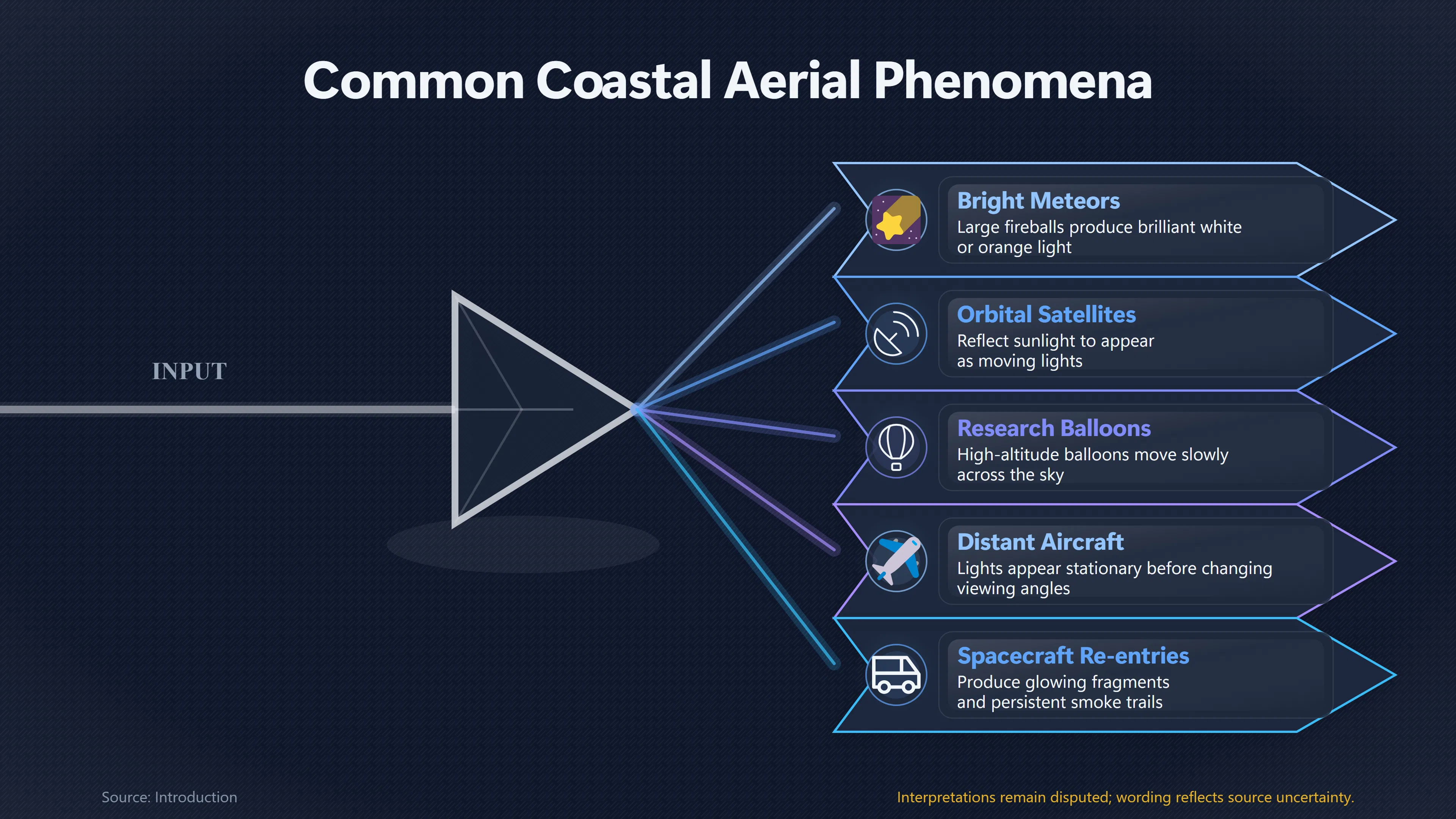
- exceptionally bright meteors and fireballs;
- satellites reflecting sunlight after sunset or before sunrise;
- spacecraft re-entries producing glowing fragments and persistent trails;
- the International Space Station and other large satellites;
- occasional high-altitude research balloons.
Rather than increasing the likelihood of genuinely anomalous objects, the darkness increases the number of visible ordinary objects whose appearance may be unfamiliar.
Fireballs are especially convincing over the coast
Several reported Namibian UFO events share characteristics commonly associated with bright meteors.
Large fireballs can:
- produce brilliant white, orange or red light;
- leave glowing smoke or ionisation trails;
- fragment dramatically;
- appear silent when distant;
- seem to descend into the ocean beyond the horizon.
Because the luminous portion of a meteor’s path occurs tens of kilometres above Earth, witnesses frequently believe it passed much lower than it actually did. A bright meteor disappearing beyond the horizon can therefore give the powerful impression that something has crashed into the sea.
The widely reported 2009 Walvis Bay incident illustrates this problem. Witnesses described a red object, a smoky trail and what appeared to be an impact near Pelican Point. Rescue teams searched offshore after reports of a possible aircraft crash, yet no wreckage or impact site was found. Defence officials rejected speculation about missile launches, while a meteor remained one of the most credible ordinary explanations consistent with the available evidence.[The Namibian]namibian.com.naThe Namibian'UFO' has Walvis Bay buzzingThe NamibianOctober 12, 2009…
Similarly, witnesses near Usakos in 2008 described a bright round object with a long tail travelling rapidly towards Swakopmund. The combination of extreme speed, brilliant light, a visible tail and lack of sustained manoeuvring is broadly compatible with a bright fireball rather than an aircraft or structured craft.[The Namibian]namibian.com.naThe Namibian'UFO' sightings at coastThe Namibian…
Satellites and high-altitude objects often appear unusual
Objects in low Earth orbit behave differently from aircraft. They produce no audible engine noise, can maintain constant speed for several minutes and may suddenly brighten or disappear as the geometry of reflected sunlight changes.
Modern satellite constellations have made such observations increasingly common worldwide. Satellite brightness depends on illumination angle, atmospheric conditions and the observer’s position, meaning an otherwise ordinary satellite may briefly become remarkably conspicuous.[arXiv]arxiv.orgPhotometric Characterization and Trajectory Accuracy of Starlink Satellites: Implications for Ground-Based Astronomical SurveysAugus…
Namibia has already provided a clear example of this mechanism. In 2021, a bright slow-moving object reported over northern Namibia was later matched to Google’s Project Loon high-altitude balloon using balloon-tracking data. The object initially generated public speculation but proved traceable through independent flight records, demonstrating how unfamiliar aerospace technology can produce convincing UFO reports.[The Namibian]namibian.com.naThe Namibian'UFO' sightings at coastThe Namibian…
Coastal weather can change how lights appear
The Namib coast possesses unusual meteorological conditions. Cold Atlantic waters, persistent marine cloud, coastal fog, dust and temperature inversions frequently affect visibility.
NASA selected the Walvis Bay region for atmospheric research because it provides one of the world’s most distinctive environments for studying aerosols, clouds and atmospheric interactions. These same conditions can influence how distant lights are perceived by observers.[NASA]nasa.govFlies to Africa to Study Climate Effects of Smoke on CloudsNASA Flies to Africa to Study Climate Effects of Smoke on Clouds - NASAAugust 24, 2016…
Although fog generally reduces visibility, clear nights following fog events can produce unusually transparent skies, allowing distant aircraft or celestial objects to remain visible much longer than observers expect. Dust layers and atmospheric scattering can also redden bright objects near the horizon, making ordinary white lights appear orange or deep red.
Why reports cluster around Walvis Bay and Swakopmund
The apparent concentration of UFO reports along Namibia’s coast probably reflects several overlapping factors rather than a unique concentration of unexplained phenomena.
These include:
- large numbers of people watching sunsets and night skies over unobstructed horizons;
- active ports with observers already monitoring the sea;
- aviation traffic serving Walvis Bay;
- excellent visibility on many nights;
- stronger regional newspaper coverage than in more remote parts of the country.
The 2009 Walvis Bay incident illustrates this reporting effect. Because port personnel, rescue services and numerous residents observed the same event, the story received substantial media attention. That does not necessarily indicate an extraordinary event; it reflects the presence of witnesses and institutions able to document what they saw.[The Namibian]namibian.com.naThe Namibian'UFO' has Walvis Bay buzzingThe NamibianOctober 12, 2009…
What remains genuinely uncertain
Some historic Namibian coastal reports cannot now be fully evaluated because the original documentation is incomplete. The frequently cited 1976 Walvis Bay “Space Monster” story survives mainly through later newspaper references, while original witness statements, photographs and observational data remain difficult to verify independently. That limits the strength of any explanation, whether sceptical or extraordinary.[The Namibian]namibian.com.naThe Namibian'UFO' sightings at coastThe Namibian…
The absence of definitive evidence should not be mistaken for evidence of unknown craft. Instead, it reflects the normal limitations of historical eyewitness reports lacking precise timing, calibrated photography, radar observations or systematic astronomical reconstruction.
The broader lesson from Namibia’s coast
Namibia’s Atlantic coastline demonstrates how an environment can naturally produce impressive UFO reports without requiring exotic explanations. Open horizons distort distance, exceptionally dark skies reveal objects invisible elsewhere, coastal atmospheric conditions alter appearance, and dramatic fireballs over the ocean can convincingly resemble descending craft.
For that reason, the coastal UFO record is best understood as a case study in observational conditions rather than evidence for extraordinary aerial technology. Some individual sightings remain unidentified because the available information is incomplete, but the overall pattern aligns far more closely with known astronomical, atmospheric and aerospace phenomena than with any confirmed anomalous objects.[com.na]namibian.com.naThe Namibian'UFO' has Walvis Bay buzzingThe NamibianOctober 12, 2009…
Amazon book picks
Further Reading
Books and field guides related to Why Namibia's Coast Produces So Many UFO Reports. Use these as the next step if you want deeper reading beyond the article.
NightWatch: A Practical Guide to Viewing the Universe
Helps identify celestial objects.
eBay marketplace picks
Marketplace Samples
Live-tested eBay searches with available results related to this page.
Selected fromastronomy poster oneBay.co.uk.
Endnotes
1.
Source: nasa.gov
Title: Flies to Africa to Study Climate Effects of Smoke on Clouds
Link:https://www.nasa.gov/news-release/nasa-flies-to-africa-to-study-climate-effects-of-smoke-on-clouds/
Source snippet
NASA Flies to Africa to Study Climate Effects of Smoke on Clouds - NASAAugust 24, 2016...
Published: August 24, 2016
2.
Source: arxiv.org
Title: arXiv Dark sky tourism and sustainable development in Namibia
Link:https://arxiv.org/abs/2102.07088
3.
Source: science.nasa.gov
Title: Science Chapter 6: Electromagnetics
Link:https://science.nasa.gov/learn/basics-of-space-flight/chapter6-6/
Source snippet
NASA ScienceChapter 6: Electromagnetics - NASA Science...
4.
Source: arxiv.org
Link:https://arxiv.org/abs/2208.03226
Source snippet
Photometric Characterization and Trajectory Accuracy of Starlink Satellites: Implications for Ground-Based Astronomical SurveysAugus...
5.
Source: arxiv.org
Link:https://arxiv.org/abs/2112.08310
6.
Source: science.nasa.gov
Title: the atmosphere after dark
Link:https://science.nasa.gov/sun/the-atmosphere-after-dark/
7.
Source: science.nasa.gov
Title: dust streams from the namibian coast 147010
Link:https://science.nasa.gov/earth/earth-observatory/dust-streams-from-the-namibian-coast-147010
8.
Source: nasa.gov
Title: Hydrogen Sulfide and Dust Plumes on Namibia’s Coast
Link:https://www.nasa.gov/image-article/hydrogen-sulfide-dust-plumes-namibias-coast/
9.
Source: science.nasa.gov
Title: hydrogen sulfide and dust plumes along the coast of namibia 45167
Link:https://science.nasa.gov/earth/earth-observatory/hydrogen-sulfide-and-dust-plumes-along-the-coast-of-namibia-45167/
10.
Source: naturalhazards.nasa.gov
Title: hydrogen sulfide and dust plumes along the coast of namibia
Link:https://www.naturalhazards.nasa.gov/images/45167/hydrogen-sulfide-and-dust-plumes-along-the-coast-of-namibia
11.
Source: science.nasa.gov
Title: dust and hydrogen sulfide along the namibian coast 44340
Link:https://science.nasa.gov/earth/earth-observatory/dust-and-hydrogen-sulfide-along-the-namibian-coast-44340/
12.
Source: science.nasa.gov
Title: hydrogen sulfide emissions along the namibian coast 43143
Link:https://science.nasa.gov/earth/earth-observatory/hydrogen-sulfide-emissions-along-the-namibian-coast-43143/
13.
Source: science.nasa.gov
Title: hydrogen sulfide eruption off namibia 18791
Link:https://science.nasa.gov/earth/earth-observatory/hydrogen-sulfide-eruption-off-namibia-18791/
14.
Source: namibian.com.na
Title: The Namibian’UFO’ has Walvis Bay buzzing
Link:https://www.namibian.com.na/ufo-has-walvis-bay-buzzing/
Source snippet
The NamibianOctober 12, 2009...
Published: October 12, 2009
15.
Source: namibian.com.na
Title: The Namibian’UFO’ sightings at coast
Link:https://www.namibian.com.na/ufo-sightings-at-coast/
Source snippet
The Namibian...
16.
Source: namibian.com.na
Title: The Namibian Namib skies a weather lab for Nasa
Link:https://www.namibian.com.na/namib-skies-a-weather-lab-for-nasa/
Source snippet
The NamibianNamib skies a weather lab for Nasa - The Namibian...
17.
Source: namibian.com.na
Title: Demystifying Starlink: Why Namibia Shouldn’t Fear the Stars
Link:https://www.namibian.com.na/demystifying-starlink-why-namibia-shouldnt-fear-the-stars/
18.
Source: namibian.com.na
Title: Radar finds Swakopmund marine oil spill
Link:https://www.namibian.com.na/radar-finds-swakopmund-marine-oil-spill/
Additional References
19.
Source: starlink.com
Title: * Starlink Can Bridge the Divide * The Impact of Starlink in Afr
Link:https://starlink.com/nl/support/article/6a4afd37-67be-8b12-3cf8-40b65eae3347
Source snippet
Starlink For Namibia - Starlink-helpcentrumMarch 23, 2026 — STARLINK FOR NAMIBIA * * * OP DEZE PAGINA * Starlink for Namibia * Licensing...
Published: March 23, 2026
20.
Source: skyandtelescope.org
Title: Satellite or Meteor?
Link:https://skyandtelescope.org/astronomy-news/satellite-or-meteor-dissecting-light-trails-in-your-sky-photos/
Source snippet
Dissecting Light Trails in Your Sky Photos - Sky & TelescopeApril 29, 2026 — SATELLITE OR METEOR? DISSECTING LIGHT TRAILS IN YOUR SKY PHO...
Published: April 29, 2026
21.
Source: youtube.com
Title: Why This UFO Sighting Was Different | Monstrum
Link:https://www.youtube.com/watch?v=dHGn_yPSgg0
Source snippet
UFOs: Investigating the Unknown MEGA Episode | National Geographic...
22.
Source: ocnamibia.org
Link:https://www.ocnamibia.org/faqs
23.
Source: namibweb.com
Link:https://www.namibweb.com/walvis-bay-lighthouse-namibia.htm
24.
Source: sciencedirect.com
Link:https://www.sciencedirect.com/science/article/abs/pii/S0169809511000615
25.
Source: pelicanpointlodge.com
Link:https://pelicanpointlodge.com/
26.
Source: darksky.org
Link:https://darksky.org/starlink-response/
27.
Source: youtube.com
Title: WHAT almost EVERYONE GETS WRONG about UFOs!
Link:https://www.youtube.com/watch?v=OtVnhQhaeks
Source snippet
Why This UFO Sighting Was Different | Monstrum...
28.
Source: youtube.com
Title: How To Recognize Space Rocks vs Satellites
Link:https://www.youtube.com/watch?v=y5bYAjCMcwM
Source snippet
WHAT almost EVERYONE GETS WRONG about UFOs...