What Do Canada's UFO Files Really Show?
Canada has a substantial and unusually accessible record of unidentified flying object reports, but that record supports a more restrained conclusion than popular mythology suggests.
Page outline Jump by section
Introduction
What makes Canada important is therefore not proof of alien spacecraft, but the scale and continuity of its documentary record. The country offers a revealing case study in how unusual sightings pass through witnesses, police, aviation authorities, the military, scientists, journalists and civilian research groups—and how fragmented reporting can turn an unresolved observation into an enduring national mystery.[gc.ca]science.gc.caManagement of Public Reporting of Unidentified Aerial Phenomena in CanadaManagement of Public Reporting of Unidentified Aerial Phenomena in Canada
How Canada investigated UFO reports
Canadian official interest began during the early Cold War, when unfamiliar objects in the sky could represent experimental aircraft, foreign surveillance, natural phenomena or errors in observation. Project Magnet, created within the Department of Transport in 1950 under radio engineer Wilbert Smith, attempted to examine UFO reports and investigate whether unusual propulsion might involve geomagnetism. Project Second Storey followed in 1952 as an interdepartmental committee involving scientific and defence personnel.
These projects are sometimes presented as evidence that the government accepted extraterrestrial craft as real. The historical record is less dramatic. Individual participants, particularly Smith, held speculative views, but the programmes were small, poorly resourced and short-lived. Canada did not establish a sustained laboratory capable of obtaining controlled measurements from alleged objects. A later historical study found that federal activity from 1950 to 1995 was largely passive and dispersed across departments that communicated inconsistently; the government accumulated nearly 4,500 distinct sighting files, but concluded that the material available did not readily support scientific investigation.[Batadora]batadora.trentu.caetd 776A History of Canada's UFO Investigation, 1950-1995 | Digital Collections…
After the early projects ended, reports continued to reach the Royal Canadian Mounted Police, the Department of National Defence, Transport Canada and the National Research Council. The NRC received public reports from 1967 until approximately the mid-1990s, but Canada then ceased to have a central federal body responsible for collecting and analysing civilian sightings. The history is therefore one of administrative continuity without investigative continuity: reports were filed, passed between agencies or assessed for immediate safety implications, but rarely subjected to a uniform national method.[Science.gc.ca]science.gc.caManagement of Public Reporting of Unidentified Aerial Phenomena in CanadaManagement of Public Reporting of Unidentified Aerial Phenomena in Canada
Library and Archives Canada now provides access to about 9,500 digitised federal documents accumulated between 1947 and the early 1980s. They include witness statements, correspondence, reporting forms, memoranda and departmental procedures. This is a valuable archive, but it is not a catalogue of validated anomalous craft. Dates and locations are missing from some records, approximately half are not tied to a specific sighting location, and filing practices differed among the agencies involved.[Canada]canada.cas UFOs: The search for the unknownCanada's UFOs: The search for the unknown - Canada.ca…
The incidents that shaped the Canadian story
Falcon Lake: strong documentation, disputed interpretation
On 20 May 1967, Stefan Michalak, a mechanic and amateur prospector, said that he encountered two luminous objects near Falcon Lake in Manitoba’s Whiteshell Provincial Park. According to his account, one object landed nearby. He approached it, heard voices, observed an opening and was struck by hot gas or exhaust as the object departed. He later suffered nausea and burns on his torso.
Falcon Lake stands apart from most Canadian reports because it generated medical attention, police interviews, government correspondence, site visits and laboratory testing. Authorities examined Michalak’s clothing, soil and pieces of metal that he associated with the location. Some material showed radioactivity, while investigators also documented marks on the ground and injuries to the witness. Library and Archives Canada describes the case as one surrounded by extensive official records rather than a story reconstructed solely from later recollections.[Canada]canada.caUFOs at LAC: The Falcon Lake incident, part 1UFOs at LAC: The Falcon Lake incident, part 1 - Canada.ca…
Documentation, however, is not the same as confirmation. The government investigation did not establish that a spacecraft had landed. Questions arose over changes in Michalak’s account, delays in locating the site, his handling of alleged evidence and the possibility that radioactive material had been contaminated or deliberately introduced. Medical interpretations of the burns also varied. The case is reasonably classified as unresolved or contested: something happened to Michalak, and the investigation was genuine, but the evidence does not securely establish what produced his injuries or whether an extraordinary vehicle was involved.[Wikipedia]WikipediaFalcon Lake IncidentFalcon Lake Incident
Falcon Lake illustrates an important distinction. A “best-documented” case may simply be one with a thick paper trail. It does not necessarily possess calibrated sensor data, independent imagery, a securely controlled physical sample or several witnesses observing the same event from different positions.
Shag Harbour: a real search for an unidentified object
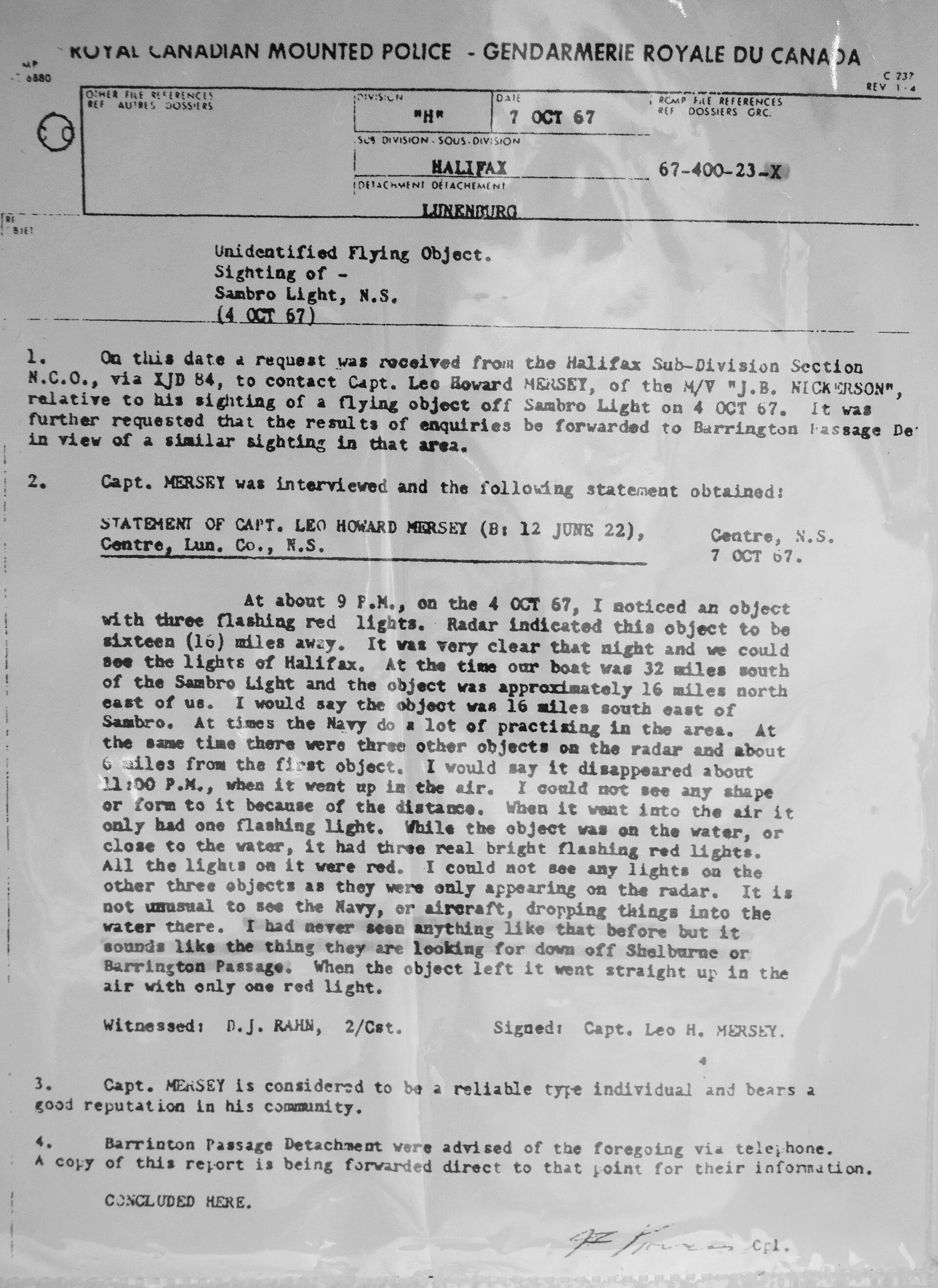
On the evening of 4 October 1967, witnesses near Shag Harbour, Nova Scotia, reported lights descending towards or into the sea. Believing that an aircraft might have crashed, residents alerted the authorities. The RCMP, Canadian Coast Guard and Canadian Forces participated in search activity, but no aircraft, occupants or identifiable wreckage were found. The event was recorded in government files as a UFO incident because the reported object was not identified—not because officials had determined that it was extraterrestrial.[LAC Research]recherche-research.bac-lac.gc.caOpen source on gc.ca.
The case remains memorable because multiple people reported an apparent descent, public agencies responded and a maritime search genuinely occurred. Those facts distinguish it from a solitary light reported long after the event. They do not, however, demonstrate that an object survived underwater or travelled to another naval location. Later stories about divers finding craft on the seabed rely heavily on retrospective testimony and have sometimes conflated Shag Harbour with an unrelated naval exercise several years earlier. The documented core is narrower: witnesses saw unusual lights, authorities treated the report as a possible aviation emergency, and the search did not identify a cause.[Popular Mechanics]popularmechanics.comStyles' interviews with aging military personnel revealed stories of active, occupied crafts resting on the seabed, although many witness…
Shag Harbour is therefore neither fully explained nor evidentially equivalent to a recovered vehicle. Its enduring value lies in the intersection of civilian testimony and confirmed institutional response.
Other reports and the problem of selection
Canada’s archives contain many less celebrated cases involving lights, discs, formations, objects near aircraft and unusual radar or visual observations. Few have become cultural landmarks because most lack the combination of compelling narrative, named witnesses, official attention and physical claims found at Falcon Lake or Shag Harbour.
This creates selection bias. Famous cases are not necessarily representative of the wider population of reports; they are the cases most suited to retelling. A national assessment must also consider mundane observations that were quickly identified and ambiguous reports containing too little detail to investigate. Otherwise, the record becomes distorted towards its most dramatic stories.
Why sightings vary across Canada
Civilian reporting data indicate that hundreds of Canadian sightings are submitted each year, but exact totals are uncertain. The federal Sky Canada report estimated roughly 600 to 1,000 annual reports, while stressing that no central collection system exists and that duplicate submissions may appear in separate databases. The long-running Canadian UFO Survey recorded 570 reports for 2023 and more than 24,000 since 1989, but it did not have access to all reports collected by other organisations.[Science.gc.ca]science.gc.caManagement of Public Reporting of Unidentified Aerial Phenomena in CanadaManagement of Public Reporting of Unidentified Aerial Phenomena in Canada
Raw provincial totals should not be treated as a map of anomalous activity. Ontario, Quebec, British Columbia and Alberta often produce many reports partly because they contain large populations, major urban areas, busy flight paths and active reporting communities. A province with more observers, better internet access or greater publicity will generally produce more submissions than a sparsely populated region.
Regional conditions also affect what people see:
- Northern and remote Canada has dark skies, long viewing distances, auroral activity, sparse reference points and substantial military and civil surveillance interests. These conditions can make ordinary lights difficult to judge for distance, altitude and speed.
- The Atlantic provinces combine coastal weather, shipping, fishing activity, aircraft routes and broad ocean horizons. Shag Harbour shows how a sighting can initially be interpreted as a maritime or aviation emergency.
- The Prairies offer long sightlines and clear horizons, making distant aircraft, planets and astronomical events conspicuous. Falcon Lake also gave Manitoba a lasting role in Canadian UFO culture and civilian research.
- Southern Ontario, Quebec and British Columbia contain dense air traffic, satellites, drones and large populations. High report totals may reflect exposure and opportunity rather than a higher rate of genuinely unusual phenomena.
Reporting rates can also rise following news coverage, meteor activity, satellite launches or widely visible objects. Public attention changes the threshold at which witnesses interpret and submit observations. Regional comparison is therefore useful only when adjusted for population, observer distribution, weather, aviation density, reporting access and duplicate records.
What official aviation reports actually mean
Transport Canada records aviation occurrences through the Civil Aviation Daily Occurrence Reporting System, known as CADORS. Reports may originate from air traffic services, pilots, airports, operators and other parties. Some entries describe unidentified lights or objects seen near aircraft, making CADORS one of the most useful public sources for examining operationally relevant Canadian sightings.
A CADORS entry is not a completed investigation. Transport Canada warns that the information is preliminary, unsubstantiated and subject to change. The term “UFO” within the system may refer to drones, balloons, meteors, birds, weather phenomena or other objects that were simply unidentified at the time of reporting. Its significance is primarily aviation safety: did the observation create a collision risk, disrupt a flight or indicate unauthorised activity?[Transport Canada]tc.canada.caTransport Canada4. High Altitude Object IncidentsTransport Canada4. High Altitude Object Incidents
This distinction became particularly visible during the high-altitude object incidents of February 2023. A US fighter, operating through the joint North American Aerospace Defense Command, shot down an unidentified object over Yukon after it crossed into Canadian airspace. The event was real, involved national-security decision-making and initially lacked a confirmed identification. That did not make the object alien. It occurred amid heightened detection of balloons and other high-altitude objects, and recovery difficulties prevented a definitive public identification.[AP News]apnews.comAP News Trudeau: US fighter shot down object over northern CanadaAP News Trudeau: US fighter shot down object over northern Canada
Official attention should consequently be read as evidence that an observation mattered to safety or security, not as endorsement of an exotic explanation.
Claims, explanations and evidence in Canada’s UFO record
A useful way to read Canada’s UFO record is to separate three different levels of evidence.
Confirmed events are those for which the basic occurrence is securely established. A witness made a report; a pilot notified air traffic control; police attended a location; a search was launched; or a document was filed. The 1967 Shag Harbour search and the 2023 Yukon interception are confirmed events in this limited sense. What remains uncertain is the identity of the reported object.
Contested cases contain but permit competing interpretations. Falcon Lake belongs here. Michalak’s injuries, official interviews and government interest are documented, yet the origin of the injuries and alleged physical traces remains disputed. Shag Harbour is similarly contested because the official response is clear while the cause of the original lights is not.
Debunked or conventionally explained reports are those linked to aircraft, satellites, celestial objects, meteors, balloons, drones, lens effects or misperception. Others remain unidentified only because their files are too incomplete for resolution. The word “unexplained” should therefore not be read as “shown to defy conventional explanation”. It often means that no conclusion can be reached from the information available.[gc.ca]science.gc.caManagement of Public Reporting of Unidentified Aerial Phenomena in CanadaManagement of Public Reporting of Unidentified Aerial Phenomena in Canada
A strong case would require contemporaneous records from independent witnesses, precise time and location data, original images with metadata, radar or other sensor information, known environmental conditions and physical evidence preserved through a documented chain of custody. Few historical Canadian cases meet that standard. Most were assembled from human testimony and administrative correspondence after a fleeting event.
Civilian research filled the federal gap
Since the end of centralised NRC collection, much of Canada’s longitudinal reporting record has been maintained by civilian groups. The Canadian UFO Survey, produced by Manitoba-based researchers, has compiled annual reports since 1989 using submissions from individuals, research organisations and government sources. Its longevity makes it valuable for tracking reported shapes, durations, locations and case classifications over time.[Science.gc.ca]science.gc.caManagement of Public Reporting of Unidentified Aerial Phenomena in CanadaManagement of Public Reporting of Unidentified Aerial Phenomena in Canada
The survey’s limitations are equally important. Participation is voluntary, coverage changes when organisations stop sharing data, and the underlying reports are not a random sample of the Canadian population. Different investigators may also classify cases differently. Patterns in the database describe reports received, not necessarily the true distribution of unusual objects.
Civilian investigators nevertheless preserve material that might otherwise disappear and often perform the practical work of comparing observations with astronomy, aviation and satellite data. Their databases are best treated as research leads rather than definitive proof. The strongest analyses openly distinguish identified cases, insufficient-information cases and those that remain unexplained after reasonable checking.
Sky Canada and the modern reporting gap
The Office of the Chief Science Advisor launched the Sky Canada Project in 2022 to examine how public UAP reports are managed. It did not investigate individual sightings or attempt to prove or disprove extraterrestrial visitation. Instead, it consulted federal departments, scientific experts and civilian organisations, reviewed historical practice and assessed weaknesses in the national reporting landscape.[Science.gc.ca]science.gc.casky canada projectsky canada project
Its final report identified three central problems: Canada lacks a standardised reporting and follow-up system; the public has no accessible official platform where observations can be submitted and explanations reviewed; and sightings are rarely analysed unless they present an immediate safety or security concern. Fragmentation makes data comparison difficult and leaves witnesses with little feedback, creating space for misinformation and conspiracy theories.[Science.gc.ca]science.gc.caManagement of Public Reporting of Unidentified Aerial Phenomena in CanadaManagement of Public Reporting of Unidentified Aerial Phenomena in Canada
The report offered fourteen recommendations, including better federal coordination, common data standards, open access to appropriate records, public educational material and a dedicated service capable of receiving testimony, analysing cases and publishing conclusions. The emphasis was not on creating an alien-hunting agency, but on treating unusual observations as a combined problem of aviation safety, public communication, citizen science and data quality.[Science.gc.ca]science.gc.caManagement of Public Reporting of Unidentified Aerial Phenomena in CanadaManagement of Public Reporting of Unidentified Aerial Phenomena in Canada
What Canada’s record really shows
Canada’s UFO history contains genuine mysteries, but its clearest lesson is institutional rather than extraterrestrial. The country repeatedly collected reports without maintaining a stable system for investigating them. That produced a large archive containing a mixture of explained events, incomplete observations, culturally amplified stories and a small residue of cases that remain unresolved.
Falcon Lake and Shag Harbour deserve attention because official agencies documented and responded to them. They should not be described as confirmed encounters with non-human craft. Their unresolved status reflects gaps, contradictions and limited evidence as much as extraordinary behaviour.
The most productive future approach is neither automatic dismissal nor belief by default. It is consistent reporting, rapid preservation of original data, comparison with aviation and astronomical records, transparent publication of findings and clear separation between “not yet identified” and “apparently inexplicable”. Canada’s historical files show that unidentified phenomena are real as reporting events. Whether any represent technology outside established human or natural explanations remains unproven.
Amazon book picks
Further Reading
Books and field guides related to What Do Canada's UFO Files Really Show?. Use these as the next step if you want deeper reading beyond the article.

UFOs: Generals, Pilots, and Government Officials Go on the Re...
Strong companion to Canada's extensive official record.
The Report on Unidentified Flying Objects
Useful comparison with Canadian official programs.
eBay marketplace picks
Marketplace Samples
Live-tested eBay searches with available results related to this page.
Selected fromUFO poster oneBay.co.uk.

Current eBay listing
VINTAGE UFO FLYING SAUCERS COMIC ADVERTISING A2 POSTER PRINT


Current eBay listing
I Want To Believe UFO Poster Giclée Fine Art Heavyweight Print
Endnotes
1.
Source: science.gc.ca
Title: Management of Public Reporting of Unidentified Aerial Phenomena in Canada
Link:https://science.gc.ca/site/science/en/office-chief-science-advisor/sky-canada-project/management-public-reporting-unidentified-aerial-phenomena-canada
2.
Source: canada.ca
Title: ‘s UFOs: The search for the unknown
Link:https://www.canada.ca/en/library-archives/collection/research-help/science-technology/ufos.html
Source snippet
Canada's UFOs: The search for the unknown - Canada.ca...
3.
Source: science.gc.ca
Title: chief science advisor annual report 2022 23
Link:https://science.gc.ca/site/science/en/office-chief-science-advisor/annual-reports/chief-science-advisor-annual-report
Source snippet
Chief Science Advisor Annual Report 2022-2316 Apr 2024 — OCSA launched the Sky Canada project in the fall of 2022 to study how UAP report...
4.
Source: canada.ca
Title: UFOs at LAC: The Falcon Lake incident, part 1
Link:https://www.canada.ca/en/library-archives/collection/engage-learn/podcasts/discover/episode-053.html
Source snippet
UFOs at LAC: The Falcon Lake incident, part 1 - Canada.ca...
5.
Source: canada.ca
Title: episode 054
Link:https://www.canada.ca/en/library-archives/collection/engage-learn/podcasts/discover/episode-054.html
Source snippet
UFOs at LAC: The Falcon Lake incident, part 229 May 2019 — Stefan Michalak's son Stan and researchers Chris Rutkowski and Palmiro C...
Published: May 2019
6.
Source: Wikipedia
Title: Falcon Lake Incident
Link:https://en.wikipedia.org/wiki/Falcon_Lake_Incident
7.
Source: Wikipedia
Title: Shag Harbour UFO incident
Link:https://en.wikipedia.org/wiki/Shag_Harbour_UFO_incident
8.
Source: tc.canada.ca
Title: Transport Canada4. High Altitude Object Incidents
Link:https://tc.canada.ca/en/binder/4-high-altitude-object-incidents
9.
Source: search.open.canada.ca
Link:https://search.open.canada.ca/qpnotes/record/tc%2CTC-2022-QP-00005
10.
Source: science.gc.ca
Title: sky canada project
Link:https://science.gc.ca/site/science/en/office-chief-science-advisor/sky-canada-project
11.
Source: science.gc.ca
Title: preview sky canada report ocsa
Link:https://science.gc.ca/site/science/en/office-chief-science-advisor/sky-canada-project/preview-sky-canada-report-ocsa
12.
Source: science.gc.ca
Title: annual report chief science advisor 2024 2025
13.
Source: Wikipedia
Title: Project Magnet (Canada)
Link:https://en.wikipedia.org/wiki/Project_Magnet_%28Canada%29
14.
Source: Wikipedia
Title: UFO sightings in Canada
Link:https://en.wikipedia.org/wiki/UFO_sightings_in_Canada
15.
Source: Wikipedia
Title: Project Second Storey
Link:https://en.wikipedia.org/wiki/Project_Second_Storey
16.
Source: tc.canada.ca
Title: civil aviation daily occurrence reporting system cadors
Link:https://tc.canada.ca/en/aviation/publications/aviation-safety-letter/issue-2-2021/civil-aviation-daily-occurrence-reporting-system-cadors
17.
Source: ised-isde.canada.ca
Title: preview sky canada report ocsa
Link:https://ised-isde.canada.ca/site/science/en/office-chief-science-advisor/sky-canada-project/preview-sky-canada-report-ocsa
18.
Source: ised-isde.canada.ca
Link:https://ised-isde.canada.ca/site/science/en/office-chief-science-advisor/sky-canada-project/management-public-reporting-unidentified-aerial-phenomena-canada
19.
Source: canada.ca
Title: episode 064
Link:https://www.canada.ca/en/library-archives/collection/engage-learn/podcasts/discover/episode-064.html
20.
Source: ised-isde.canada.ca
Link:https://ised-isde.canada.ca/site/science/sites/default/files/documents/report-sky-canada-project.pdf
21.
Source: ised-isde.canada.ca
Link:https://ised-isde.canada.ca/site/science/sites/default/files/documents/rapport-sky-canada.pdf
22.
Source: science.gc.ca
Title: questions and answers about sky canada project
Link:https://science.gc.ca/site/science/en/office-chief-science-advisor/sky-canada-project/questions-and-answers-about-sky-canada-project
23.
Source: science.gc.ca
Title: sky canada report
Link:https://science.gc.ca/site/science/sites/default/files/documents/sky-canada-report.pdf
24.
Source: batadora.trentu.ca
Title: etd 776
Link:https://batadora.trentu.ca/objects/etd-776
Source snippet
A History of Canada's UFO Investigation, 1950-1995 | Digital Collections...
25.
Source: recherche-research.bac-lac.gc.ca
Link:https://recherche-research.bac-lac.gc.ca/fra/publique/liste/43130
26.
Source: popularmechanics.com
Link:https://www.popularmechanics.com/science/a68066027/ufo-crash-defcon-mystery-underwater/
Source snippet
Styles' interviews with aging military personnel revealed stories of active, occupied crafts resting on the seabed, although many witness...
27.
Source: apnews.com
Title: AP News Trudeau: US fighter shot down object over northern Canada
Link:https://apnews.com/article/93071207f2bbdf93b591d6b40ce1cb5a
28.
Source: digitalcollections.trentu.ca
Title: A History of Canada s UFO Investigation 1950 1995
Link:https://digitalcollections.trentu.ca/_flysystem/fedora/2022-04/A_History_of_Canada_s_UFO_Investigation_1950_1995.pdf
29.
Source: books.google.com
Title: Canada s UFO Secrets
Link:https://books.google.com/books/about/Canada_s_UFO_Secrets.html?id=Df-KEQAAQBAJ
30.
Source: revenantjournal.com
Link:https://www.revenantjournal.com/contents/search-for-the-unknown-canadas-ufo-files-and-the-rise-of-conspiracy-theory-by-matthew-hayes-montreal-quebec-mcgill-queens-university-press-2022-isbn-978-0228010746-210pp-34/
31.
Source: drdavidclarke.co.uk
Title: canadas ufo files book review
Link:https://drdavidclarke.co.uk/2022/08/04/canadas-ufo-files-book-review/
32.
Source: recherche-research.bac-lac.gc.ca
Link:https://recherche-research.bac-lac.gc.ca/eng/public/list/43130
33.
Source: globalnews.ca
Link:https://globalnews.ca/news/3761270/canadas-best-documented-ufo-sighting-still-intrigues-50-years-on/
34.
Source: youtube.com
Link:https://www.youtube.com/watch?v=rtPuEN6wAa4
35.
Source: canadaufohistory.com
Link:https://www.canadaufohistory.com/1967
36.
Source: canadaufohistory.com
Title: Project Magnet
Link:https://www.canadaufohistory.com/1947-1954/project-magnet
37.
Source: sacred-texts.com
Link:https://sacred-texts.com/ufo/canada.htm
38.
Source: aa.com.tr
Title: canada ufo sightings include reports from airline crews
Link:https://www.aa.com.tr/en/americas/canada-ufo-sightings-include-reports-from-airline-crews/3120051
39.
Source: activehistory.ca
Title: Canada, UFOs, and Wishful Thinking
Link:https://activehistory.ca/blog/2017/02/10/canada-ufos-and-wishful-thinking-2/
Additional References
40.
Source: arcs-atom.uottawa.ca
Title: Project Second Story/Storey
Link:https://arcs-atom.uottawa.ca/index.php/project-second-story
Source snippet
University of OttawaProject Second Storey was a committee within the Canadian government,… Read more and established on April 22, 1952 to...
Published: April 22, 1952
41.
Source: youtube.com
Title: UFOs over Canada? Government urged to start tracking | The Current
Link:https://www.youtube.com/watch?v=hrxW9jrbtmM
Source snippet
The Shag Harbour UFO Incident - Full Documentary...
42.
Source: youtube.com
Title: What the Canadian government knows about UFOs
Link:https://www.youtube.com/watch?v=ntyUWhbtcqM
Source snippet
the Sky Canada Project Report Preview (with Chris Rutkowski)...
43.
Source: facebook.com
Link:https://www.facebook.com/CanadianCoastGuard/posts/did-you-know-the-coast-guard-once-searched-for-a-possible-ufo-in-1967-residents-/1138213549994735/
44.
Source: canadianuforeport.ca
Link:https://canadianuforeport.ca/
45.
Source: themorbidlibrary.com
Link:https://themorbidlibrary.com/the-extraterrestrial-falcon-lake-incident/
46.
Source: reviewcanada.ca
Link:https://reviewcanada.ca/magazine/2022/07/eyes-like-saucers/
47.
Source: publications.gc.ca
Link:https://publications.gc.ca/site/eng/9.954480/publication.html
48.
Source: reddit.com
Link:https://www.reddit.com/r/UFOs/comments/1ft1s2g/project_magnet/
49.
Source: bst.gc.ca
Link:https://www.bst.gc.ca/eng/incidents-occurrence/aviation/index.html