Within Russian UFO Files
Why Did the Soviet Union Investigate UFOs?
Soviet UFO projects were built to identify threats, launches and atmospheric anomalies, not to recover alien spacecraft.
On this page
- From Petrozavodsk to organised state research
- What the civilian and military programmes examined
- What investigators concluded about alien contact
Page outline Jump by section
Introduction
The Soviet Union did run official programmes to investigate unidentified aerial phenomena, but their primary mission was not to search for alien spacecraft. Instead, the programmes were created to determine whether unusual reports represented military threats, secret weapons tests, missile launches, atmospheric phenomena, equipment malfunctions or other events affecting national security. Although classified, these investigations were largely scientific and defence-oriented rather than extraterrestrial in purpose. After more than a decade of systematic data collection, the investigators themselves reported that they had found no verified evidence of alien landings, recovered spacecraft or contact with non-human intelligence.[Skeptical Inquirer]skepticalinquirer.orgSkeptical InquirerA History of State UFO Research in the USSR | Skeptical InquirerDecember 1, 2000…
Understanding these programmes is essential for interpreting Russia’s UFO history. They demonstrate that Soviet authorities treated unexplained aerial reports as an intelligence and scientific problem, not as confirmation of extraterrestrial visitation.
From Petrozavodsk to organised state research
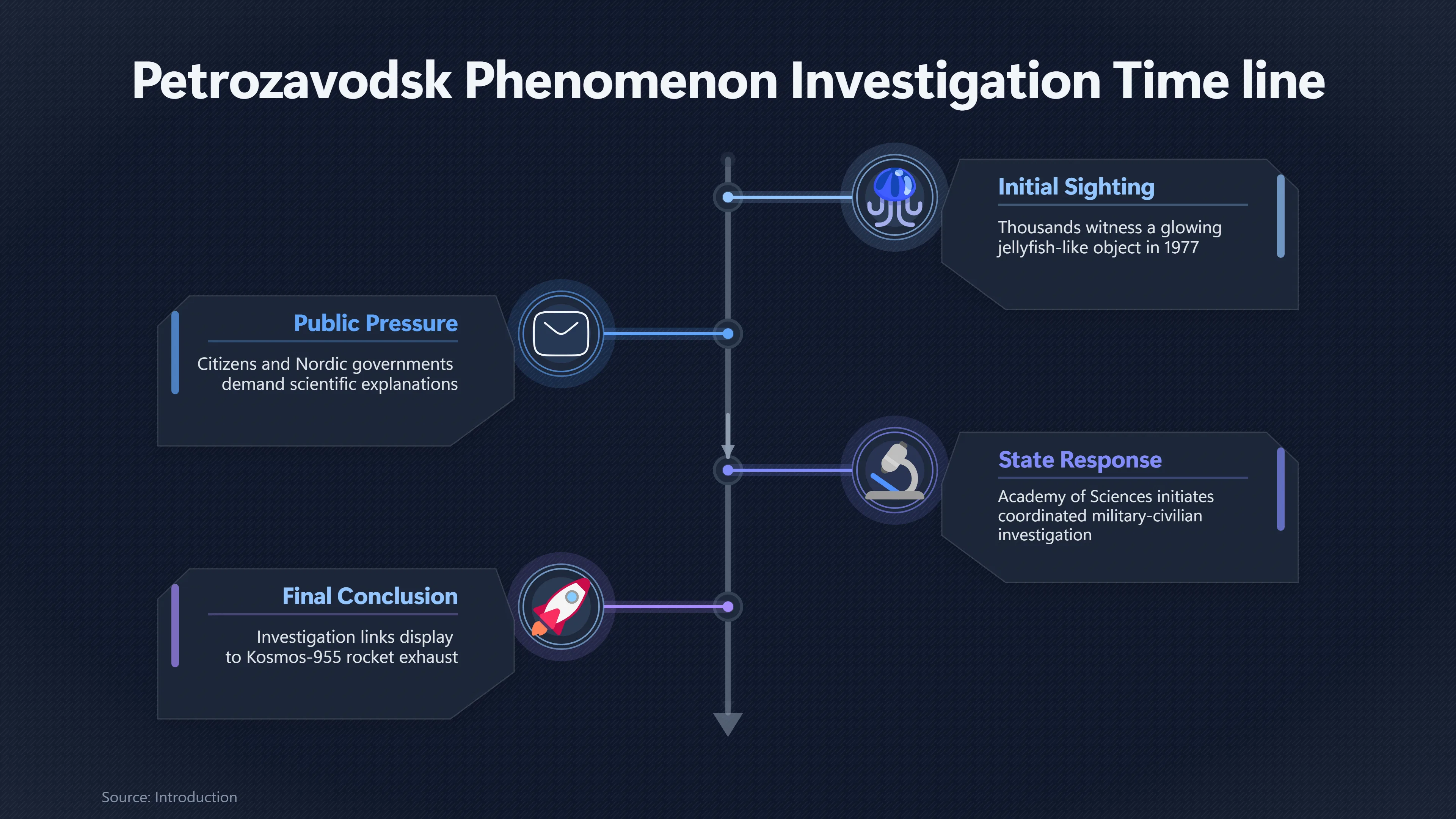
The catalyst for organised Soviet investigation was the Petrozavodsk phenomenon of 20 September 1977. Thousands of witnesses across north-western parts of the Soviet Union and neighbouring Finland reported an extraordinary luminous object resembling a glowing jellyfish that appeared to radiate beams towards the ground.
The incident generated unusual political pressure. Local authorities requested scientific explanations, Soviet citizens flooded newspapers and research institutions with letters, and several Nordic governments sought clarification over whether the event resulted from Soviet military activity. The Academy of Sciences acknowledged that it could neither ignore nor immediately explain the reports, prompting calls for a coordinated investigation involving both civilian scientists and the military.[Skeptical Inquirer]skepticalinquirer.orgSkeptical InquirerA History of State UFO Research in the USSR | Skeptical InquirerDecember 1, 2000…
The resulting state response was notable because it treated unidentified aerial reports as an issue requiring formal government coordination rather than isolated scientific curiosity.
Why the Soviet Union created official UFO programmes
Contrary to many later conspiracy theories, the Soviet government did not establish these projects to recover alien technology. Official documents and later accounts from programme participants indicate several practical objectives:
- identify previously unknown atmospheric or geophysical phenomena;
- distinguish civilian observations from missile launches, satellite operations and military exercises;
- determine whether reports indicated foreign reconnaissance or advanced weapons;
- study possible effects on military personnel and equipment;
- improve reporting procedures for unusual aerial events.
The programmes deliberately avoided language implying extraterrestrial visitors. Official terminology referred instead to “anomalous atmospheric and space phenomena”, reflecting an effort to frame investigations within defence and physical science rather than speculative ufology.[Skeptical Inquirer]skepticalinquirer.orgSkeptical InquirerA History of State UFO Research in the USSR | Skeptical InquirerDecember 1, 2000…
This distinction is important because many later publications incorrectly portrayed the Soviet projects as equivalents of alleged secret alien-recovery programmes. The surviving documentary record does not support that interpretation.
What the civilian and military programmes actually examined
The Soviet investigation developed into two coordinated but distinct branches.
Setka-AN: the scientific programme
The civilian branch, generally known as Setka-AN, operated under the Academy of Sciences. Its purpose was to investigate the physical nature of unexplained observations.
Researchers examined:
- atmospheric optics;
- ionospheric effects;
- astronomical objects;
- meteorological conditions;
- satellite and rocket exhaust phenomena;
- observational errors and witness reports.
The Academy appointed institutes with expertise in terrestrial magnetism, the ionosphere and radio-wave propagation to lead much of the work, reflecting the expectation that many reports would ultimately have natural or technological explanations rather than extraordinary origins.[UAP Codex]uapcodex.orgsetka ussr 1978UAP CodexPrograma SETKA · investigación estatal soviética de UAP (1978–1991) · UAP Codex…
Setka-MO: the military programme
The parallel military programme, Setka-MO, belonged to the Ministry of Defence.
Its priorities differed significantly from the civilian branch. Investigators focused on whether unexplained aerial phenomena:
- interfered with radar;
- affected weapons systems;
- influenced military personnel;
- represented foreign intelligence activity;
- indicated previously unknown aerospace technology.
Because Soviet air-defence networks monitored enormous areas of national airspace during the Cold War, unexplained observations were considered operational matters even if they ultimately proved mundane. Reports from military personnel therefore received systematic attention.
The two branches exchanged information but maintained separate reporting structures appropriate to their scientific and defence responsibilities.[UAP Codex]uapcodex.orgsetka ussr 1978UAP CodexPrograma SETKA · investigación estatal soviética de UAP (1978–1991) · UAP Codex…

What investigators discovered
The programmes accumulated a substantial archive of reports over approximately thirteen years.
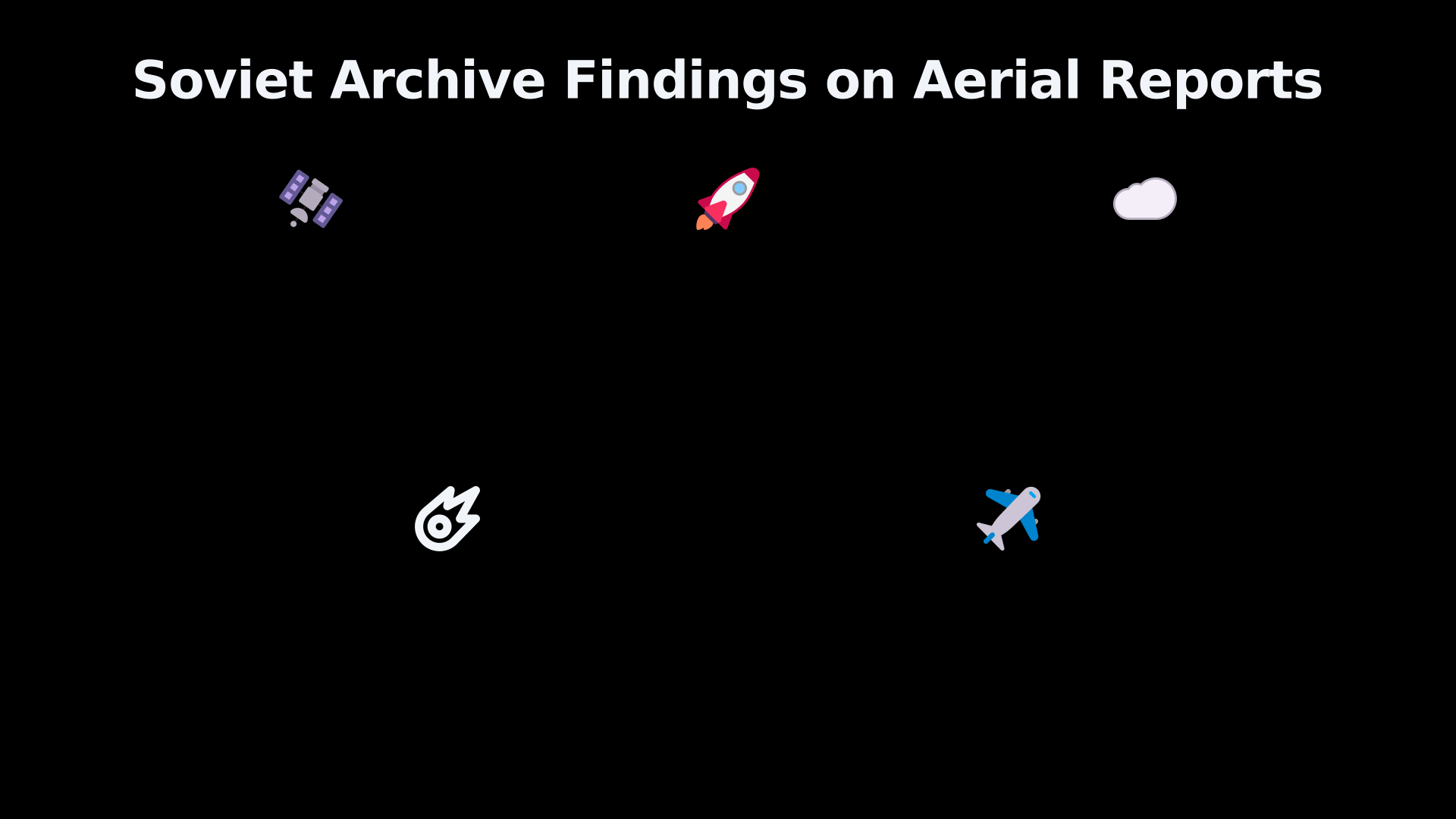
According to Boris Sokolov and Yuli Platov—participants in the Academy of Sciences’ investigation—the overwhelming majority of cases eventually received conventional explanations. These included:
- missile launches;
- satellite launches and orbital manoeuvres;
- aircraft;
- balloons;
- meteors;
- unusual cloud formations;
- atmospheric optical effects;
- rare natural phenomena.
The investigators emphasised that systematic examination produced no confirmed evidence of extraterrestrial landings or recovered alien technology despite access to reports from both military and civilian sources across the Soviet Union.[Skeptical Inquirer]skepticalinquirer.orgSkeptical InquirerA History of State UFO Research in the USSR | Skeptical InquirerDecember 1, 2000…
Rather than reinforcing extraordinary claims, the programmes strengthened Soviet understanding of how frequently routine aerospace activity could appear mysterious to observers.
The Petrozavodsk case illustrates the programmes’ real purpose
The Petrozavodsk incident itself demonstrates how the Soviet approach operated.
Initially, scientists could not immediately account for every reported feature. Rather than declaring an alien encounter, investigators collected witness testimony, compared timings, examined meteorological conditions and analysed concurrent military and space activity.
The leading explanation eventually associated much of the observed phenomenon with the launch of Kosmos-955 from the Plesetsk Cosmodrome. Modern analyses generally support the conclusion that illuminated rocket exhaust and atmospheric conditions produced much of the spectacular display, although some witness descriptions remain difficult to reconcile perfectly with a single mechanism.[Skeptical Inquirer]skepticalinquirer.orgSkeptical InquirerA History of State UFO Research in the USSR | Skeptical InquirerDecember 1, 2000…
This measured response became characteristic of Soviet investigations: unusual reports were treated as problems requiring evidence rather than immediate confirmation of extraordinary explanations.
Why secrecy encouraged later myths
One reason Soviet UFO programmes later became surrounded by conspiracy theories was their classified status.
Classification, however, reflected Cold War security practices more than alien secrecy. Publicly discussing missile launches, radar capabilities, military reporting procedures or classified aerospace activities could reveal information valuable to foreign intelligence services.
Programme participants later explained that officials also wished to avoid encouraging sensational speculation while genuine investigations were underway. Consequently, relatively little was publicly known during the Soviet period, allowing rumours about hidden discoveries to flourish after the USSR collapsed.[Skeptical Inquirer]skepticalinquirer.orgSkeptical InquirerA History of State UFO Research in the USSR | Skeptical InquirerDecember 1, 2000…
Many post-Soviet stories about recovered spacecraft, secret KGB archives or alien bodies emerged years later through secondary publications rather than contemporary official documentation. These claims remain unsupported by verifiable evidence.
What investigators concluded about alien contact
Perhaps the most significant conclusion came from the scientists who actually participated in the programmes.
After reviewing years of reports collected from military units, scientific institutions and civilian observers, they stated that they had found:
- no verified alien landings;
- no confirmed extraterrestrial vehicles;
- no authenticated alien contact;
- no substantiated abduction cases;
- no recovered extraterrestrial technology.
This conclusion carries particular weight because the programmes possessed access to nationwide reporting networks that far exceeded those available to civilian UFO organisations. Had compelling physical evidence existed, these investigators were among the people most likely to encounter it.
Instead, they concluded that unexplained observations generally reflected incomplete information rather than extraterrestrial visitation.[Skeptical Inquirer]skepticalinquirer.orgSkeptical InquirerA History of State UFO Research in the USSR | Skeptical InquirerDecember 1, 2000…
How the Soviet programmes fit into Russia’s wider UFO history
The Soviet UFO programmes occupy an unusual place in Russian history because they were simultaneously genuine government investigations and poor evidence for alien visitation.
Their legacy lies less in discovering unknown craft than in demonstrating how a technologically advanced state approached uncertainty during the Cold War. Faced with thousands of unusual reports, Soviet authorities built structured scientific and military systems to determine whether they represented defence threats, natural phenomena or ordinary aerospace activity.
For readers exploring Russia’s wider UFO history, these programmes also provide an important framework for interpreting famous incidents such as Petrozavodsk, Dalnegorsk and other well-known sightings. They show that official interest in UFO reports stemmed primarily from national security, scientific investigation and operational awareness—not from an established belief that extraterrestrial spacecraft were operating over Soviet territory.
Amazon book picks
Further Reading
Books and field guides related to Why Did the Soviet Union Investigate UFOs?. Use these as the next step if you want deeper reading beyond the article.

UFOs: Generals, Pilots, and Government Officials Go on the Re...
Provides context for evaluating historical international cases.
Above Top Secret
Cites evidence of extensive official suppression of information regarding UFOs.
eBay marketplace picks
Marketplace Samples
Live-tested eBay searches with available results related to this page.
Selected fromUFO poster oneBay.co.uk.


Current eBay listing
I Want To Believe UFO Poster Giclée Fine Art Heavyweight Print


Current eBay listing
VINTAGE UFO FLYING SAUCERS COMIC ADVERTISING A2 POSTER PRINT
Endnotes
1.
Source: skepticalinquirer.org
Link:https://skepticalinquirer.org/newsletter/history-of-state-ufo-research-in-the-ussr/
Source snippet
Skeptical InquirerA History of State UFO Research in the USSR | Skeptical InquirerDecember 1, 2000...
Published: December 1, 2000
2.
Source: uapcodex.org
Title: setka ussr 1978
Link:https://uapcodex.org/cases/setka-ussr-1978/
Source snippet
UAP CodexPrograma SETKA · investigación estatal soviética de UAP (1978–1991) · UAP Codex...
3.
Source: ufoconnect.com
Title: Even the Academy of Sciences noted in their repo
Link:https://ufoconnect.com/petrozavodsk-phenomenon/
Source snippet
Petrozavodsk Phenomenon | UFO Event on UFOConnect.comSeptember 26, 2025 — Despite the variety of descriptions, their accounts were broadl...
Published: September 26, 2025
4.
Source: a.osmarks.net
Title: Kosmos 955
Link:https://a.osmarks.net/content/wikipedia_en_all_maxi_2020-08/A/Kosmos-955
5.
Source: cernohajev.omeka.net
Link:https://cernohajev.omeka.net/items/show/15
Additional References
6.
Source: theoriesofanything.com
Title: Soviet and Russian UAP Programs | Theories of Anything
Link:https://theoriesofanything.com/research/soviet-and-russian-uap-programs
Source snippet
March 9, 2026 — I_2_06 — SOVIET AND RUSSIAN UAP PROGRAMS Credible (Tier 2) Confidence: 1/5 Section: I Updated: March 9, 2026 Soviet UFO R...
Published: March 9, 2026
7.
Source: sentinel-news.org
Title: Unspeakable secrets and space jellyfish
Link:https://www.sentinel-news.org/p/unspeakable-secrets-and-space-jellyfish
Source snippet
April 12, 2026 — UNSPEAKABLE SECRETS AND SPACE JELLYFISH THE USSR AND UFO RESEARCH: A STORY OF PARADOXES Alban Deschamps Apr 12, 2026 Con...
Published: April 12, 2026
8.
Source: ufo-declassified.com
Title: The record is date
Link:https://ufo-declassified.com/documents/release-02-file-004-cia-uap-d001-intelligence-information-report-ussr-1973/
Source snippet
CIA-UAP-D001 - Intelligence Information Report, USSR, 1973 | UFO DeclassifiedMay 22, 2026 — CIA-UAP-D001 - INTELLIGENCE INFORMATION REPOR...
Published: May 22, 2026
9.
Source: youtube.com
Title: The USSR Ran the Largest UFO Hunt in History
Link:https://www.youtube.com/watch?v=Th_MORwUMNM
Source snippet
Soviet UFO program Setka Petrozavodsk military investigation The USSR Ran the Largest UFO Hunt in History Strange Universe...
10.
Source: english.pravda.ru
Title: 166321 petrozavodsk ufo jellyfish phenomenon
Link:https://english.pravda.ru/history/166321-petrozavodsk-ufo-jellyfish-phenomenon/
Source snippet
m. on September 20, 1977, the sky over Petrozavodsk, Karelia, was illuminated by a pheno...
Published: September 20, 1977
11.
Source: youtube.com
Title: Soviet UFO Secrets | Dyatlov Pass, [Voronezh]({{ ‘voronezh/’ | relative_url }}) & Petrozavodsk
Link:https://www.youtube.com/watch?v=VFq8nqD18mw
Source snippet
They hid the truth for 30 years, secret UFO files leaked...
12.
Source: uapcheck.com
Title: UAP Check
Link:https://www.uapcheck.com/news/id/2024-07-06-a-short-history-of-ufo-research-in-the-former-soviet-union/
Source snippet
Zigel finally succeeded in opening a state-financed project for UFO studies at Moscow Aviation Institute (MAI). Top officials of the Inst...
13.
Source: youtube.com
Title: They hid the truth for 30 years, secret UFO files leaked
Link:https://www.youtube.com/watch?v=cl77E3i_l7s
Source snippet
Aliens in Soviet Union | Full Aliens Documentary...
14.
Source: ufo-declassified.com
Link:https://ufo-declassified.com/documents/
15.
Source: debunker.com
Link:https://www.debunker.com/historical/HistoryRussianUFOlogy.html