Within Congo UFO Files
Why Are Congo's UFO Records So Thin?
DR Congo's UFO record is sparse, fragmented, and shaped by foreign archives, retrospective memories, and uneven local documentation.
On this page
- What survives in public archives
- Contemporary reports versus late memories
- How provenance changes a case's credibility
Page outline Jump by section
Introduction
The Democratic Republic of the Congo has one of the thinnest public UFO records of any large African country. Rather than a continuous archive of sightings, investigations and official case files, the available material consists of a handful of isolated reports preserved through foreign intelligence collections, international news coverage and private UFO databases. That makes source reliability more important than the number of reported incidents. In practice, understanding the Congolese record depends less on asking whether a sighting was unusual than on asking where the information came from, when it was recorded, whether independent evidence exists and whether later investigation changed the original interpretation.
For researchers, the main lesson is straightforward: the scarcity of records is itself part of the evidence. The strongest documented modern Congolese “UFO” case ultimately proved to be an identified human-made object, while the country’s best-known historical case survives primarily because it entered foreign archival systems rather than because Congolese authorities created a lasting investigative record.[CIA]cia.govTake a Peek Into Our "X-FilesTake a Peek Into Our "X-Files" - CIAJanuary 21, 2016…
Why are the public records so limited?
Unlike countries that developed formal military or civilian UFO reporting programmes during the Cold War, the Democratic Republic of the Congo has no publicly accessible national archive dedicated to unidentified aerial phenomena. Several historical factors help explain this.
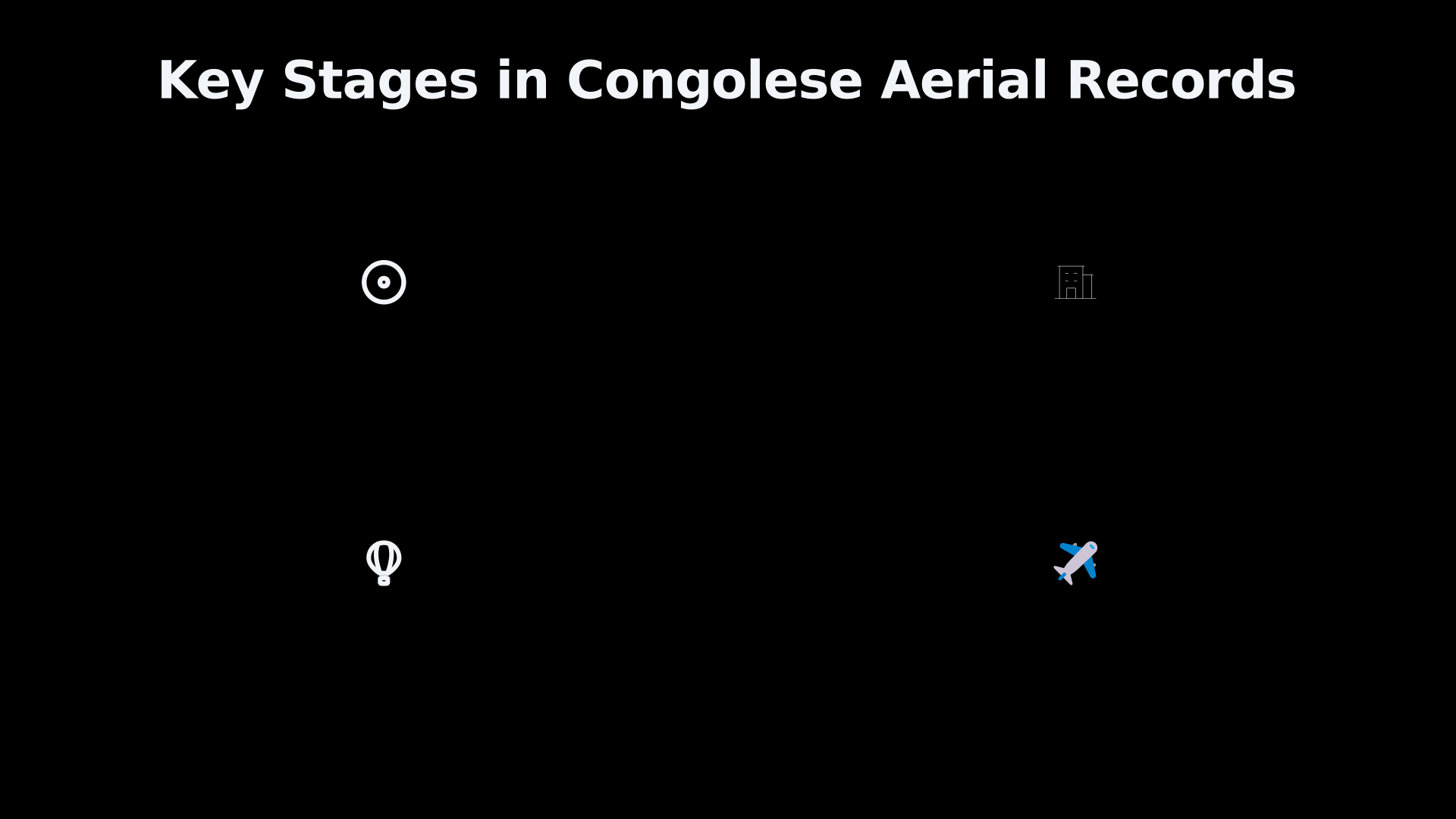
Colonial administration before independence prioritised security, mining and governance rather than systematic publication of unusual aerial observations. Following independence in 1960, decades of political instability, conflict and limited archival resources further reduced the likelihood that isolated reports would be preserved in accessible public collections. Consequently, researchers often encounter references to Congolese incidents only because they were copied into foreign intelligence files, newspapers or later UFO catalogues rather than surviving in original domestic archives.[CIA]cia.govCONGO | CIA FOIA (foia.cia.govCONGO | CIA FOIA (foia.cia.gov)October 13, 1960…
This creates an unusually fragmented evidential landscape. Instead of comparing multiple independent reports from the same incident, investigators frequently rely on a single surviving document whose original supporting material is unavailable.
What survives in public archives?
Only a small number of Congolese UFO-related records are readily accessible.
The most famous is the March 1952 report describing luminous discs over uranium-mining areas in what was then the Belgian Congo. The document appears in the CIA’s declassified UFO collection because it reproduced foreign reporting received during the early Cold War. Its presence in CIA files is often misunderstood. The archive shows that the Agency collected the report as intelligence material; it does not demonstrate that investigators authenticated the reported objects or concluded they represented extraordinary technology. The CIA itself presents the document as part of a historical collection of reports rather than as evidence of verified anomalous craft.[CIA]cia.govTake a Peek Into Our "X-FilesTake a Peek Into Our "X-Files" - CIAJanuary 21, 2016…
A second category consists of modern news reporting. The 2020 object recovered near Buta in Bas-Uele Province generated photographs, statements from local officials and confirmation from Loon, Alphabet’s stratospheric balloon project. Unlike many historical UFO stories, this case produced physical evidence, identifiable operators and an explanation consistent with the recovered hardware and recorded flight path.[The Indian Express]indianexpress.comThe Indian Express…
Private UFO databases also include occasional Congolese reports, but these should not be confused with official investigations. Their evidential value depends heavily on submission dates, witness documentation and the availability of corroborating material.
Contemporary reports versus late memories
One of the biggest reliability differences in the Congolese record is whether an account was documented when the event supposedly occurred or decades afterwards.
Contemporary records generally preserve details that can be checked against weather conditions, aviation activity, astronomical phenomena or other documentary evidence. They also reduce the effects of memory distortion.
By contrast, some Congolese cases entered public databases many decades after the alleged event. A reported 1972 sighting near Kinshasa, for example, was submitted more than fifty years later. Such reports may honestly reflect witness memories, but they lack the supporting documentation needed for robust historical reconstruction. Without original notes, photographs, radar information, newspaper coverage or independent witnesses, investigators cannot confidently distinguish between accurate recollection, mistaken identification or altered memory over time.
This distinction is especially important in a country where the overall number of reports is already small. A single retrospective account can appear disproportionately significant despite resting on comparatively weak evidential foundations.
How provenance changes a case’s credibility
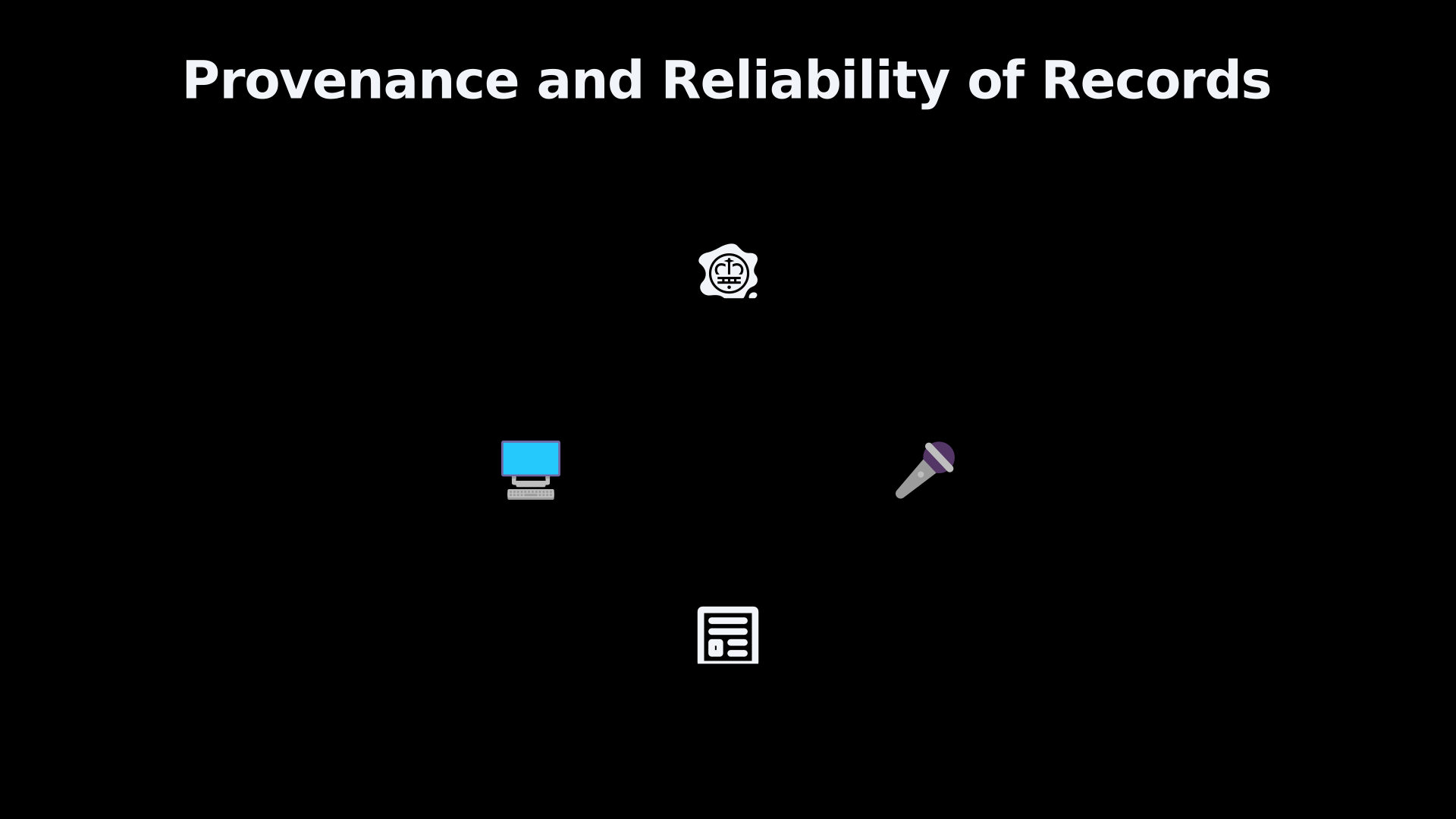
For Congolese UFO reports, provenance—the documented chain showing where information originated and how it was preserved—is often more informative than the claim itself.
A useful way to assess surviving cases is to separate them into four broad categories.
Record typeReliabilityTypical limitationsContemporary official or institutional documentsRelatively high for establishing that an event was reportedMay not verify the reported phenomenon itselfContemporary journalism with identifiable witnessesModerateReporting may rely on incomplete early informationRetrospective witness submissionsLow to moderateMemory degradation and lack of corroborationRepeated secondary retellingsLowDetails often become exaggerated or altered over time
The 1952 Katanga report illustrates why provenance matters. Although the underlying event remains unresolved, researchers can identify the approximate document trail and evaluate what the surviving source actually says. By contrast, stories that circulate only through later books, websites or social media without identifiable primary documentation are much harder to assess objectively.[CIA]cia.govTake a Peek Into Our "X-FilesTake a Peek Into Our "X-Files" - CIAJanuary 21, 2016…
Foreign archives shape the historical record
An unusual feature of the Congolese UFO record is that many surviving documents are preserved outside the country.
Cold War intelligence agencies monitored central Africa because of its geopolitical importance, including the strategic value of Congolese uranium. Foreign newspapers, diplomatic reporting and intelligence summaries therefore became the main repositories for unusual stories originating in the region. This explains why researchers often encounter Congolese UFO material in American or European archives rather than in Congolese government collections.
However, this also introduces an interpretive risk. Intelligence archives primarily document what officials received, circulated or considered worth filing. They are not equivalent to completed scientific investigations, and inclusion in an intelligence archive should not be mistaken for institutional endorsement of the reported claims.[CIA]cia.govTake a Peek Into Our "X-FilesTake a Peek Into Our "X-Files" - CIAJanuary 21, 2016…
Confirmed cases versus unresolved claims
Because the documentary record is so limited, distinguishing between unresolved and explained incidents is essential.
The modern Buta incident demonstrates how an initially unidentified object can become a resolved case once physical evidence, operator confirmation and technical information are available. Its value lies not in supporting extraordinary hypotheses but in illustrating the investigative process that transforms a “UFO” into an identified object.[The Indian Express]indianexpress.comThe Indian Express…
The 1952 Katanga report occupies a different category. The original report survives, but no equivalent body of technical evidence—such as recovered material, photographs, radar data or multiple independently verified investigations—has emerged publicly. As a result, the event remains historically interesting but evidentially limited rather than confirmed as an unexplained phenomenon.[CIA]cia.govTake a Peek Into Our "X-FilesTake a Peek Into Our "X-Files" - CIAJanuary 21, 2016…
What the thin record actually tells us
The scarcity of Congolese UFO records should not be interpreted either as evidence that unusual aerial events never occurred or as evidence that extraordinary incidents were concealed. Instead, it reflects the practical realities of archival survival.
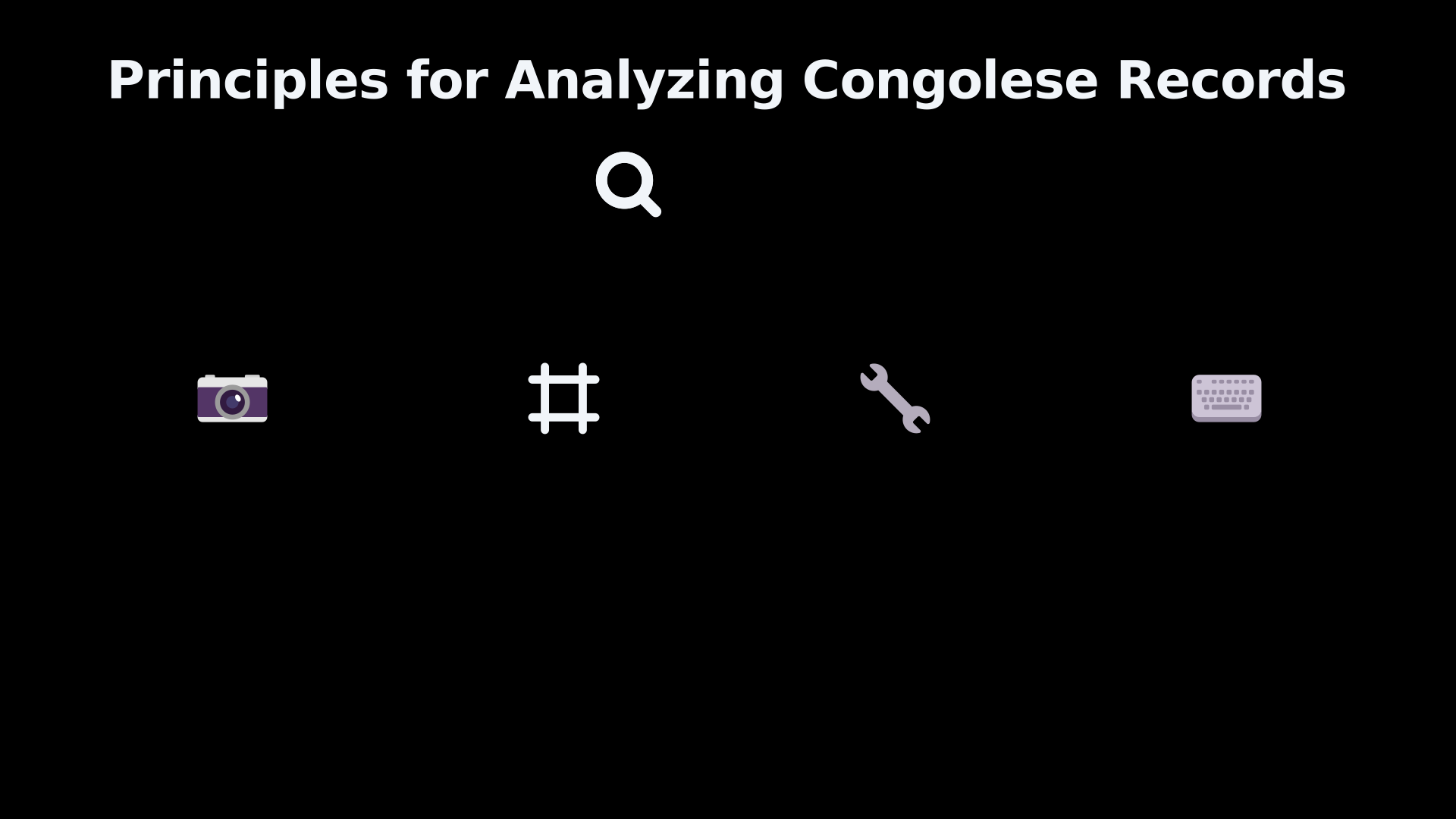
Researchers examining the Democratic Republic of the Congo should therefore approach the record with several principles in mind:
- Give greatest weight to contemporary documents whose origin can be traced.
- Distinguish between a document recording a report and evidence confirming the reported event.
- Treat retrospective memories as historical testimony rather than verified observation.
- Prefer cases with multiple independent sources, physical evidence or documented follow-up investigations.
- Be cautious of repeated internet retellings that add details absent from the earliest surviving records.
Viewed through this lens, the Congolese UFO record is less a catalogue of unexplained phenomena than a case study in how incomplete archives, foreign preservation and uneven documentation shape historical understanding. The country’s surviving material is valuable primarily because it illustrates the importance of provenance, corroboration and careful source criticism when evaluating rare and fragmentary reports.
Amazon book picks
Further Reading
Books and field guides related to Why Are Congo's UFO Records So Thin?. Use these as the next step if you want deeper reading beyond the article.
The UFO Experience
Explains how sightings are investigated and classified, reinforcing careful assessment of limited historical records.
In Plain Sight: an Investigation Into UFOs and Impossible Sci...
Explores modern UFO evidence, documentation, and official sources, complementing discussion of sparse archival records.
Wonders in the Sky: Unexplained Aerial Objects from Antiquity...
Focuses on historical source material and the importance of tracing original records and their transmission.
Passport to Magonia
Provides historical and international context for unusual aerial reports, including discussion of folklore and documentation.
eBay marketplace picks
Marketplace Samples
Live-tested eBay searches with available results related to this page.
Selected fromUFO poster oneBay.co.uk.

Current eBay listing
I Want To Believe UFO Poster Giclée Fine Art Heavyweight Print



Current eBay listing
VINTAGE UFO FLYING SAUCERS COMIC ADVERTISING A2 POSTER PRINT
Endnotes
1.
Source: cia.gov
Title: Take a Peek Into Our “X-Files”
Link:https://www.cia.gov/stories/story/take-a-peek-into-our-x-files/
Source snippet
Take a Peek Into Our "X-Files" - CIAJanuary 21, 2016...
Published: January 21, 2016
2.
Source: cia.gov
Title: CONGO | CIA FOIA (foia.cia.gov)
Link:https://www.cia.gov/readingroom/document/cia-rdp79r00890a001300010004-8
Source snippet
CONGO | CIA FOIA (foia.cia.gov)October 13, 1960...
Published: October 13, 1960
3.
Source: cia.gov
Title: How To Investigate a Flying Saucer
Link:https://www.cia.gov/stories/story/how-to-investigate-a-flying-saucer/
Source snippet
How To Investigate a Flying Saucer - CIA...
4.
Source: archives.gov
Link:https://www.archives.gov/research/topics/uaps/rg-collections
Source snippet
National ArchivesRecords Related to Unidentified Flying Objects (UFOs) and Unidentified Anomalous Phenomena (UAPs) at the National Archiv...
5.
Source: indianexpress.com
Link:https://indianexpress.com/article/trending/trending-globally/ufo-spotted-in-congo-jungle-turns-out-to-be-internet-balloon-6570607/
Source snippet
The Indian Express...
Additional References
6.
Source: youtube.com
Title: Watch the Pentagon’s three declassified UFO videos taken by U.S. Navy pilots
Link:https://www.youtube.com/watch?v=rO_M0hLlJ-Q
Source snippet
Coronavirus quarantine: Declassified FBI and CIA UFO files on Today It's Our Turn...
7.
Source: youtube.com
Link:https://www.youtube.com/watch?v=3TCmj_WMPpQ
Source snippet
UFO Document Archive Disappears After Trump's Order...
8.
Source: youtube.com
Title: All the videos from Pentagon’s first batch of UFO files
Link:https://www.youtube.com/watch?v=WpRWkuYu9V8
Source snippet
Watch the Pentagon's three declassified UFO videos taken by U.S. Navy pilots...
9.
Source: youtube.com
Link:https://www.youtube.com/watch?v=zzQWkYB6n1U
Source snippet
All the videos from Pentagon's first batch of UFO files...
10.
Source: scmp.com
Link:https://www.scmp.com/news/world/africa/article/3098878/ufo-congo-jungle-turns-out-be-loon-internet-balloon
11.
Source: youtube.com
Title: UFO Document Archive Disappears After Trump’s Order
Link:https://www.youtube.com/watch?v=4TNsyfitBpg