Within Iran UFO Files
Why the Tehran UFO Case Still Resists Closure
Iran's 1976 fighter interception remains compelling because multiple witnesses, radar claims and equipment failures entered official records.
On this page
- The Night Two F 4 s Were Scrambled
- Witnesses, Radar and Reported System Failures
- What the Surviving Record Cannot Confirm
Page outline Jump by section
Introduction
The Tehran interception of 19 September 1976 remains the single most extensively documented unidentified aerial incident in Iranian history because it combines multiple forms of evidence that rarely appear together in one case: numerous civilian reports, visual observations by military aircrews, claimed airborne radar contact, and official military documentation circulated within the United States defence and intelligence system. Nearly fifty years later, however, the case remains unresolved not because it conclusively demonstrates an extraordinary craft, but because the surviving evidence is incomplete. The available record establishes that an unusual military interception took place and that experienced personnel reported events they could not readily explain. What it does not establish is the physical identity of the object, the precise cause of the reported equipment failures, or whether all elements of the incident arose from a single phenomenon.[NSA]nsa.govJoint Chiefs of Staff report concerning the sighting of a UFO in Iran on 19 September 1976July 13, 2021…
The Night Two F-4s Were Scrambled
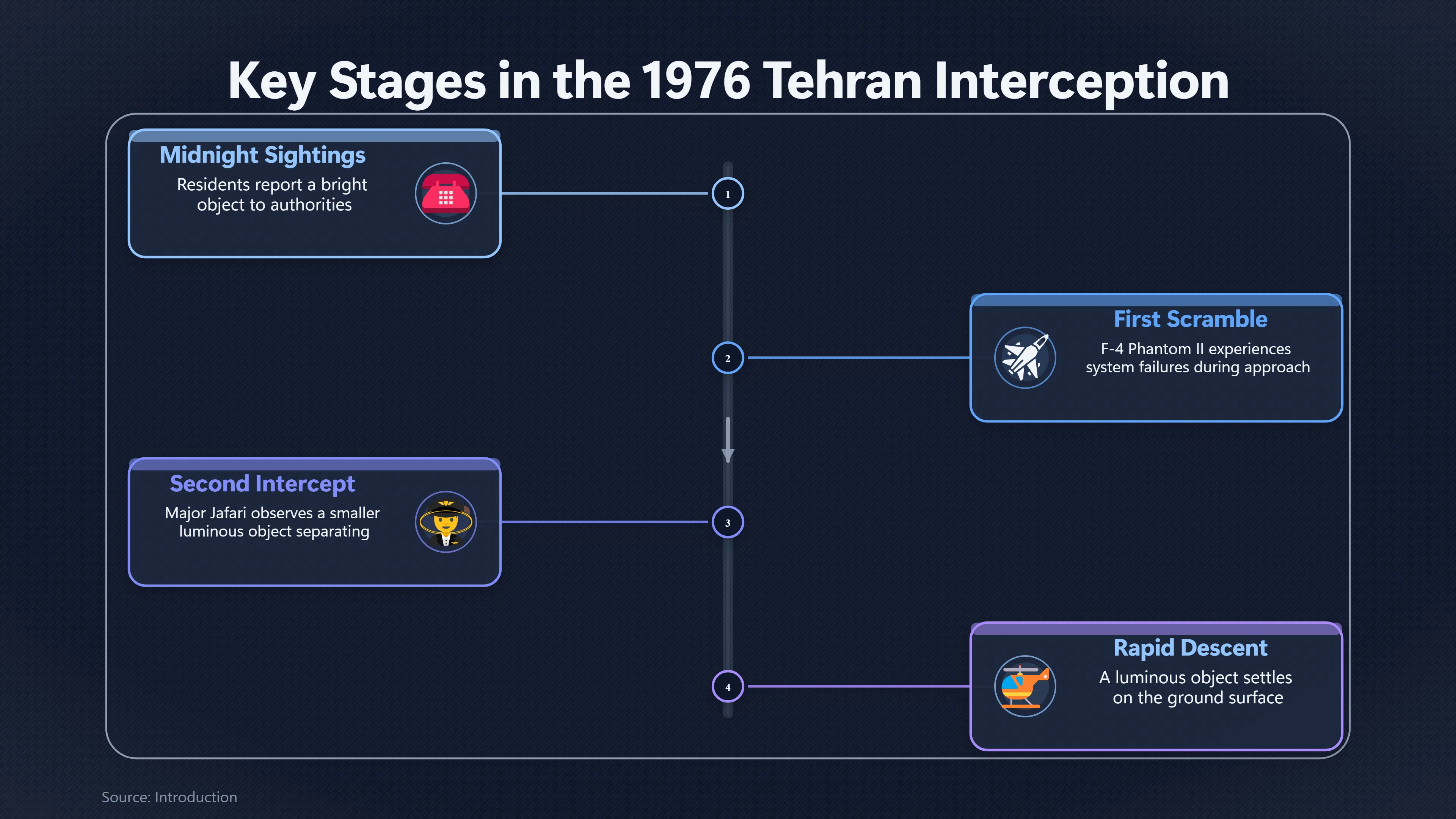
Shortly after midnight, residents in northern Tehran telephoned military authorities and Mehrabad Airport to report an unusually bright object that remained visible long enough to attract repeated attention. Initial attempts to identify it as a star or conventional aircraft failed to satisfy observers, prompting the Imperial Iranian Air Force to launch an F-4 Phantom II interceptor from Shahrokhi Air Base.[NSA]nsa.govJoint Chiefs of Staff report concerning the sighting of a UFO in Iran on 19 September 1976July 13, 2021…
According to the military message later distributed through U.S. defence channels, the first F-4 experienced failures of instrumentation and radio communications while approaching the object. The crew reportedly broke off the interception, after which the aircraft’s systems returned to normal. Because the object remained visible, a second F-4 was launched.[NSA]nsa.govJoint Chiefs of Staff report concerning the sighting of a UFO in Iran on 19 September 1976July 13, 2021…
The second aircraft, flown by Major Parviz Jafari, has become the focal point of later discussion. The official report states that the crew obtained a radar return on the object before observing a smaller luminous object apparently separating from the larger one. When the pilot prepared to employ an air-to-air missile, he reported that the weapons-control panel and some communications ceased functioning temporarily. The systems reportedly returned after the aircraft disengaged. Later in the flight, another luminous object was seen descending rapidly before appearing to settle on the ground, though subsequent helicopter investigation reportedly found no wreckage.[NSA]nsa.govJoint Chiefs of Staff report concerning the sighting of a UFO in Iran on 19 September 1976July 13, 2021…
Witnesses, Radar and Reported System Failures
The Tehran case attracts continuing attention because several categories of evidence appear to overlap. Each category has strengths and important limitations.
Multiple independent witnesses
Unlike many military UFO reports that depend solely on one crew, the Tehran incident began with numerous civilian observations from different parts of the city. Air traffic personnel and military officers also reported seeing an unusually bright object before fighters were launched. Independent observations do not prove an extraordinary explanation, but they reduce the likelihood that the event consisted entirely of one individual’s misperception.[NSA]nsa.govJoint Chiefs of Staff report concerning the sighting of a UFO in Iran on 19 September 1976July 13, 2021…
Claimed radar contact
One of the strongest elements frequently cited by researchers is the reported airborne radar acquisition by the second F-4. According to the military report, the radar return appeared substantial enough for the weapons systems officer to track it, with the target maintaining separation as the fighter closed in. However, the publicly available record consists of narrative summaries rather than preserved radar recordings or technical telemetry. No raw radar tapes, calibration data or detailed intercept reconstruction have entered the public domain. Consequently, historians know that radar contact was reported, but cannot independently evaluate its quality.[NSA]nsa.govJoint Chiefs of Staff report concerning the sighting of a UFO in Iran on 19 September 1976July 13, 2021…
Reported electronic interference
The alleged failures of communications, instrumentation and weapons systems are among the most debated aspects of the case.
The official military account describes:
- communications and instrumentation failures in the first F-4 during approach;
- restoration of those systems after turning away;
- temporary loss of missile-control capability in the second aircraft while attempting engagement;
- subsequent recovery of normal operation.
These reports are unusual enough to distinguish the Tehran incident from many other military UFO cases. At the same time, the surviving documentation does not include engineering analysis identifying which specific components failed, whether faults were recorded after landing, or whether maintenance inspections isolated a common cause.[NSA]nsa.govJoint Chiefs of Staff report concerning the sighting of a UFO in Iran on 19 September 1976July 13, 2021…

Why the Official Documents Matter
One reason the Tehran interception continues to receive serious historical attention is that it entered official military paperwork soon after the event rather than surviving only through later recollections.
A Defence Intelligence Agency evaluation circulated alongside Joint Chiefs of Staff reporting characterised the source as highly reliable and noted that the incident could have intelligence significance. Importantly, this assessment referred to the credibility of the reporting chain rather than certifying any extraordinary interpretation of the object itself. Intelligence agencies routinely preserve reports of unexplained military encounters because unidentified aircraft—whether foreign technology, atmospheric phenomena or something else—can represent legitimate defence concerns.[NSA]nsa.govJoint Chiefs of Staff report concerning the sighting of a UFO in Iran on 19 September 1976July 13, 2021…
Equally significant is what the documentation does not contain. The declassified material is primarily narrative reporting summarising witness statements and operational events. It does not include complete maintenance records, original radar plots, cockpit voice recordings, telemetry, photographic evidence or laboratory analysis that could conclusively resolve competing explanations.[NSA]nsa.govJoint Chiefs of Staff report concerning the sighting of a UFO in Iran on 19 September 1976July 13, 2021…
What the Surviving Record Cannot Confirm
The enduring uncertainty surrounding the Tehran interception arises from gaps in the evidence rather than from a lack of witnesses.
Several important questions remain unanswered:
- The object’s identity. The available records do not identify the observed object as an aircraft, astronomical body, atmospheric phenomenon or unknown technology.
- The radar evidence. Public documentation describes radar acquisition but does not preserve the underlying sensor data needed for independent technical review.
- The equipment failures. The reports describe temporary system malfunctions, yet no complete engineering investigation has been released explaining precisely what failed or why.
- The smaller luminous objects. Witnesses described secondary objects separating from the primary light, but there is no physical evidence establishing what these represented.
- Ground traces. Although one luminous object reportedly appeared to descend towards the ground, no publicly documented recovery or physical material has emerged.[NSA]nsa.govJoint Chiefs of Staff report concerning the sighting of a UFO in Iran on 19 September 1976July 13, 2021…
These absences prevent the case from moving beyond the category of an unresolved military encounter.
Competing Interpretations
Supporters of the case’s significance argue that no ordinary explanation accounts simultaneously for the civilian sightings, military observations, reported radar tracking and temporary equipment anomalies. They also note that experienced military personnel continued to regard the event as exceptional years later.[NSA]nsa.govJoint Chiefs of Staff report concerning the sighting of a UFO in Iran on 19 September 1976July 13, 2021…
Sceptical investigators have proposed more conventional explanations. Philip J. Klass argued that the pilots may initially have been observing the bright planet Jupiter and that at least some reported anomalies reflected known reliability problems with one of the F-4 aircraft, pilot interpretation of radar behaviour, and unrelated electrical faults rather than an external influence. James Oberg has similarly suggested that astronomical misidentification and normal aircraft malfunctions could account for much of the reported sequence.[Wikipedia]Wikipedia1976 Tehran UFO incident1976 Tehran UFO incident
Neither interpretation completely resolves every reported feature. The sceptical explanation must account for the sequence of witness reports and official concern, while extraordinary interpretations remain limited by the absence of preserved physical evidence, complete sensor data and independently verifiable technical records.
Why the Tehran Case Still Resists Closure
The Tehran interception occupies a distinctive place within Iran’s UFO history because it combines stronger documentation than almost any other Iranian case with evidence that remains insufficient for definitive conclusions.
The historical record supports several propositions with reasonable confidence: military aircraft were scrambled in response to widespread reports; crews reported visual observations and unusual operational experiences; the incident was documented through official military channels; and defence analysts considered it worthy of intelligence attention. Beyond those points, confidence decreases steadily.
The case therefore remains unresolved in the strict evidential sense. It is neither a confirmed example of extraordinary technology nor a demonstrated case of simple misidentification. Instead, it illustrates how an event can be unusually well documented yet still resist definitive explanation when the most important forms of technical evidence—raw radar data, engineering diagnostics and physical artefacts—are unavailable or have not survived in the public record.[nsa.gov]nsa.govJoint Chiefs of Staff report concerning the sighting of a UFO in Iran on 19 September 1976July 13, 2021…
Amazon book picks
Further Reading
Books and field guides related to Why the Tehran UFO Case Still Resists Closure. Use these as the next step if you want deeper reading beyond the article.

UFOs: Generals, Pilots, and Government Officials Go on the Re...
Covers military encounters, official documentation, and evidential standards closely aligned with the Tehran case.
The UFO Experience
Provides a framework for evaluating witness testimony and unexplained aerial incidents without assuming conclusions.
Encounter in Rendlesham Forest
Offers useful comparison with another famous military interception and investigation.
Identified Flying Objects
Explores scientific interpretations of unexplained aerial observations while encouraging critical examination.
eBay marketplace picks
Marketplace Samples
Live-tested eBay searches with available results related to this page.
Selected fromUFO poster oneBay.co.uk.

Current eBay listing
I Want To Believe UFO Poster Giclée Fine Art Heavyweight Print



Current eBay listing
VINTAGE UFO FLYING SAUCERS COMIC ADVERTISING A2 POSTER PRINT
Endnotes
1.
Source: nsa.gov
Link:https://www.nsa.gov/Helpful-Links/NSA-FOIA/Declassification-Transparency-Initiatives/FOIA-Reports-and-Releases/FOIA-Reports-and-Releases-List/igphoto/2002761354/
Source snippet
Joint Chiefs of Staff report concerning the sighting of a UFO in Iran on 19 September 1976July 13, 2021...
Published: July 13, 2021
2.
Source: Wikipedia
Title: 1976 Tehran UFO incident
Link:https://en.wikipedia.org/wiki/1976_Tehran_UFO_incident
3.
Source: nsa.gov
Title: Routing and Transmittal Slip from Louis E. Foster, DIA with a DIA
Link:https://www.nsa.gov/Helpful-Links/NSA-FOIA/Declassification-Transparency-Initiatives/FOIA-Reports-and-Releases/FOIA-Reports-and-Releases-List/igphoto/2002761364/
4.
Source: nsa.gov
Link:https://www.nsa.gov/Press-Room/Digital-Media-Center/Document-Gallery/igphoto/2002761354/
5.
Source: nsa.gov
Link:https://www.nsa.gov/Helpful-Links/NSA-FOIA/Declassification-Transparency-Initiatives/FOIA-Reports-and-Releases/
6.
Source: sloppyintelligence.com
Title: 1976 tehran ufo incident
Link:https://sloppyintelligence.com/1976-tehran-ufo-incident/
Source snippet
Sloppy Intelligence1976 Tehran UFO incident - Sloppy Intelligence...
7.
Source: archives.gov
Link:https://www.archives.gov/declassification/iscap/releases
Source snippet
ISCAP Releases | National ArchivesApril 10, 2026 — Doc 1: Foreign Intelligence Information Report [Iran] Doc 2: Foreign Intelligence Info...
Published: April 10, 2026
8.
Source: thelivingmoon.com
Title: 1976 Tehran UFO incident
Link:https://www.thelivingmoon.com/49ufo_files/03files2/1976_Tehran_UFO_incident.html
Additional References
9.
Source: uapedia.ai
Title: Phone calls from residents in Shemira
Link:https://www.uapedia.ai/wiki/tehran-uap-incident-1976/
Source snippet
Tehran UAP Incident (1976) - UAPediaOctober 9, 2025 — TEHRAN UAP INCIDENT (1976) In the early hours of September 19, 1976, Tehran’s night...
Published: October 9, 2025
10.
Source: thecoldfile.com
Title: 1976 tehran f4 encounter
Link:https://www.thecoldfile.com/articles/1976-tehran-f4-encounter/
Source snippet
The Report That Outlived the Night: The 1976 Tehran F-4 Encounter | The Cold FileMay 24, 2026 — UFO/UAP / Case file / Filed May 24, 2026...
Published: May 24, 2026
11.
Source: theblackvault.com
Title: the 1976 iran incident
Link:https://www.theblackvault.com/casefiles/the-1976-iran-incident/
Source snippet
The Vault Files: 1976 Iran Incident - The Black Vault Case FilesJuly 27, 2025 — THE VAULT FILES: 1976 IRAN INCIDENT Image: John Greenewal...
Published: July 27, 2025
12.
Source: thegalacticmind.com
Title: case file tehran ufo incident 1976 iran
Link:https://www.thegalacticmind.com/case-file-tehran-ufo-incident-1976-iran/
Source snippet
They should not be treated as equal. WHAT IS DOCUMENTED The strongest documented elements are: * A U.S. Joint...
13.
Source: youtube.com
Link:https://www.youtube.com/watch?v=rVDxsz0zVTc
Source snippet
Air Force Pilots and the 1976 Tehran UFO[https://www.youtube.com/watch?v=YMHUFb2HRLc](https://www.youtube.com/watch?v=YMHUFb2HRLc) newspaceeconomy.ca...
14.
Source: youtube.com
Link:https://www.youtube.com/watch?v=ttv4fPgj2m8
Source snippet
"The Tehran UFO Incident: Best Evidence?[https://www.youtube.com/watch?v=Uen4pbnEanU..."](https://www.youtube.com/watch?v=Uen4pbnEanU...")...
15.
Source: disclosurearchives.com
Link:https://disclosurearchives.com/events/tehran-incident-1976
16.
Source: nowdeclassified.com
Link:https://www.nowdeclassified.com/incidents/tehran-uap-1976
17.
Source: archives.gov
Title: ISCA P Releases | National Archives[Department of State Cable,
Link:https://www.archives.gov/declassification/iscap/decision-table
18.
Source: nowdeclassified.com
Title: tehran ufo 1976
Link:https://www.nowdeclassified.com/guides/tehran-ufo-1976
Source snippet
Now DeclassifiedThe Tehran UFO Incident 1976 — DIA's 'Outstanding Report' | Now Declassified...