Within Chile UFO Files
Why Do Chile's UFO Reports Cluster by Region?
Regional differences in sightings often reflect geography, population, air traffic, weather, and reporting access rather than more anomalous craft.
On this page
- Northern skies and the Arica reporting tradition
- The central aviation corridor and camera density
- Remote southern and Antarctic observation gaps
Page outline Jump by section
Introduction
UFO reports are not spread evenly across Chile. Instead, they cluster in particular regions for reasons that are largely understandable once geography, population, aviation activity, observing conditions and reporting systems are considered together. Northern Chile produces a disproportionate share of famous sightings because it combines exceptionally clear skies, frequent military and commercial aviation, border surveillance and a long-standing local reporting culture. Central Chile generates many reports simply because most of the country’s population, airports and cameras are concentrated there. By contrast, southern Chile and the Antarctic sector contain vast areas where relatively few people are present to witness or document unusual events.

These regional patterns do not, by themselves, indicate that anomalous aerial phenomena are more common in one part of Chile than another. Rather, they show how environmental conditions and human activity influence what is seen, recorded and ultimately investigated by Chile’s aviation authorities. Official investigators at SEFAA (formerly CEFAA) emphasise that reports are evaluated primarily for aviation safety, with many eventually attributed to conventional causes such as satellites, aircraft, atmospheric effects or photographic artefacts, while a much smaller proportion remain unresolved because available evidence is insufficient for a definitive identification.[gob.cl]sefaa.dgac.gob.clSEFAAQuiénes somos – SEFAASEFAAQuiénes somos – SEFAA
Why regional clustering is expected rather than surprising
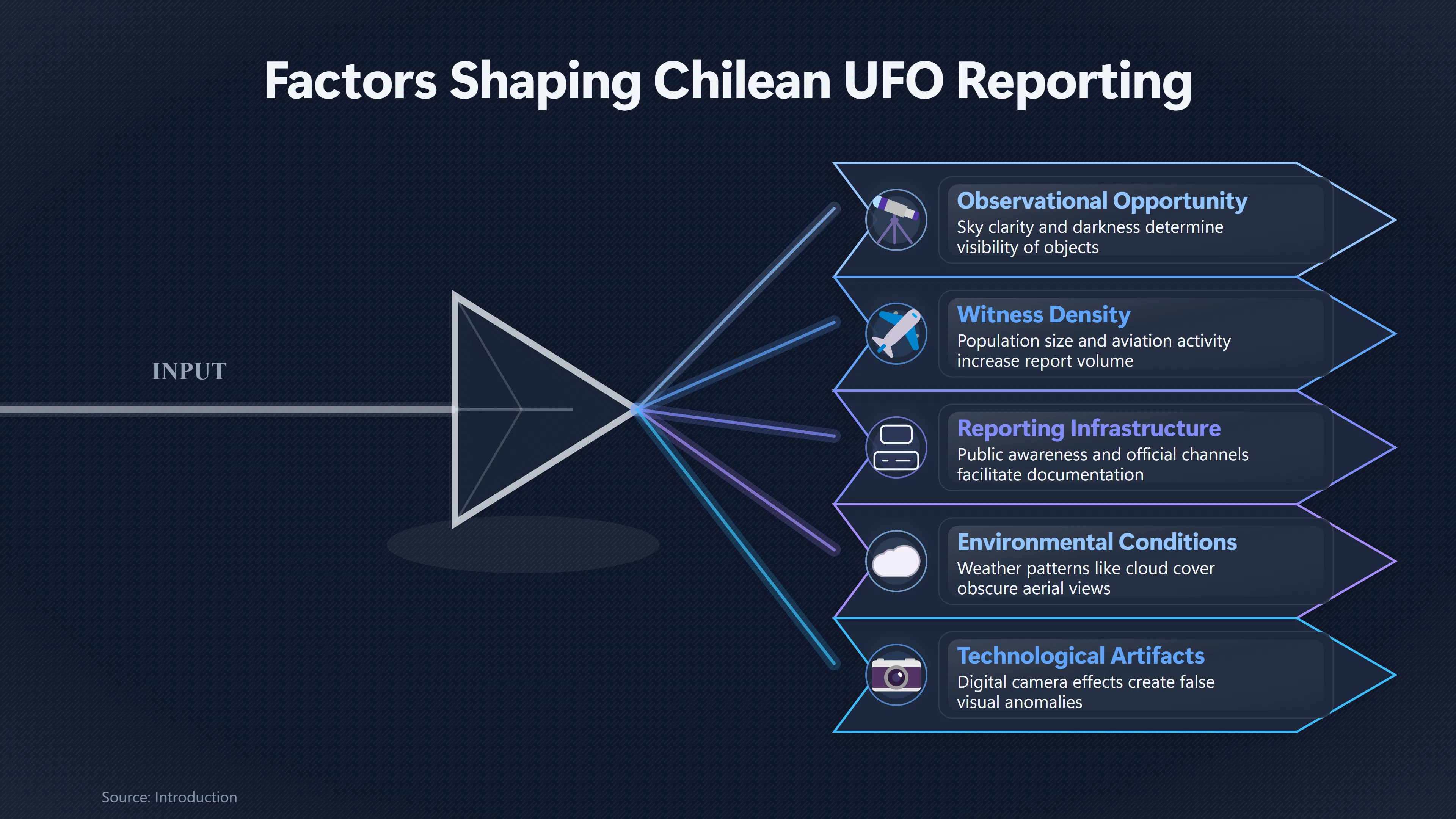
Regional clusters are common in observational data because reports depend on three separate factors:
- The opportunity to observe, including sky clarity, darkness and weather.
- The number of potential witnesses, especially pilots, airport personnel and residents.
- The likelihood that an observation is formally reported and investigated.
Chile varies dramatically in all three respects. Stretching more than 4,000 kilometres from the Atacama Desert to Patagonia and Antarctica, the country contains some of the world’s clearest astronomical skies alongside densely populated metropolitan areas and almost uninhabited southern wilderness. As a result, the same aerial phenomenon could be widely reported in one region but pass unnoticed in another.
SEFAA’s own remit reinforces this pattern. Reports are received from pilots, cabin crews, air traffic personnel and civilians, meaning areas with heavier aviation activity and stronger reporting networks naturally generate more official case files.[SEFAA]sefaa.dgac.gob.clSEFAASEFAA – Sección de Estudios de Fenómenos Aéreos AnómalosSEFAASEFAA – Sección de Estudios de Fenómenos Aéreos Anómalos
Northern skies and the Arica reporting tradition
Northern Chile has become the country’s best-known UFO region for reasons extending well beyond folklore.
Exceptionally favourable observing conditions
The Atacama Desert offers unusually dry air, low cloud cover and minimal atmospheric moisture. These conditions are why northern Chile hosts many of the world’s premier astronomical observatories. Clear skies increase the chances of noticing satellites, aircraft, meteors, planets and other luminous objects that might attract attention if their appearance is unfamiliar.[arXiv]arxiv.orgProtecting the Dark Skies of Chile: Initiatives, Education and CoordinationMarch 13, 2017…
The same transparency that benefits astronomy also means observers often see distant aircraft lights, high-altitude satellites and atmospheric optical effects that would be obscured elsewhere.
Border activity and aviation
The northern frontier contains:
- commercial air routes,
- military operations,
- border patrols,
- mining aviation,
- scientific activity,
- remote observation posts.
These occupations place trained observers outdoors at night more often than the average civilian. Pilots and military personnel are also more likely to file formal reports when they encounter unusual lights because aviation safety procedures encourage documentation.
SEFAA itself traces part of its institutional history to repeated northern reports, and has conducted outreach in Arica and Parinacota because of the area’s long association with notable sightings.[DGAC]dgac.gob.clJuly 21, 2023…
The influence of local reputation
Arica developed a reputation for unusual aerial sightings during the late twentieth century. Well-publicised cases—including reports from pilots and the widely discussed 1997 cluster of lights that helped motivate the creation of CEFAA—made the region synonymous with UFO reporting.
This reputation can produce a feedback effect. Communities already known for unusual sightings often generate greater public attention, encouraging additional reporting while also attracting investigators and journalists. That increases the recorded number of cases without necessarily increasing the underlying number of unusual aerial events.[gob.cl]sefaa.dgac.gob.clSEFAAQuiénes somos – SEFAASEFAAQuiénes somos – SEFAA
The central aviation corridor and camera density
Northern Chile may dominate UFO folklore, but central Chile produces a large share of modern reports for different reasons.
The Santiago metropolitan region contains:
- the country’s largest population,
- its busiest airports,
- the greatest concentration of mobile phones,
- extensive road traffic,
- dense media coverage,
- numerous amateur photographers.
Simply put, more people looking upward means more reports.
Commercial aviation also reaches its highest density around Santiago and neighbouring regions. Aircraft approaching or departing major airports often appear unusual when viewed from unfamiliar angles, particularly during sunrise, sunset or night operations. Landing lights can remain visible for long periods while the aircraft itself appears stationary, a classic source of UFO reports worldwide.
Modern digital cameras further influence reporting. High zoom levels, image stabilisation, rolling shutter effects and autofocus limitations frequently transform distant lights into apparently unusual shapes. Chilean investigators have repeatedly identified photographic artefacts, insects, birds, satellites and aircraft among submitted evidence.[DGAC]dgac.gob.clOpen source on gob.cl.
Why southern Chile appears quieter
Southern Chile is not necessarily free of unusual observations. Instead, several factors reduce the number of documented reports.
Large areas of Patagonia, the fjords and the far south contain extremely low population densities. Fewer residents mean fewer opportunities for independent witnesses to observe the same event.
Weather also plays an important role. Persistent cloud cover, rain, snow and rapidly changing conditions frequently obscure the night sky. Even when unusual aerial lights occur, they are less likely to be observed clearly than in the dry northern desert.
The result is an observational gap rather than evidence that unusual phenomena avoid southern Chile.
Recent scientific monitoring illustrates this point. Wildlife camera systems in remote Patagonia have occasionally captured unusual light phenomena that remain under investigation, but even researchers caution that possibilities such as insects, optical reflections or rare atmospheric effects must be evaluated before extraordinary interpretations are considered. The rarity of such recordings despite hundreds of thousands of collected images highlights how unusual these events are, regardless of their eventual explanation.[Live Science]livescience.comResearchers are scrambling to explain them.September 12, 2025 — In January 2025, a camera trap used by the University of Magallanes (UMAG…
Antarctica creates a reporting paradox
Chile’s aviation authorities are responsible for an enormous area extending into Antarctic airspace, yet relatively few public UFO reports originate there.
Several practical reasons explain this:
- very few permanent observers,
- limited civilian air traffic,
- harsh weather,
- long periods of darkness or daylight,
- restricted access,
- relatively few cameras compared with populated regions.
Any unusual aerial observation in Antarctica is therefore less likely to acquire multiple independent witnesses or extensive photographic documentation than an equivalent event over central Chile.
This does not prevent investigations, but it means the available evidence is often much thinner than for reports originating near populated areas.[SEFAA]sefaa.dgac.gob.clSEFAAQuiénes somos – SEFAASEFAAQuiénes somos – SEFAA
Reporting behaviour shapes the map
The geographical distribution of reports reflects not only where phenomena occur but also where people choose to report them.
SEFAA actively encourages submissions from both aviation professionals and the public, requesting precise information about:
- location,
- time,
- viewing direction,
- weather,
- surrounding landmarks,
- photographs or video.
Regions where the public is more aware of this reporting process are likely to contribute more cases to the official archive. In other words, a reporting hotspot is not necessarily a phenomenon hotspot.[SEFAA]sefaa.dgac.gob.clSEFAAReportar un caso – SEFAASEFAAReportar un caso – SEFAA
Why clear skies can increase both sightings and explanations
One apparent contradiction is that northern Chile has both the highest reputation for UFO sightings and some of the strongest astronomical expertise in the world.
These facts are compatible rather than contradictory.
Clear skies increase visibility of all aerial and astronomical objects. At the same time, they provide better opportunities to identify them correctly. Astronomers, aviation specialists and investigators can often compare reports against satellite trajectories, aircraft movements, astronomical objects and atmospheric conditions.
Recent research into pilot reports has also shown how satellite constellations, including newly launched Starlink trains, can generate convincing unidentified aerial observations until orbital data are reconstructed. Such mechanisms are increasingly relevant in Chile’s exceptionally transparent skies.[arXiv]arxiv.orgEnhancing Space Situational Awareness to Mitigate Risk: A Single-Case Study in the Misidentification of a Recently-Launched Starlink…
What the regional pattern actually tells us
The clustering of Chilean UFO reports is best understood as the combined result of environmental visibility, human geography and reporting infrastructure rather than evidence that anomalous craft favour particular locations.
Northern Chile stands out because exceptionally clear skies, intensive aviation, border activity and decades of public attention create ideal conditions for both observation and reporting. Central Chile produces many reports because it contains the country’s largest concentration of people, aircraft and cameras. Southern Chile and Antarctica generate comparatively fewer documented cases largely because weather, remoteness and sparse populations reduce opportunities for observation.
This regional pattern helps explain why Chile remains prominent in discussions of unidentified aerial phenomena while also illustrating an important lesson from the country’s official investigations: where reports cluster is often determined as much by who is watching, what they can see and how they report it as by the aerial phenomena themselves.[gob.cl]sefaa.dgac.gob.clSEFAAQuiénes somos – SEFAASEFAAQuiénes somos – SEFAA
Amazon book picks
Further Reading
Books and field guides related to Why Do Chile's UFO Reports Cluster by Region?. Use these as the next step if you want deeper reading beyond the article.

UFOs and Government: A Historical Inquiry
Places official reporting systems into context.

UFOs: Generals, Pilots, and Government Officials Go on the Re...
Examines official investigations and aviation-related cases.
eBay marketplace picks
Marketplace Samples
Live-tested eBay searches with available results related to this page.
Selected fromChile map print oneBay.co.uk.
Endnotes
1.
Source: arxiv.org
Link:https://arxiv.org/abs/2403.08155
Source snippet
Enhancing Space Situational Awareness to Mitigate Risk: A Single-Case Study in the Misidentification of a Recently-Launched Starlink...
2.
Source: arxiv.org
Link:https://arxiv.org/abs/1703.04684
Source snippet
Protecting the Dark Skies of Chile: Initiatives, Education and CoordinationMarch 13, 2017...
Published: March 13, 2017
3.
Source: arxiv.org
Link:https://arxiv.org/abs/astro-ph/0103345
4.
Source: sefaa.dgac.gob.cl
Title: SEFAAHistoria – SEFAA
Link:https://sefaa.dgac.gob.cl/historia/
5.
Source: sefaa.dgac.gob.cl
Title: SEFAAReportar un caso – SEFAA
Link:https://sefaa.dgac.gob.cl/reportar-un-caso/
6.
Source: chile.travel
Title: Ufology in Chile: The best destinations for the sighting of UFOs
Link:https://chile.travel/en/blog/ufology-in-chile-the-best-destinations-for-the-sighting-of-ufos-2/
7.
Source: chile.travel
Title: Ufología en Chile: Los mejores destinos para el avistamiento de OVNIS
Link:https://chile.travel/blog/ufologia-chile-destinos-avistamiento-ovnis/
8.
Source: youtube.com
Title: UFO Chile Navy 9 Minutes Official
Link:https://www.youtube.com/watch?v=LbFzZwnh6tI
Source snippet
UFO - Chilean Military Captures Video of Mystery Object - Confirms it is Real...
9.
Source: youtube.com
Link:https://www.youtube.com/watch?v=6pS7qVF2lTQ
10.
Source: sefaa.dgac.gob.cl
Title: SEFAAQuiénes somos – SEFAA
Link:https://sefaa.dgac.gob.cl/quienes-somos/
11.
Source: dgac.gob.cl
Link:https://www.dgac.gob.cl/cefaa-en-jornada-de-seguridad-operacional/
12.
Source: sefaa.dgac.gob.cl
Title: SEFAASEFAA – Sección de Estudios de Fenómenos Aéreos Anómalos
Link:https://sefaa.dgac.gob.cl/
13.
Source: dgac.gob.cl
Link:https://www.dgac.gob.cl/cefaa-dicto-charlas-en-retenes-fronterizos-del-norte-del-pais/
Source snippet
July 21, 2023...
Published: July 21, 2023
14.
Source: livescience.com
Link:https://www.livescience.com/space/extraterrestrial-life/camera-trap-in-chile-detects-strange-lights-blazing-through-the-wilderness-researchers-are-scrambling-to-explain-them
Source snippet
Researchers are scrambling to explain them.September 12, 2025 — In January 2025, a camera trap used by the University of Magallanes (UMAG...
Published: September 12, 2025
15.
Source: sefaa.dgac.gob.cl
Link:https://sefaa.dgac.gob.cl/2025/02/26/
16.
Source: dgac.gob.cl
Link:https://www.dgac.gob.cl/dmc-informacion-sobre-clima-espacial/
17.
Source: sefaa.dgac.gob.cl
Title: satelites starlink provocan ola de denuncias sobre ovnis
Link:https://sefaa.dgac.gob.cl/2022/01/07/satelites-starlink-provocan-ola-de-denuncias-sobre-ovnis/
18.
Source: dgac.gob.cl
Link:https://www.dgac.gob.cl/formulario-de-reportes-de-fenomenos-aereos-para-el-siglo-xxi/
19.
Source: dgac.gob.cl
Title: “TRENES DE LUCES” EN EL ESPACIO – DGAC | Dirección General de Aeronáutica Civil
Link:https://www.dgac.gob.cl/trenes-de-luces-en-el-espacio-2/
20.
Source: dgac.gob.cl
Title: CONFERENCI A DEL CEFAA EN ARICA – DGAC | Dirección General de Aeronáutica Civil
Link:https://www.dgac.gob.cl/conferencia-del-cefa-en-arica/
21.
Source: dgac.gob.cl
Title: CEFA A CELEBRA 21 AÑOS DE VIDA – DGAC | Dirección General de Aeronáutica Civil
Link:https://www.dgac.gob.cl/cefaa-celebra-21-anos-de-vida/
22.
Source: snifa.sma.gob.cl
Link:https://snifa.sma.gob.cl/SeguimientoAmbiental/Ficha/21706
23.
Source: bibliotecanacionaldigital.gob.cl
Title: Arica [material cartográfico] Instituto Geográfico Militar
Link:https://www.bibliotecanacionaldigital.gob.cl/bnd/631/w3-article-156911.html
24.
Source: sefaa.dgac.gob.cl
Link:https://sefaa.dgac.gob.cl/preguntas-frecuentes/
25.
Source: sefaa.dgac.gob.cl
Link:https://sefaa.dgac.gob.cl/2025/02/
Additional References
26.
Source: youtube.com
Link:https://www.youtube.com/watch?v=Mf70imTsuuo
Source snippet
The Proof Is Out There: FLYING ORBS SPOTTED IN CHILE (Season 2) | History...
27.
Source: youtube.com
Title: Discover these AWESOME facts about Chile
Link:https://www.youtube.com/watch?v=wnVOI20yPnI
Source snippet
Could The Strange Object In This Video Be A UFO? | Expedition Unknown: Hunt for Extraterrestrials...
28.
Source: nationalacademies.org
Link:https://www.nationalacademies.org/publications/5846
29.
Source: t13.cl
Link:https://www.t13.cl/amp/noticia/nacional/objetos-mas-1200-km-h-revelan-registros-militares-chile-fenomenos-aereos-anomalos
30.
Source: ap.org
Link:https://www.ap.org/news-highlights/spotlights/2026/the-threat-of-light-pollution-puts-the-worlds-darkest-skies-in-the-atacama-desert-at-risk/
31.
Source: bibliotecadigital.ciren.cl
Link:https://bibliotecadigital.ciren.cl/items/c6aa5523-d055-4735-855a-d9c6e2ba1106/full
32.
Source: geo.fu-berlin.de
Link:https://www.geo.fu-berlin.de/en/geol/fachrichtungen/geophy/AG_Magnetotellurik/Publikationen/echternacht1997/index.html
33.
Source: biobiochile.cl
Link:https://www.biobiochile.cl/noticias/nacional/chile/2023/04/02/lluvia-de-estrellas-ovni-meteoro-expertos-explican-fenomeno-captado-en-cielo-de-chile.shtml
34.
Source: 13.cl
Link:https://www.13.cl/amp/programas/entretencion/actualidad/que-fue-eso-expertos-explican-avistamiento-en-santiago-este/video
35.
Source: youtube.com
Title: The Proof Is Out There: FLYING ORBS SPOTTED IN CHILE (Season 2) | History
Link:https://www.youtube.com/watch?v=j_DiUQ82kPk
Source snippet
UFO Chile Navy 9 Minutes Official...