Within Congo UFOs
Which Congo Do the UFO Files Describe?
Changing colonial and national names have caused UFO cases from today's Democratic Republic of the Congo to be repeatedly mislocated.
On this page
- Belgian Congo and Congo Leopoldville names
- Locating Elisabethville and Kerekere today
- How naming errors distort later retellings
Page outline Jump by section
Introduction
Many UFO references to “the Congo” are geographically correct only if they are read in their historical context. The best-known cases did not occur in today’s Republic of the Congo (capital: Brazzaville). Instead, they took place in territory that is now the Democratic Republic of the Congo (DRC), whose changing official names have repeatedly confused later writers. This distinction matters because several UFO catalogues, websites and secondary books have assigned incidents to the wrong country simply by reading an outdated political name without checking the location.[Wikisource]en.wikisource.orgPage:Flying saucers over Belgian Congo uranium mines, CIA report.pdf/1Page:Flying saucers over Belgian Congo uranium mines, CIA report.pdf/1 - Wikisource, the free online libraryMarch 29, 1952…
Understanding which Congo a document actually describes is therefore a prerequisite to evaluating the evidence. Once the historical geography is reconstructed, it becomes clear that the principal Cold War-era UFO records—including the famous 1952 Belgian Congo sighting and the 1965 Kerekere fragment investigation—belong to the history of the present-day Democratic Republic of the Congo, not its western neighbour.
Why two countries are called Congo
Modern readers encounter an unusual problem because two independent African states share the name “Congo”:
- Democratic Republic of the Congo (DRC) – capital Kinshasa.
- Republic of the Congo – capital Brazzaville.
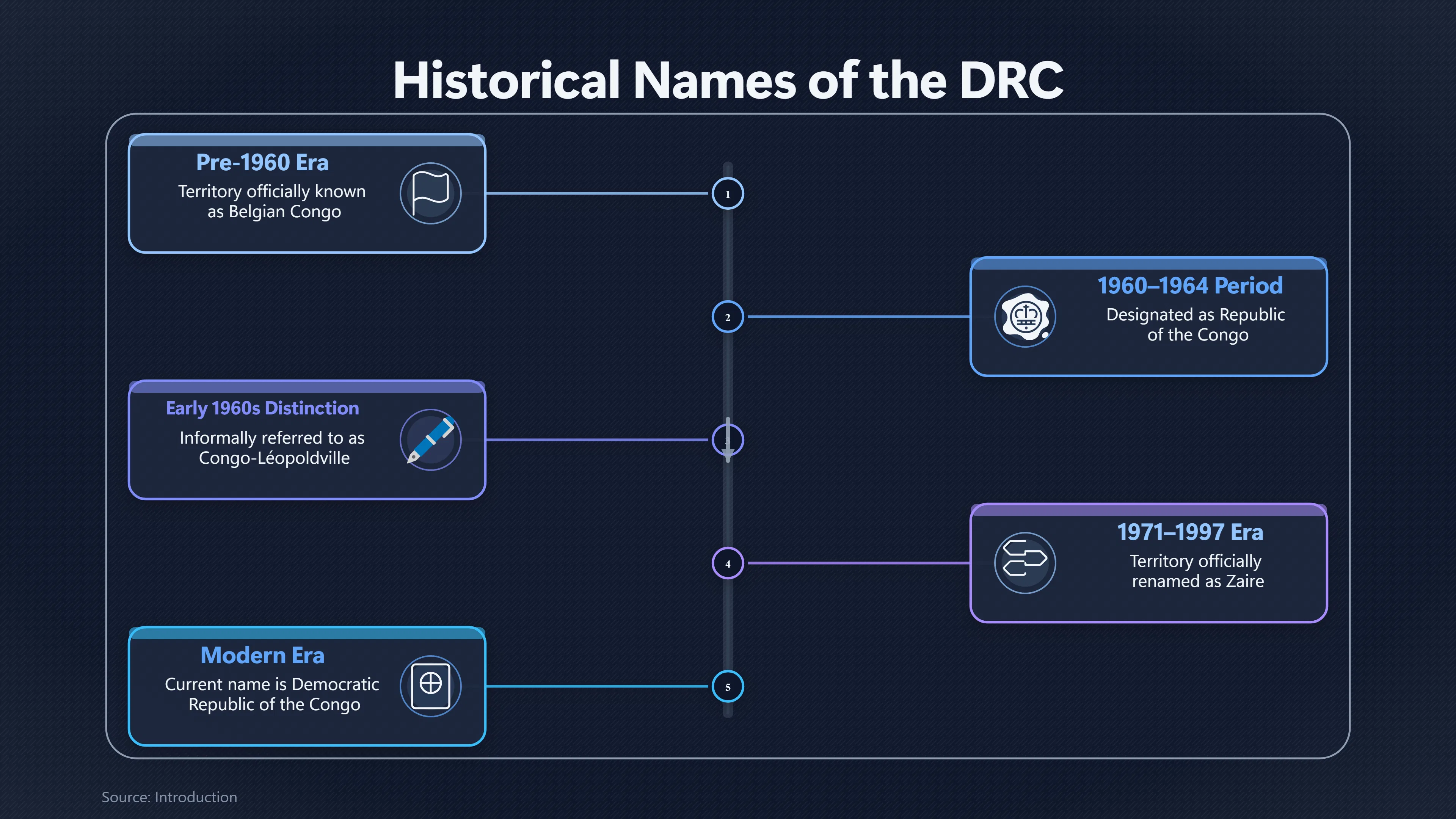
The confusion deepens because historical documents often use names that no longer exist. Depending on the year in which a report was written, the same territory may be described as:
Historical nameApproximate periodModern countryBelgian CongoBefore independence (to 1960)Democratic Republic of the CongoRepublic of the Congo1960–1964 (official name of the former Belgian Congo)Democratic Republic of the CongoCongo-LéopoldvilleEarly 1960s informal distinctionDemocratic Republic of the CongoDemocratic Republic of the Congo1964–1971 and again from 1997Democratic Republic of the CongoZaire1971–1997Democratic Republic of the Congo
At the same time, the neighbouring former French colony was also officially known as the Republic of the Congo, often distinguished as Congo-Brazzaville. As a result, documents from the early 1960s can legitimately refer to two different countries using nearly identical names.[Time]content.time.comThe Congo: Nominal ConfusionThe Congo: Nominal Confusion - TIME…
Belgian Congo and Congo-Léopoldville in the UFO record
The best-known Congolese UFO reports consistently point to the eastern and southern parts of what is now the Democratic Republic of the Congo.
The celebrated 1952 “Belgian Congo uranium mines” report explicitly places the observations in the Elisabethville district, east of the Luapula River. The CIA archive preserves the report as an unevaluated intelligence item translated from an Austrian newspaper, and the original text repeatedly identifies the location as Belgian Congo, not French Congo.[Wikisource]en.wikisource.orgPage:Flying saucers over Belgian Congo uranium mines, CIA report.pdf/1Page:Flying saucers over Belgian Congo uranium mines, CIA report.pdf/1 - Wikisource, the free online libraryMarch 29, 1952…
Likewise, the later 1965 metallic fragment case refers to recovery near Kerekere in the Republic of the Congo. Read literally by modern audiences, that phrase appears to indicate today’s Republic of the Congo. However, the date is decisive. In October 1965 the former Belgian colony was officially the Democratic Republic of the Congo, although it was still widely called Republic of the Congo or Congo-Léopoldville to distinguish it from Brazzaville. Contemporary political terminology therefore points to the modern DRC rather than the neighbouring republic.[Office of the Historian]history.state.govOffice of the Historian Historical DocumentsOffice of the HistorianHistorical Documents - Office of the Historian…
Locating Elisabethville and Kerekere today
Historical place names are another major source of misunderstanding.
Elisabethville is modern Lubumbashi
The city called Elisabethville in colonial records was renamed Lubumbashi in 1966 during a broader programme of replacing Belgian colonial place names. A reader unfamiliar with that change may mistakenly assume the report concerns a vanished settlement or even a different country. In reality, the location lies in the mineral-rich Katanga region of the present-day Democratic Republic of the Congo.[Time]content.time.comThe Congo: Nominal ConfusionThe Congo: Nominal Confusion - TIME…
The 1952 UFO report’s association with uranium mining has also encouraged dramatic retellings. While the region genuinely contained important mining operations, the geographical reference alone does not strengthen the evidential quality of the sighting itself; it simply identifies where the reported observations occurred.[Wikisource]en.wikisource.orgPage:Flying saucers over Belgian Congo uranium mines, CIA report.pdf/1Page:Flying saucers over Belgian Congo uranium mines, CIA report.pdf/1 - Wikisource, the free online libraryMarch 29, 1952…
Kerekere belongs in the present-day DRC
The location identified as Kerekere in the 1965 fragment investigation has caused even greater confusion because later reproductions often omitted the historical political context.
The surviving technical report describes examination of a metallic fragment recovered after an unidentified object reportedly fell to Earth. Although many later UFO summaries repeated only the opening description, the report ultimately identified the object as a terrestrial electrical component rather than evidence of extraterrestrial technology. Because the document referred to the “Republic of the Congo” during a period of changing official names, numerous later writers incorrectly relocated the incident into today’s Republic of the Congo instead of the DRC.[Reddit]reddit.comOn file in CIA library is an exploitation report on a metallic fragment recovered by ground search after a UFO fell to earth…Jul…
How naming errors distort later retellings
The geographical confusion has affected UFO literature in several ways.
Cases become assigned to the wrong nation. Databases sometimes list the 1965 fragment recovery under the Republic of the Congo even though the historical political terminology indicates the modern Democratic Republic of the Congo.
Colonial place names disappear from recognition. Readers who do not know that Elisabethville became Lubumbashi may fail to connect archival reports with a modern map.
Political history is mistaken for inconsistent evidence. Apparent contradictions between “Belgian Congo”, “Republic of the Congo”, “Congo-Léopoldville” and “Zaire” often reflect successive official names for the same territory rather than disagreements over where an incident occurred.[Time]content.time.comThe Congo: Nominal ConfusionThe Congo: Nominal Confusion - TIME…
Secondary sources inherit earlier mistakes. Once an incorrectly labelled location appears in a catalogue or compilation, later authors frequently repeat it without returning to the original document, allowing the error to spread through UFO literature.
What the historical geography actually tells us
When the changing political names are untangled, the pattern becomes much clearer.
The two principal Cold War UFO records associated with “the Congo” both belong to the territory of the modern Democratic Republic of the Congo. The 1952 sighting occurred in the colonial Belgian Congo, centred on the Elisabethville (now Lubumbashi) region. The 1965 Kerekere fragment investigation also belongs to the same national lineage despite being described in contemporary documentation using the ambiguous title “Republic of the Congo.”[wikisource.org]en.wikisource.orgPage:Flying saucers over Belgian Congo uranium mines, CIA report.pdf/1Page:Flying saucers over Belgian Congo uranium mines, CIA report.pdf/1 - Wikisource, the free online libraryMarch 29, 1952…
By contrast, no similarly well-documented body of official UFO material has emerged for the present-day Republic of the Congo. That absence does not demonstrate that unusual aerial observations never occurred there; rather, it means that the most frequently cited archival UFO cases attributed simply to “Congo” almost always refer, after careful historical identification, to the territory of today’s Democratic Republic of the Congo rather than its neighbouring namesake.
Amazon book picks
Further Reading
Books and field guides related to Which Congo Do the UFO Files Describe?. Use these as the next step if you want deeper reading beyond the article.

UFOs: Generals, Pilots, and Government Officials Go on the Re...
Provides context for evaluating historical international cases.
The UFO Experience: A Scientific Inquiry
Useful background for interpreting historical reports.
The Congo: From Leopold to Kabila
Clarifies historical place names and political transitions.
eBay marketplace picks
Marketplace Samples
Live-tested eBay searches with available results related to this page.
Selected fromUFO map poster oneBay.co.uk.
Endnotes
1.
Source: en.wikisource.org
Title: Page:Flying saucers over Belgian Congo uranium mines, CIA report.pdf/1
Link:https://en.wikisource.org/wiki/Page%3AFlying_saucers_over_Belgian_Congo_uranium_mines%2C_CIA_report.pdf/1
Source snippet
Page:Flying saucers over Belgian Congo uranium mines, CIA report.pdf/1 - Wikisource, the free online libraryMarch 29, 1952...
Published: March 29, 1952
2.
Source: content.time.com
Title: The Congo: Nominal Confusion
Link:https://content.time.com/time/subscriber/article/0%2C33009%2C835489%2C00.html
Source snippet
The Congo: Nominal Confusion - TIME...
3.
Source: reddit.com
Link:https://www.reddit.com/r/UFOs/comments/ohrd85
Source snippet
On file in CIA library is an exploitation report on a metallic fragment recovered by ground search after a UFO fell to earth...Jul...
4.
Source: cia.gov
Title: A Close Call in Africa
Link:https://www.cia.gov/resources/csi/studies-in-intelligence/archives/vol-43-no-3/a-close-call-in-africa/
Source snippet
3 UNCLASSIFIED A Plane Crash, Rescue, and Recovery RICHARD L. HOLM In September 1964, I reported to CIA Headquarters following a two-year...
Published: September 1964
5.
Source: cia.gov
Link:https://www.cia.gov/readingroom/document/cia-rdp79t00826a001100010007-6
Source snippet
INTELLIGENCE REPORT PREPARED WEEKLY FOR THE SENIOR INTERDEPARTMENTAL GROUP | CIA FOIA (foia.cia.gov)August 1, 1966 — INTELLIGENCE REPORT...
Published: August 1, 1966
6.
Source: cia.gov
Link:https://www.cia.gov/readingroom/document/0005996114
Source snippet
CONGOLESE ARMY HEADQUARTERS IN LEOPOLDVILLE HAS AN AMBITIOUS PLAN TO TAKE ADVANTAGE OF THE SITUATION BY OCCUPY- ING TOWNS IN NORTHERN KAT...
7.
Source: cia.gov
Title: CENTRA L INTELLIGENCE BULLETIN | CIA FOIA (foia.cia.gov)
Link:https://www.cia.gov/readingroom/document/cia-rdp79t00975a006100190001-3
Source snippet
CENTRAL INTELLIGENCE BULLETIN | CIA FOIA (foia.cia.gov)December 15, 1961 — CENTRAL INTELLIGENCE BULLETIN Document Type: CREST Collection...
Published: December 15, 1961
8.
Source: cia.gov
Title: CONG O | CIA FOIA (foia.cia.gov)
Link:https://www.cia.gov/readingroom/document/cia-rdp79r00890a001300010004-8
Source snippet
CONGO | CIA FOIA (foia.cia.gov)October 13, 1960 — CONGO Document Type: CREST Collection: General CIA Records Document Number (FOIA) /ESDN...
Published: October 13, 1960
9.
Source: cia.gov
Title: AFRIC A | CIA FOIA (foia.cia.gov)
Link:https://www.cia.gov/readingroom/document/cia-rdp79r00890a001200040014-5
Source snippet
AFRICA | CIA FOIA (foia.cia.gov)April 13, 1960 — AFRICA Document Type: CREST Collection: General CIA Records Document Number (FOIA) /ESDN...
Published: April 13, 1960
10.
Source: en.wikisource.org
Title: Flying saucers over Belgian Congo uranium mines
Link:https://en.wikisource.org/wiki/Flying_saucers_over_Belgian_Congo_uranium_mines
Source snippet
00-W-23602 | INFORMATION FROM FOREIGN DOCUMENTS OR RADIO BROADCASTS | CD NO. | -- COUNTRY | Belgia...
11.
Source: history.state.gov
Title: Office of the Historian Historical Documents
Link:https://history.state.gov/historicaldocuments/frus1961-63v20/d6
Source snippet
Office of the HistorianHistorical Documents - Office of the Historian...
12.
Source: digitallibrary.un.org
Link:https://digitallibrary.un.org/record/631959
Source snippet
dated 11 November 1961 from the Minister for Foreign Affairs of the Republic of the Congo (Leopoldville) addressed to the Acting Secretar...
Published: November 1961
Additional References
13.
Source: cufon.org
Title: cia 52 2
Link:https://cufon.org/cufon/cia-52-2.htm
Source snippet
The CUFON 1952 CIA UFO-Related Documents Sampler, Part 2 of 2May 17, 1996 — INFORMATION 1952 SUBJECT Military; Scientific - Air HOW DATE...
Published: May 17, 1996
14.
Source: youtube.com
Title: The Story of Zaïre (Documentary)
Link:https://www.youtube.com/watch?v=6WaoBA_FyNs
Source snippet
5 5 De Classified CIA Documents Proving UFOs Are Real...
15.
Source: youtube.com
Title: WHY ARE THERE TWO CONGOS?
Link:https://www.youtube.com/watch?v=WoYrhQ5A8DA
Source snippet
3 DR Congo vs Republic of the Congo: What's the Difference?...
16.
Source: youtube.com
Title: Democratic Republic of the Congo and Republic of the Congo Compared
Link:https://www.youtube.com/watch?v=1j51bOGvjl0
Source snippet
2 WHY ARE THERE TWO CONGOS?...
17.
Source: youtube.com
Title: DR Congo vs Republic of the Congo: What’s the Difference?
Link:https://www.youtube.com/watch?v=zK_f3sBgqQ0
Source snippet
4 The Story of Zaïre (Documentary)...
18.
Source: youtube.com
Title: 5 De Classified CIA Documents Proving UFOs Are Real
Link:https://www.youtube.com/watch?v=S8NWQi7vaII