Within Mali UFOs
Why Is Mali's UFO Record So Sparse?
Sparse archives, limited digitisation, conflict and reporting bias make Mali's UFO history unusually hard to reconstruct.
On this page
- The Reporting and Archive Gaps
- How Geography and Conflict Limit Verification
- What a Credible National Record Would Require
Page outline Jump by section
Introduction
Mali’s UFO record is unusually sparse, but the absence of documented cases should not be mistaken for evidence that unusual aerial sightings never occur. Instead, the available record reflects deeper structural problems: limited long-term archiving, incomplete digitisation of historical materials, decades of political instability and armed conflict, uneven local media coverage, and the lack of any dedicated national body for investigating unidentified aerial phenomena (UAP). Together, these factors make it exceptionally difficult to reconstruct a reliable chronology of reports or distinguish genuine unexplained observations from folklore, misidentifications and rumours.
Understanding these limitations is essential when assessing claims about UFOs in Mali. The central question is not simply how many sightings have been reported, but why so few reports can be independently verified, preserved and analysed years later.
The Reporting and Archive Gaps
The greatest obstacle to studying Mali’s UFO history is not necessarily a lack of observations but a lack of durable records.
Unlike countries that maintain formal civilian reporting systems or release official investigation files, Mali has no publicly documented national programme dedicated to collecting, classifying or publishing reports of unidentified aerial phenomena. This means that sightings are generally recorded only if they appear in local media, are shared informally, or are submitted voluntarily to international databases.
Even those routes leave substantial gaps. Many local newspapers have had limited digital preservation, while older print publications are often difficult to search remotely. Researchers therefore face an archival landscape where isolated accounts may survive but broader patterns cannot easily be reconstructed.
The problem extends beyond UFO research. Historians of Mali have long noted that valuable documentary collections remain dispersed across regional archives, private collections and institutions with uneven preservation standards, making systematic historical reconstruction challenging even for well-established academic subjects.[Cambridge University Press & Assessment]cambridge.orgCambridge University Press & AssessmentArchival Resources in Mali | History in Africa | Cambridge CoreMay 13, 2014…
Digitisation has improved access to some forms of documentary heritage, but the process remains incomplete and has often focused on culturally significant manuscripts rather than newspapers, local administrative records or ephemeral reporting that might preserve descriptions of unusual aerial events.[Cambridge University Press & Assessment]cambridge.orgCambridge University Press & AssessmentPreserving and Digitizing Djenné’s Manuscript Collections: The Politics of Space and Agency in Cen…
How Geography and Conflict Limit Verification
Even when unusual aerial events are witnessed, confirming them is exceptionally difficult.
Mali covers a vast territory stretching from densely populated southern regions into enormous sparsely inhabited areas of the Sahara. Large distances between communities reduce the likelihood that multiple independent witnesses will observe and document the same event from different locations.
Verification becomes even harder because many regions have limited infrastructure for collecting supporting evidence such as:
- contemporaneous photographs with preserved metadata;
- radar records accessible to civilian researchers;
- local weather observations;
- air traffic information;
- rapid interviews with witnesses.
Armed conflict has compounded these difficulties. Since 2012, insecurity across northern and central Mali has disrupted government institutions, displaced communities and restricted access for journalists, researchers and independent investigators. Conflict has also forced attention towards humanitarian and security priorities rather than the preservation of routine documentary records.
UNESCO’s repeated efforts to safeguard endangered documentary heritage in Mali illustrate how conflict threatens archives more generally. Preservation initiatives have concentrated on rescuing vulnerable collections and expanding digitisation because instability places historical records themselves at risk.[unesco.org]whc.unesco.orgUNESCO World Heritage CentreBamako conference urges emergency action to safeguard manuscripts - UNESCO World Heritage CentreJanuary 30, 2015…
These conditions inevitably affect any attempt to reconstruct historical UFO reports decades later.
Why International Databases Show So Few Malian Cases
International UFO databases contain remarkably few reports originating from Mali.
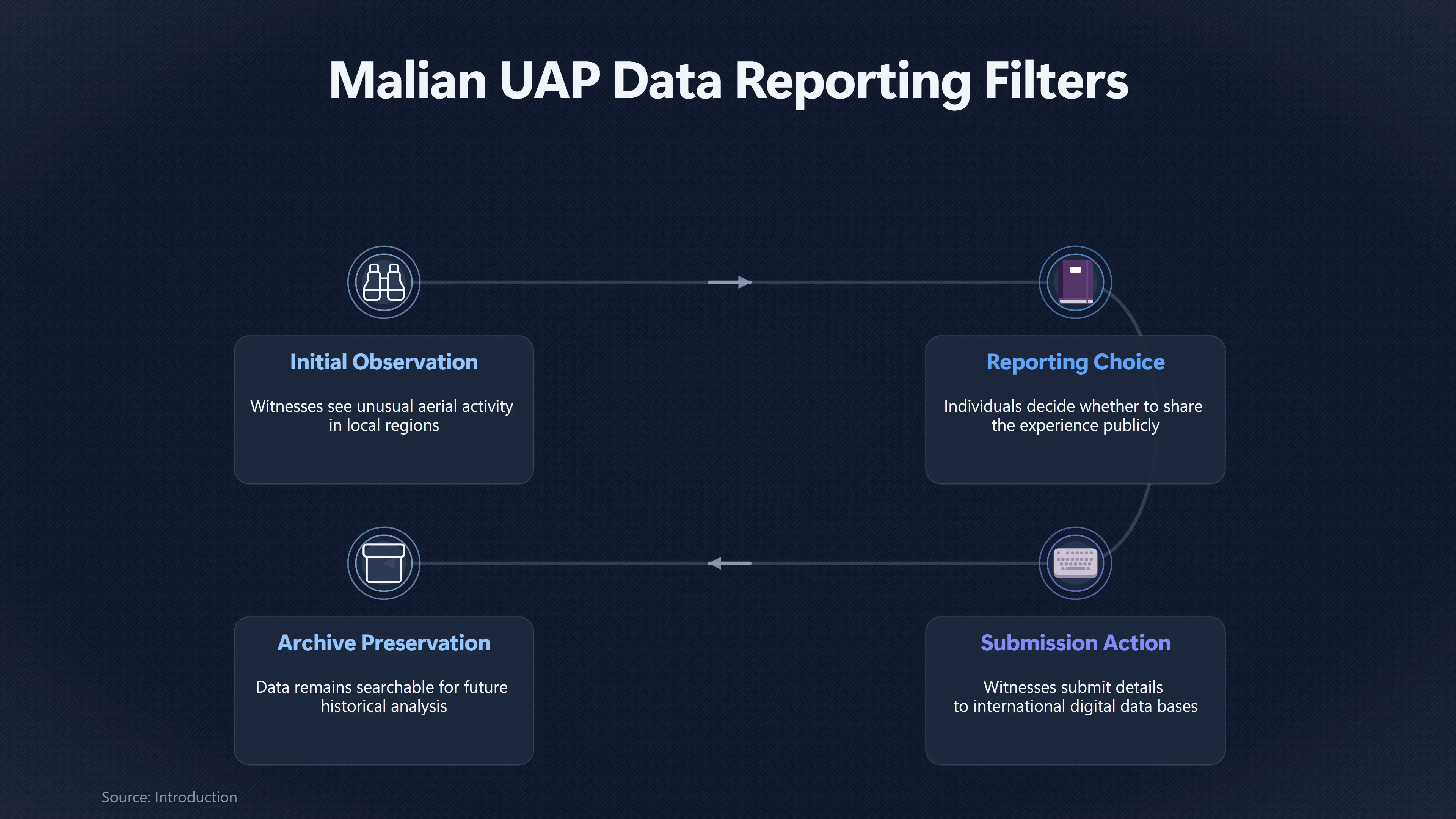
This scarcity does not necessarily indicate an unusually low frequency of unexplained observations. Instead, several reporting filters operate simultaneously:
- relatively limited internet reporting compared with higher-income countries;
- lower public awareness of international reporting databases;
- language barriers between local witnesses and predominantly English-language reporting systems;
- fewer aviation enthusiasts and amateur astronomical organisations submitting reports;
- reduced media amplification of unusual sightings.
Consequently, an incident must pass through several unlikely steps before appearing in a searchable archive: someone observes the event, chooses to report it, knows where to submit it, provides sufficient detail, and the report is preserved.
Each missing step reduces the historical record.

The Difference Between Missing Evidence and Evidence of Absence
One of the most common misunderstandings is to treat Mali’s sparse UFO archive as proof that nothing unusual has ever been observed.
From an evidence perspective, these are very different claims.
A missing historical record can result from:
- reports never being written down;
- documents being lost;
- newspapers disappearing;
- archives remaining inaccessible;
- conflict interrupting preservation;
- reports existing only as oral testimony.
None of these possibilities demonstrates that an aerial phenomenon occurred, but neither do they justify concluding that no sightings ever happened.
Researchers therefore distinguish between:
CategoryWhat it meansNo reported caseNo surviving documentation has been located.Unverified reportA witness account exists but lacks corroborating evidence.Investigated caseIndependent information allows evaluation of competing explanations.
Much of Mali’s available material falls into the second category rather than the third.
Cultural Narratives Are Not Investigation Files
Another reason Mali’s UFO record appears confusing is the frequent mixing of cultural traditions with modern UFO claims.
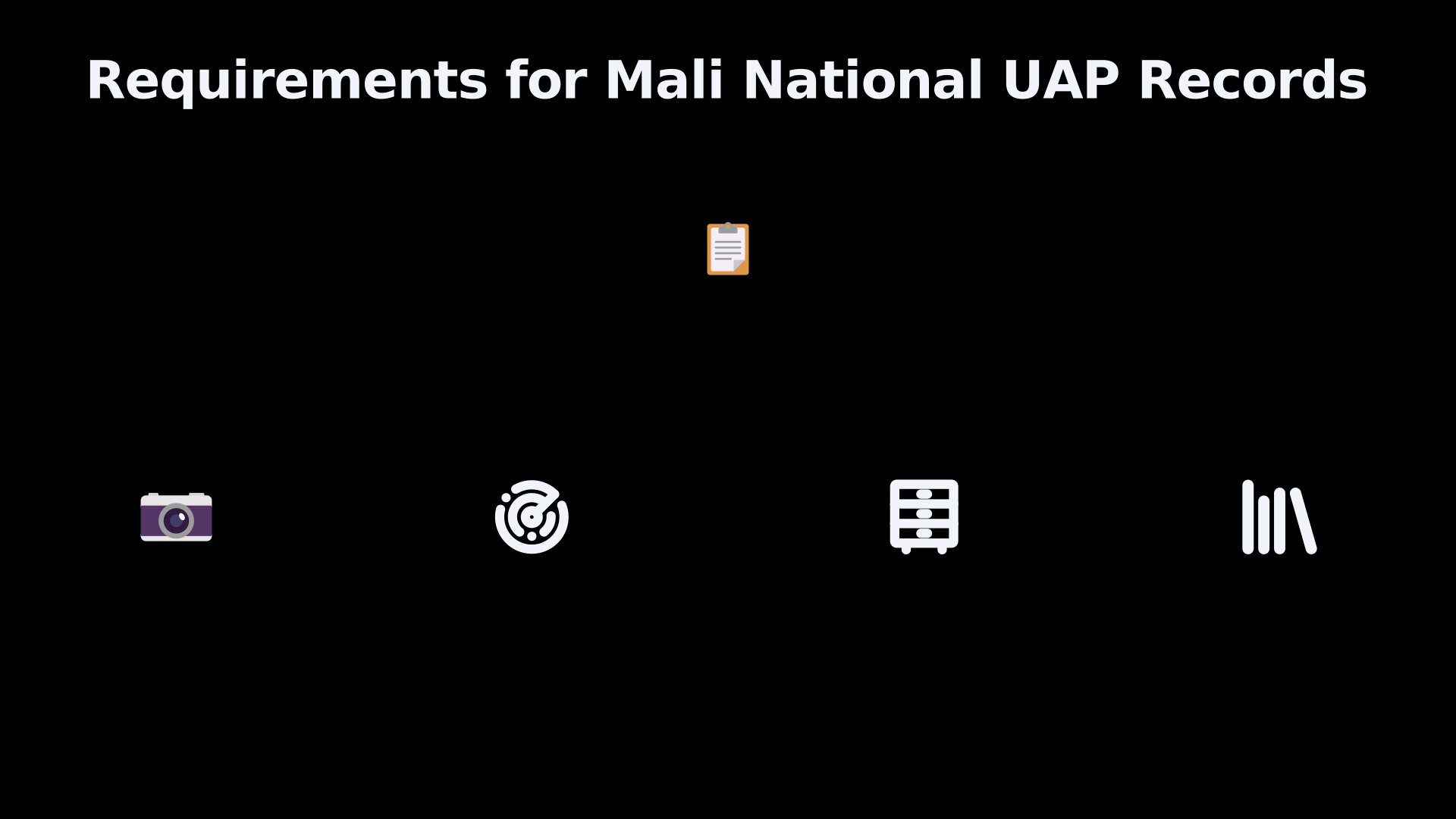
International popular culture has often linked the Dogon people with speculative stories about advanced astronomical knowledge and extraterrestrial visitors. These narratives spread widely through books and television despite extensive scholarly criticism of the underlying evidence.
Such material differs fundamentally from documented UFO investigations.
Traditional cosmology, oral history and religious belief can provide valuable insight into how communities understand the sky, but they are not equivalent to contemporaneous reports of unidentified aerial objects supported by technical evidence.
Separating folklore from observational data is therefore essential when assessing Mali’s national UFO record.
What a Credible National Record Would Require
If Mali were to develop a comprehensive national record of unidentified aerial phenomena, it would require consistent documentation rather than extraordinary discoveries.
A robust archive would include:
- standardised witness questionnaires recording exact time and location;
- preservation of original photographs and videos;
- coordination with aviation and meteorological data where available;
- long-term digital archiving of reports;
- transparent classification of explained, probably explained and unresolved cases;
- public access to anonymised historical records for independent review.
These are the same principles recommended for preserving documentary heritage more broadly: systematic cataloguing, digitisation, reliable metadata and long-term accessibility. UNESCO has repeatedly emphasised that documentary preservation depends not only on protecting physical records but also on ensuring that they remain searchable and accessible over time.[UNESCO]unesco.orgRecommendation concerning the preservation of, and access to, documentary heritage including in digital form - Legal AffairsNovembe…
Why the Sparse Record Should Be Interpreted Carefully
The most evidence-based conclusion is that Mali’s UFO history is incomplete because its documentary ecosystem is incomplete.
There is currently no public archive that allows researchers to trace a continuous national history of aerial anomaly reporting. Instead, the surviving material consists of scattered witness accounts, occasional international database entries, isolated local narratives and broader cultural traditions that are often incorrectly presented as UFO evidence.
For anyone studying the wider picture of unidentified aerial phenomena in Mali, the key lesson is methodological rather than sensational: an incomplete archive limits what can be concluded. Sparse documentation is primarily evidence of reporting, preservation and verification challenges—not, by itself, evidence either for or against the existence of unusual aerial phenomena.
Amazon book picks
Further Reading
Books and field guides related to Why Is Mali's UFO Record So Sparse?. Use these as the next step if you want deeper reading beyond the article.

UFOs: Generals, Pilots, and Government Officials Go on the Re...
Highlights the importance of documented official records.
eBay marketplace picks
Marketplace Samples
Live-tested eBay searches with available results related to this page.
Selected fromUFO poster oneBay.co.uk.


Current eBay listing
I Want To Believe UFO Poster Giclée Fine Art Heavyweight Print


Current eBay listing
VINTAGE UFO FLYING SAUCERS COMIC ADVERTISING A2 POSTER PRINT
Endnotes
1.
Source: cambridge.org
Link:https://www.cambridge.org/core/journals/history-in-africa/article/archival-resources-in-mali/1B0E89C53D132E408C09869F8EC9456C
Source snippet
Cambridge University Press & AssessmentArchival Resources in Mali | History in Africa | Cambridge CoreMay 13, 2014...
Published: May 13, 2014
2.
Source: cambridge.org
Link:https://www.cambridge.org/core/journals/history-in-africa/article/abs/dust-to-dust-a-users-guide-to-local-archives-in-mali/DED675F64990EE983CA5ECEC9E61E8AF
Source snippet
Cambridge University Press & AssessmentDust to Dust: a User's Guide to Local Archives in Mali | History in Africa | Cambridge Core...
3.
Source: cambridge.org
Link:https://www.cambridge.org/core/journals/history-in-africa/article/abs/preserving-and-digitizing-djennes-manuscript-collections-the-politics-of-space-and-agency-in-central-mali/AF82E02587EBDC4965BD871F35BFC3AD
Source snippet
Cambridge University Press & AssessmentPreserving and Digitizing Djenné’s Manuscript Collections: The Politics of Space and Agency in Cen...
4.
Source: core.unesco.org
Link:https://core.unesco.org/en/project/537INT5000
Source snippet
unesco.orgProject: Preservation and Accessibility of Ancient Manuscripts in the Sahel details | Core Data PortalDecember 24, 2021 — [BUTT...
Published: December 24, 2021
5.
Source: whc.unesco.org
Link:https://whc.unesco.org/en/news/1228
Source snippet
UNESCO World Heritage CentreBamako conference urges emergency action to safeguard manuscripts - UNESCO World Heritage CentreJanuary 30, 2015...
Published: January 30, 2015
6.
Source: unesco.org
Title: Protecting, preserving and promoting access to the world’s documentary
Link:https://www.unesco.org/en/articles/protecting-preserving-and-promoting-access-worlds-documentary-heritage
Source snippet
Protecting, preserving and promoting access to the world’s documentary...
7.
Source: unesco.org
Link:https://www.unesco.org/en/legal-affairs/recommendation-concerning-preservation-and-access-documentary-heritage-including-digital-form?hub=701
Source snippet
Recommendation concerning the preservation of, and access to, documentary heritage including in digital form - Legal AffairsNovembe...
8.
Source: unesco.org
Title: Ces deux sessions complémentaires permettront de c
Link:https://www.unesco.org/fr/articles/unesco-mali-et-savama-dci-lancent-un-programme-de-renforcement-des-capacites-sur-la-preservation-et
Source snippet
UNESCO Mali et SAVAMA-DCI lancent un programme de renforcement desJune 30, 2026 — UNESCO MALI ET SAVAMA-DCI LANCENT UN PROGRAMME DE RENFO...
Published: June 30, 2026
9.
Source: unesco.org
Link:https://www.unesco.org/en/articles/unesco-releases-new-publication-protecting-journalism-sources-digital-age
10.
Source: ich.unesco.org
Link:https://ich.unesco.org/en/assistances/inventory-of-intangible-cultural-heritage-in-mali-with-a-view-to-its-urgent-safeguarding-01026
11.
Source: whc.unesco.org
Link:https://whc.unesco.org/en/list/516/documents
12.
Source: unesdoc.unesco.org
Title: access rules
Link:https://unesdoc.unesco.org/archives/access-rules
Additional References
13.
Source: youtube.com
Title: UAP FILES
Link:https://www.youtube.com/watch?v=rhP8VdCIz9A
Source snippet
DOW-UAP-PR43, Unresolved UAP Report, Africa, 2025...
14.
Source: youtube.com
Title: Mali preserves historic texts for future generations
Link:https://www.youtube.com/watch?v=31Qu1vqEJwQ
Source snippet
UAP FILES - Visual Evidence from 3 Cases over Africa (2022-2024)...
15.
Source: youtube.com
Title: The Ancient Astronomers of Timbuktu | Full Documentary
Link:https://www.youtube.com/watch?v=XC1NZwCmlWE
Source snippet
Mali preserves historic texts for future generations...
16.
Source: youtube.com
Link:https://www.youtube.com/watch?v=_rnJ8iNtLsI
Source snippet
The Extraterrestrial Ancestors of the Dogon and Sirius...
17.
Source: youtube.com
Title: The Extraterrestrial Ancestors of the Dogon and Sirius
Link:https://www.youtube.com/watch?v=YLDl3xSbcGA