Within Korea UFO Files
What Did Korean War Witnesses Actually See?
Wartime sightings gained authority from trained witnesses, but flares, balloons, aircraft and incomplete files leave many cases unresolved.
On this page
- Project Blue Book cases from the peninsula
- How wartime conditions shaped misidentification
- What unresolved military files do and do not prove
Page outline Jump by section
Introduction
The Korean War produced the largest concentration of documented UFO reports associated with the Korean peninsula, including many observations made over what is now South Korea or by United Nations forces operating from South Korean bases. Unlike later civilian sightings, these reports often came from military pilots, aircrew, radar operators and ground personnel whose observations were formally recorded. That makes the Korean War period historically significant, but not because it provides confirmed evidence of extraordinary craft. Rather, it offers one of the best archival windows into how trained observers reported unusual aerial phenomena under the most demanding operational conditions imaginable.
The surviving military record shows a mixture of well-documented observations, incomplete investigations and unresolved cases. Many reports entered United States Air Force files that later became part of Project Blue Book, while others appeared in intelligence summaries or private research collections compiled from veterans’ testimony. The historical value of these records lies less in proving exotic explanations than in revealing how wartime conditions, incomplete evidence and Cold War intelligence priorities shaped both the sightings themselves and the investigations that followed.[National Archives]archives.govNational Archives Project BLUE BOOKNational ArchivesProject BLUE BOOK - Unidentified Flying Objects | National ArchivesJune 25, 2024…
What made Korean War reports different?
The Korean War created circumstances unlike those found in peacetime UFO reports. Air operations occurred around the clock over contested territory, while pilots frequently encountered unfamiliar aircraft, searchlights, artillery bursts, meteorological balloons and rapidly changing weather. Identification often had to be made within seconds.
Several factors gave wartime reports greater evidential value than ordinary civilian accounts:
- Many witnesses were trained military observers accustomed to recognising aircraft.
- Some incidents involved multiple observers in different aircraft or on the ground.
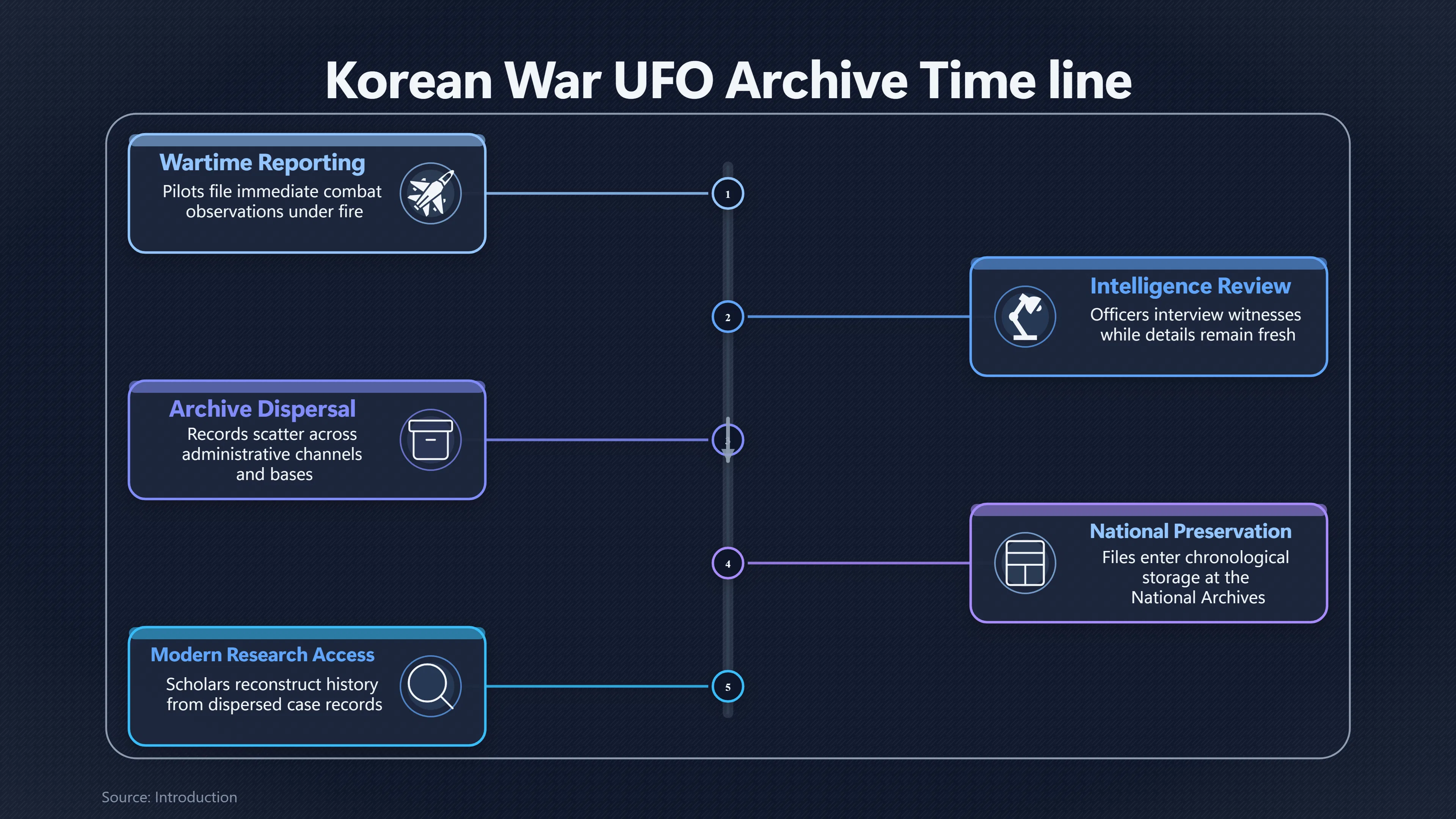
- Reports were often filed immediately through military reporting channels rather than recalled years later.
- Intelligence officers sometimes interviewed witnesses while operational details were still fresh.
At the same time, these same operational conditions increased the likelihood of misidentification. High-speed jet combat, anti-aircraft fire, illumination flares, tracer ammunition, burning aircraft, rocket exhaust and atmospheric effects created visual conditions that differed dramatically from normal flying. Consequently, an experienced pilot could accurately report seeing an unidentified object while still being unable to determine what it actually was.
This distinction remains important throughout the archival record: “unidentified” generally meant that investigators lacked sufficient evidence for a confident identification, not that they had identified an extraordinary technology.[National Archives]archives.govNational Archives Project BLUE BOOKNational ArchivesProject BLUE BOOK - Unidentified Flying Objects | National ArchivesJune 25, 2024…
Project Blue Book cases from the Korean peninsula
Although Project Blue Book officially operated from 1952 onward, it absorbed reports originating during the later stages of the Korean War as well as retrospective material relating to earlier incidents. The surviving archive contains reports associated with locations including Seoul, Suwon and south-eastern Korea, alongside cases simply identified as occurring over the Korean peninsula.
The records vary considerably in quality.
Some files consist of only a few pages summarising witness statements. Others include:
- aircraft information;
- weather conditions;
- sketches;
- military correspondence;
- evaluation notes;
- proposed explanations.
The National Archives preserves these files largely in chronological order rather than as a coherent “Korean War collection”, meaning researchers must reconstruct the wartime picture from dispersed case records and Air Force administrative material.[National Archives]archives.govNational Archives Project BLUE BOOKNational ArchivesProject BLUE BOOK - Unidentified Flying Objects | National ArchivesJune 25, 2024…
The problem of incomplete documentation
One recurring limitation is that many operational records were never intended as UFO investigations. Combat reports focused primarily on tactical events rather than unexplained aerial phenomena.
As a result, surviving files frequently omit information modern investigators would consider essential, such as:
- radar tracking data;
- precise flight paths;
- original photographs;
- aircraft maintenance records;
- intelligence follow-up;
- corroborating communications logs.
Some reports refer to additional classified material that has never been located publicly or may no longer exist. Others mention interviews whose transcripts were apparently never preserved with the surviving case file.
These gaps make it difficult to distinguish between genuinely unresolved observations and cases that simply lack enough surviving evidence for modern reassessment.
How wartime conditions encouraged misidentification
Many apparently mysterious wartime observations become more understandable when viewed within the operational environment of the Korean War.
Common sources of confusion included:
Illumination flares. Slow-descending military flares could appear stationary before drifting unexpectedly with upper-level winds.
Weather balloons. Meteorological balloons were widely launched by military forces and could reflect sunlight in unusual ways.
Jet aircraft. Early jet fighters sometimes produced unfamiliar lighting effects, especially during dusk or dawn missions.
Tracer fire and artillery. Continuous anti-aircraft fire created moving luminous objects capable of producing misleading impressions of speed and manoeuvrability.
Astronomical objects. Bright planets viewed from moving aircraft could appear to pace an observer or execute apparent movements caused by changing aircraft heading.
These explanations do not solve every case individually, but they demonstrate why even trained observers operating under combat stress sometimes reported objects they could not identify confidently.
Military investigators themselves frequently evaluated these possibilities before assigning a case to the unresolved category.[National Archives]archives.govNational Archives Project BLUE BOOKNational ArchivesProject BLUE BOOK - Unidentified Flying Objects | National ArchivesJune 25, 2024…
The frequently cited 1951–1953 case family
A number of later researchers assembled Korean War sightings into broader case catalogues. Among the most frequently discussed are reports involving pilots who described luminous objects apparently pacing military aircraft or manoeuvring in unexpected ways during combat operations.
One often-referenced group concerns alleged observations near the Iron Triangle during 1951. These accounts became widely known through later research by aviation psychologist Richard Haines rather than through a single comprehensive wartime government report. Haines collected military witness testimony and related documentation decades after the conflict, and his research papers are now preserved in an institutional archive.
While these reports remain important within UFO literature, historians distinguish between:
- contemporaneous military documentation;
- later witness recollections;
- modern secondary summaries.
That distinction matters because retrospective accounts sometimes contain greater narrative detail than appears in surviving wartime records, making it difficult to determine which elements were documented at the time and which emerged through later interviews.[National Archives]archives.govNational Archives Project BLUE BOOKNational ArchivesProject BLUE BOOK - Unidentified Flying Objects | National ArchivesJune 25, 2024…
What unresolved military files do—and do not—prove
Some Korean War cases remain officially unidentified because investigators could not reach a satisfactory conventional explanation using the evidence available.
That does not automatically imply extraordinary technology.
[Project BLUE BOOK]archives.govProject BLUE BOOK ‘s final assessment distinguished between two separate conclusions:
- a report may remain unidentified because evidence was insufficient; and
- there was no evidence that unidentified reports collectively demonstrated extraterrestrial vehicles or technology beyond contemporary scientific understanding.
This distinction is often lost in later retellings. An unresolved file records uncertainty rather than confirmation of any particular explanation.
Likewise, missing records should not be interpreted automatically as evidence of suppression. Wartime documentation was created under operational pressures, classified according to military needs and preserved unevenly over subsequent decades. Many ordinary combat records from the Korean War are also incomplete or lost, making archival gaps unsurprising in themselves.[National Archives]archives.govNational Archives Project BLUE BOOKNational ArchivesProject BLUE BOOK - Unidentified Flying Objects | National ArchivesJune 25, 2024…
Why United States records dominate the historical archive
One notable feature of Korean War UFO history is that relatively little documentation originates from South Korean government archives.
Several historical factors explain this imbalance.
During the war, United States forces operated extensive air and intelligence networks across South Korea, producing large quantities of operational paperwork. American Air Force organisations also maintained formal procedures for reporting unusual aerial observations that eventually fed into Project Blue Book and related intelligence channels.
South Korea, by contrast, was rebuilding state institutions while fighting for national survival. Many wartime records were destroyed, dispersed or never organised into permanent public archives. Consequently, researchers studying South Korean wartime UFO reports depend heavily upon United States military records rather than Korean government investigations.
This archival asymmetry shapes modern understanding of the subject. It means the surviving evidence reflects American reporting practices and intelligence priorities at least as much as it reflects the full range of unusual observations over South Korea during the war.[National Archives]archives.govNational Archives Project BLUE BOOKNational ArchivesProject BLUE BOOK - Unidentified Flying Objects | National ArchivesJune 25, 2024…
What historians can conclude today
The Korean War remains the most historically important period for military UFO reports connected with South Korea because it generated an unusually rich—if incomplete—body of official documentation. Compared with later civilian cases, wartime reports often involved trained observers and formal reporting procedures, giving historians a firmer evidential foundation.
Nevertheless, the surviving record does not support either extreme interpretation. It neither demonstrates confirmed encounters with extraordinary craft nor reduces every report to a single mundane explanation. Instead, it presents a mixed historical picture in which some observations were plausibly explained by wartime conditions, others lacked enough information for resolution, and a minority continue to be debated because the available evidence remains fragmentary.
Within the broader history of South Korean UFO reports, the Korean War therefore stands not as proof of alien visitation but as the period in which official military documentation, operational uncertainty and enduring historical interest intersect most clearly.
Amazon book picks
Further Reading
Books and field guides related to What Did Korean War Witnesses Actually See?. Use these as the next step if you want deeper reading beyond the article.
The Report on Unidentified Flying Objects
Directly relevant to Project Blue Book investigations.

UFOs: Generals, Pilots, and Government Officials Go on the Re...
Provides context for evaluating historical international cases.
eBay marketplace picks
Marketplace Samples
Live-tested eBay searches with available results related to this page.
Selected frommilitary UFO patch oneBay.co.uk.

Endnotes
1.
Source: archives.gov
Title: National Archives Project BLUE BOOK
Link:https://www.archives.gov/research/military/air-force/ufos
Source snippet
National ArchivesProject BLUE BOOK - Unidentified Flying Objects | National ArchivesJune 25, 2024...
Published: June 25, 2024
2.
Source: archives.gov
Title: National Archives Korean War Records | National Archives
Link:https://www.archives.gov/research/military/korean-war
Source snippet
Korean War Records | National ArchivesAugust 13, 2024 — KOREAN WAR RECORDS Image: Refer to Caption Enlarge With her brother on her back a...
Published: August 13, 2024
3.
Source: archives.gov
Link:https://www.archives.gov/research/topics/uaps/rg-collections
Source snippet
ecord Group or Collection | National ArchivesDecember 12, 2025 — RECORDS RELATED TO UNIDENTIFIED FLYING OBJECTS (UFOS) AND UNIDENTIFIED A...
Published: December 12, 2025
4.
Source: archives.gov
Link:https://www.archives.gov/research/topics/uaps/textual-and-microfilm
Source snippet
icrofilm | National ArchivesApril 24, 2025 — RECORDS RELATED TO UNIDENTIFIED FLYING OBJECTS (UFOS) AND UNIDENTIFIED ANOMALOUS PHENOMENA (...
Published: April 24, 2025
5.
Source: archives.gov
Link:https://www.archives.gov/news/articles/project-blue-book-50th-anniversary
Source snippet
December 5, 2019 — PUBLIC INTEREST IN UFOS PERSISTS 50 YEARS AFTER PROJECT BLUE BOOK TERMINATION By Jonathan Marker | National Archives N...
Published: December 5, 2019
6.
Source: archives.gov
Title: 50 Years Ago: Government stops investigating UFOs | National Archives
Link:https://www.archives.gov/press/press-releases/2020/nr20-19
Source snippet
November 20, 2019 — 50 YEARS AGO: GOVERNMENT STOPS INVESTIGATING UFOS Press Release · Wednesday, November 20, 2019 Washington, DC To mark...
Published: November 20, 2019
7.
Source: archives.gov
Title: Do Records Show Proof of UFOs? | National Archives
Link:https://www.archives.gov/news/articles/do-records-show-proof-of-ufos
8.
Source: archives.gov
Title: Project BLUE BOOK
Link:https://www.archives.gov/foia/ufos.html
9.
Source: youtube.com
Title: Project Blue Book: Declassified – The True Story of The Korean War Encounter
Link:https://www.youtube.com/watch?v=B5EaNouxaQc
Source snippet
Encounters that threatened America | UFOs: Top Secret Alien Files | History...
10.
Source: media.nationalarchives.gov.uk
Title: nationalarchives.gov.uk The Cold War and UFOs | The National Archives
Link:https://media.nationalarchives.gov.uk/index.php/cold-war-ufos/
11.
Source: nationalarchives.gov.uk
Title: UF O reports
Link:https://www.nationalarchives.gov.uk/explore-the-collection/explore-by-time-period/postwar/ufo-reports/
12.
Source: nationalarchives.gov.uk
Link:https://www.nationalarchives.gov.uk/help-with-your-research/research-guides/ufos/
Additional References
13.
Source: osi.af.mil
Link:https://www.osi.af.mil/News/Features/Display/Article/2302429/project-blue-book-part-1-ufo-reports/
Source snippet
6, 2020 * By Dr. Deborah Kidwell * OSI Command Historian QUANTICO, Va. -- In late 1975, OSI declassified their investigative files of report...
14.
Source: youtube.com
Title: HISTORY of UFOs
Link:https://www.youtube.com/watch?v=5xoYR0YjGh8
Source snippet
Things About The Korean War That Don't Make Sense...
15.
Source: youtube.com
Title: US Soldiers Attacked By Aliens In North Korea
Link:https://www.youtube.com/watch?v=E85-tQ2lO_I
Source snippet
HISTORY of UFOs - Episode 2 - The 1940s and 1950s - The Roswell Incident and Project Blue Book...
16.
Source: youtube.com
Title: Encounters that threatened America | UFOs: Top Secret Alien Files | History
Link:https://www.youtube.com/watch?v=ilR7mCjtveE
Source snippet
US Soldiers Attacked By Aliens In North Korea...
17.
Source: cia.gov
Link:https://www.cia.gov/readingroom/document/0005516065
18.
Source: cia.gov
Link:https://www.cia.gov/readingroom/document/cia-rdp82-00457r006900610008-5
19.
Source: ibiblio.org
Link:https://www.ibiblio.org/korean-war-cia-foia-releases/
20.
Source: theprojectbluebookarchive.org
Link:https://theprojectbluebookarchive.org/archive/
21.
Source: theprojectbluebookarchive.org
Link:https://www.theprojectbluebookarchive.org/archive/NSA/
22.
Source: secretsdeclassified.af.mil
Link:https://www.secretsdeclassified.af.mil/Fact-Sheets/Display/Article/459832/project-blue-book/