Within Vanuatu
What Could Vanuatu's Mystery Lights Actually Be?
Many strange lights over Vanuatu can plausibly come from aircraft geometry, satellite trains, meteors or atmospheric effects.
On this page
- Aircraft that appear to hover
- Satellites and orbital light trains
- Meteors, cloud and atmospheric effects
Page outline Jump by section
Introduction
Most reports of mysterious lights over Vanuatu do not require an exotic explanation. While a small number of sightings remain unresolved because of limited evidence, the country’s geography and observing conditions create an environment where ordinary aerial and astronomical phenomena can appear surprisingly unusual. Clear tropical skies, wide ocean horizons, limited foreground reference points and relatively low levels of light pollution make distant aircraft, satellites and meteors especially conspicuous. At the same time, the rapid growth of satellite constellations has introduced entirely new patterns of lights that were uncommon only a decade ago.[nasa.gov]science.nasa.govScience Identifying UFOs and UAPsNASA ScienceIdentifying UFOs and UAPs - NASA ScienceDecember 1, 2013…
For anyone assessing reports from Vanuatu, the first question is usually not “What extraordinary object was seen?” but “Which known phenomenon best matches the description?” In many cases, aircraft approaching the observer, Starlink satellite trains, bright meteors or atmospheric effects provide plausible explanations that fit the available evidence more closely than claims of unidentified craft.
Why Vanuatu’s skies can be deceptive
Vanuatu stretches across hundreds of kilometres of the South Pacific, with observers often looking across unobstructed ocean horizons. These viewing conditions affect depth perception in several important ways.
Without nearby buildings, mountains or other visual references, estimating the altitude, speed and distance of a bright light becomes extremely difficult. A light that appears to hover over one island may actually belong to an aircraft many tens of kilometres away. Likewise, an object that seems to accelerate can simply be changing its angle relative to the observer rather than changing speed.
The country’s generally dark skies also make relatively faint satellites, distant aircraft lights and brief meteor events far easier to notice than they would be above brightly illuminated cities.
Aircraft that appear to hover
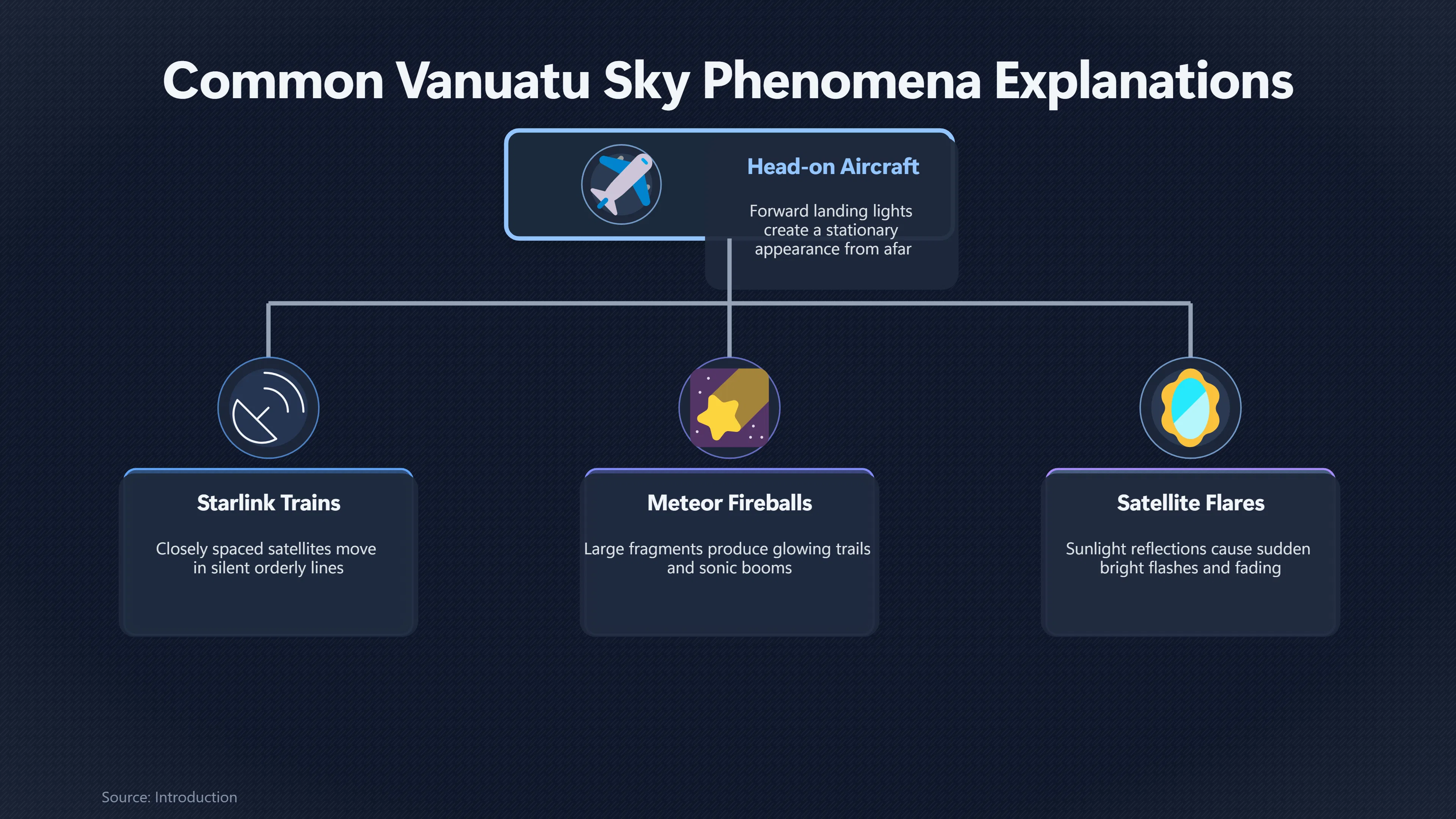
One of the most common sources of “stationary UFO” reports worldwide is an ordinary aircraft approaching almost directly towards the observer.
When an aircraft flies nearly head-on, its forward landing lights remain visible while its sideways motion is minimal. Instead of crossing the sky like a typical aircraft, it can appear almost motionless for several minutes before suddenly drifting sideways or seeming to accelerate once its flight path changes relative to the observer. NASA lists aircraft among the most common explanations for unidentified night lights reported by the public.[NASA Science]science.nasa.govScience Identifying UFOs and UAPsNASA ScienceIdentifying UFOs and UAPs - NASA ScienceDecember 1, 2013…
In Vanuatu this effect can be strengthened by:
- long views across open water;
- limited ground lighting for comparison;
- humid tropical air that scatters bright landing lights;
- observations made near airports or established regional flight corridors.
An aircraft’s anti-collision lights may also appear irregular if haze, thin cloud or vegetation intermittently obscures them, creating the impression that the light is switching itself on and off.
Satellites and orbital light trains
The rapid expansion of satellite constellations has transformed the appearance of the night sky.
Why satellite trains surprise observers
Following launch, Starlink satellites often travel in closely spaced lines before gradually spreading into higher operational orbits. To anyone unfamiliar with the phenomenon, a chain of identical lights moving silently across the sky can appear highly unusual.
Unlike aircraft, satellites generally:
- move steadily without sudden turns;
- produce no audible sound;
- show no conventional navigation lights;
- brighten and fade as sunlight reflects from their surfaces.
These changing reflections can create the impression that objects appear from nowhere before disappearing again. Research examining pilot reports has shown that recently launched Starlink trains have repeatedly been mistaken for unidentified aerial phenomena because of unusual illumination geometry rather than extraordinary flight behaviour.[arXiv]arxiv.orgEnhancing Space Situational Awareness to Mitigate Risk: A Single-Case Study in the Misidentification of a Recently-Launched Starlink…
Bright satellite flares
Even single satellites can produce unexpectedly bright flashes.
As sunlight strikes reflective surfaces at favourable angles, satellites may brighten dramatically for only a few seconds before fading. To an observer who catches only the brightest part of the event, the light can resemble an object suddenly switching itself on or vanishing.
Astronomers increasingly note that these reflections have become more common with the growing number of satellites in low Earth orbit.[Sky & Telescope]skyandtelescope.orgSky & Telescope Satellite or Meteor? Dissecting Light Trails in Your Sky PhotosSky & TelescopeSatellite or Meteor? Dissecting Light Trails in Your Sky Photos - Sky & Telescope…
Meteors, fireballs and atmospheric effects
Bright meteors provide another convincing explanation for some reports from Vanuatu.

Fireballs
Most people think of meteors as brief “shooting stars,” but larger fragments entering Earth’s atmosphere can produce spectacular fireballs.
These events may:
- illuminate large areas of sky;
- leave glowing persistent trails;
- fragment into multiple bright pieces;
- appear blue, green, orange or white;
- occasionally produce delayed sonic booms.
Because fireballs are visible over enormous distances, observers separated by hundreds of kilometres can report the same event while describing very different directions and apparent altitudes. International meteor organisations routinely reconstruct these events using reports from many independent witnesses.[International Meteor Organization]imo.netInternational Meteor Organization Fireball Program | IMOInternational Meteor Organization Fireball Program | IMO
High cloud and tropical atmosphere
Vanuatu’s maritime climate also creates optical conditions that can exaggerate unusual lights.
Thin high cloud may diffuse aircraft lights into glowing orbs. Moist air can increase halos around bright objects. Temperature layers over the ocean occasionally alter the apparent position of distant lights through atmospheric refraction, making them seem higher, lower or displaced from their true location.
These effects rarely create entirely new objects, but they can substantially change the appearance of ordinary ones.
Applying these explanations to Vanuatu reports
The publicly available Vanuatu record contains relatively few cases with precise timings, calibrated photographs or multiple independently documented observations. That limitation makes retrospective identification difficult.
Nevertheless, several recurring descriptions correspond well with known mechanisms:
- Lights that appear stationary before moving away are consistent with aircraft viewed nearly head-on.
- Multiple lights travelling together in orderly formation match modern satellite trains more closely than conventional aircraft.
- Brief brilliant flashes crossing the sky fit meteor or fireball events.
- Lights that brighten and disappear without obvious manoeuvres are compatible with satellite reflections.
These explanations cannot automatically solve every reported sighting, but they represent the highest-probability interpretations unless stronger evidence indicates otherwise.

Why some sightings remain unidentified
An unidentified sighting is not necessarily an unexplained phenomenon.
Many Vanuatu reports remain unidentified simply because investigators lack essential information such as:
- exact observation time;
- viewing direction;
- duration;
- weather conditions;
- photographs with original metadata;
- independent witness accounts;
- aircraft or satellite correlation.
Without these details, investigators often cannot distinguish confidently between an aircraft, satellite, meteor or another ordinary source. The most scientifically defensible conclusion in such cases is usually “insufficient information” rather than confirmation of an unknown object. NASA similarly recommends checking aircraft, planets, satellites, meteors and atmospheric conditions before treating unusual lights as anomalous.[NASA Science]science.nasa.govScience Identifying UFOs and UAPsNASA ScienceIdentifying UFOs and UAPs - NASA ScienceDecember 1, 2013…
How this fits into the wider Vanuatu UFO record
Viewed alongside the broader collection of reported Vanuatu sightings, ordinary sky phenomena provide a strong interpretive framework. The country’s observing conditions naturally enhance the visibility of satellites, distant aircraft and meteors while simultaneously making their distance and motion difficult to judge accurately.
This does not prove that every reported mystery light has been identified. Instead, it explains why many accounts can be understood without invoking extraordinary technology, while the remaining unresolved cases generally reflect incomplete evidence rather than compelling proof of an unknown aerial phenomenon.
Amazon book picks
Further Reading
Books and field guides related to What Could Vanuatu's Mystery Lights Actually Be?. Use these as the next step if you want deeper reading beyond the article.

UFOs: Generals, Pilots, and Government Officials Go on the Re...
Provides context for evaluating historical international cases.
NightWatch: A Practical Guide to Viewing the Universe
A practical guide to viewing the universe.
eBay marketplace picks
Marketplace Samples
Live-tested eBay searches with available results related to this page.
Selected fromastronomy poster oneBay.co.uk.
Endnotes
1.
Source: science.nasa.gov
Title: Science Identifying UFOs and UAPs
Link:https://science.nasa.gov/solar-system/skywatching/night-sky-network/identifying-ufos-and-uaps/
Source snippet
NASA ScienceIdentifying UFOs and UAPs - NASA ScienceDecember 1, 2013...
Published: December 1, 2013
2.
Source: arxiv.org
Link:https://arxiv.org/abs/2403.08155
Source snippet
Enhancing Space Situational Awareness to Mitigate Risk: A Single-Case Study in the Misidentification of a Recently-Launched Starlink...
3.
Source: arxiv.org
Title: arXiv Extreme Flaring of Starlink Satellites
Link:https://arxiv.org/abs/2405.13091
4.
Source: fireballs.ndc.nasa.gov
Link:https://fireballs.ndc.nasa.gov/skyfalls/events/20260429-071216
5.
Source: unexplained.co
Link:https://www.unexplained.co/news/nwt-drillers-ufo-sighting
6.
Source: nasa.gov
Title: That’s No Meteor: NASA Satellite’s Elusive Green Lasers Spotted at Work
Link:https://www.nasa.gov/missions/icesat-2/thats-no-meteor-nasa-satellites-elusive-green-lasers-spotted-at-work/
7.
Source: skyandtelescope.org
Title: Sky & Telescope Satellite or Meteor? Dissecting Light Trails in Your Sky Photos
Link:https://skyandtelescope.org/astronomy-news/satellite-or-meteor-dissecting-light-trails-in-your-sky-photos/
Source snippet
Sky & TelescopeSatellite or Meteor? Dissecting Light Trails in Your Sky Photos - Sky & Telescope...
8.
Source: imo.net
Title: International Meteor Organization Fireball Program | IMO
Link:https://www.imo.net/observations/fireballs/fireball-report-program/
9.
Source: imo.net
Title: International Meteor Organization IMO | International Meteor Organization
Link:https://www.imo.net/sr/
10.
Source: astronomy.com
Title: What’s that in the sky?
Link:https://www.astronomy.com/observing/whats-that-in-the-sky/
Source snippet
With patience and a little experience, few objects will remain unidentified. By Molly Wakeling |...
11.
Source: naa.gov.au
Title: Flying saucers – fact or fiction? | naa.gov.au
Link:https://www.naa.gov.au/blog/flying-saucers-fact-or-fiction
12.
Source: imo.net
Link:https://www.imo.net/af/
13.
Source: imo.net
Link:https://www.imo.net/category/fireball/
14.
Source: imo.net
Link:https://www.imo.net/cs/
15.
Source: imo.net
Link:https://www.imo.net/observations/fireballs/fireballs/
16.
Source: imo.net
Link:https://www.imo.net/fr/
Additional References
17.
Source: strangesounds.org
Link:https://strangesounds.org/man-made-sky-phenomena-explained
Source snippet
Strange SoundsMay 18, 2026 — MAN-MADE SKY PHENOMENA EXPLAINED Space & Beyond • Strange Sky Events • Human-Made Atmospheric Phenomena Man...
Published: May 18, 2026
18.
Source: skyatnightmagazine.com
Title: 17 things commonly mistaken for UFOs | BBC Sky at Night Magazine
Link:https://www.skyatnightmagazine.com/space-science/things-mistaken-for-ufos
Source snippet
Consider the following possibilities... Get monthly inspiration to your door with BBC Sky At Night Magazine - subscribe toda...
19.
Source: ufouap.net
Title: venus planets ufo
Link:https://www.ufouap.net/en/explainers/venus-planets-ufo
Source snippet
Venus Mistaken for a UFO: Official Astronomy Sources and Identification Guide | Global UFO Archive3 days ago — Skywatching / Updated 2026...
20.
Source: youtube.com
Title: Starlink Satellites Mistaken As UFOs Over Pittsburgh
Link:https://www.youtube.com/watch?v=1sMvdE8MfgA
Source snippet
Quantum physicists REanalyze GOFAST UFO video footage...
21.
Source: youtube.com
Title: Quantum physicists REanalyze GOFAST UFO video footage
Link:https://www.youtube.com/watch?v=y5Uf4N-JkQY
Source snippet
Breakdown of the Pentagon UFO videos with Mick West...
22.
Source: skyatnightmagazine.com
Link:https://www.skyatnightmagazine.com/advice/strange-flash-in-the-night-sky-explanation
23.
Source: forbes.com
Link:https://www.forbes.com/sites/jonathanocallaghan/2020/04/21/what-are-those-strange-moving-lights-in-the-night-sky-elon-musks-starlink-satellites-explained/
24.
Source: orbitalnodes.ai
Link:https://orbitalnodes.ai/identify/
25.
Source: sciencefocus.com
Link:https://www.sciencefocus.com/space/the-ufos-that-scientists-think-are-real-but-cant-explain
26.
Source: abc.net.au
Link:https://www.abc.net.au/news/2026-02-03/bright-light-seen-in-victorian-skies-not-meteor-but-space-debris/106298226