Within Marshall Islands UFOs
When a UFO Like Event Becomes a Meteoroid
The instrumented 1994 meteoroid shows how a spectacular aerial event can be identified through sensors, timing and physical modelling.
On this page
- The 1994 western Pacific fireball
- How sensors established a natural cause
- A practical identification hierarchy for new reports
Page outline Jump by section
Introduction
The strongest documented example of a UFO-like aerial event associated with the Marshall Islands is not an unresolved mystery but a scientifically identified meteoroid. On 1 February 1994, a large fireball crossed the western Pacific near the Marshall Islands and was recorded by multiple United States government space-based sensors. Rather than remaining an unexplained sighting, it became one of the best-studied atmospheric entries of its era, allowing researchers to reconstruct its speed, fragmentation, energy release and probable origin.[epa.gov]hero.epa.govFEBRUARY 1, 1994…
For readers examining UFO reports from the Marshall Islands, this event provides an important benchmark. It demonstrates how spectacular lights in the sky can be transformed from eyewitness impressions into testable scientific evidence through independent sensor records, timing analysis and physical modelling. It also illustrates why dramatic visual appearance alone is not sufficient evidence for an extraordinary explanation.
When a UFO-Like Event Became a Meteoroid
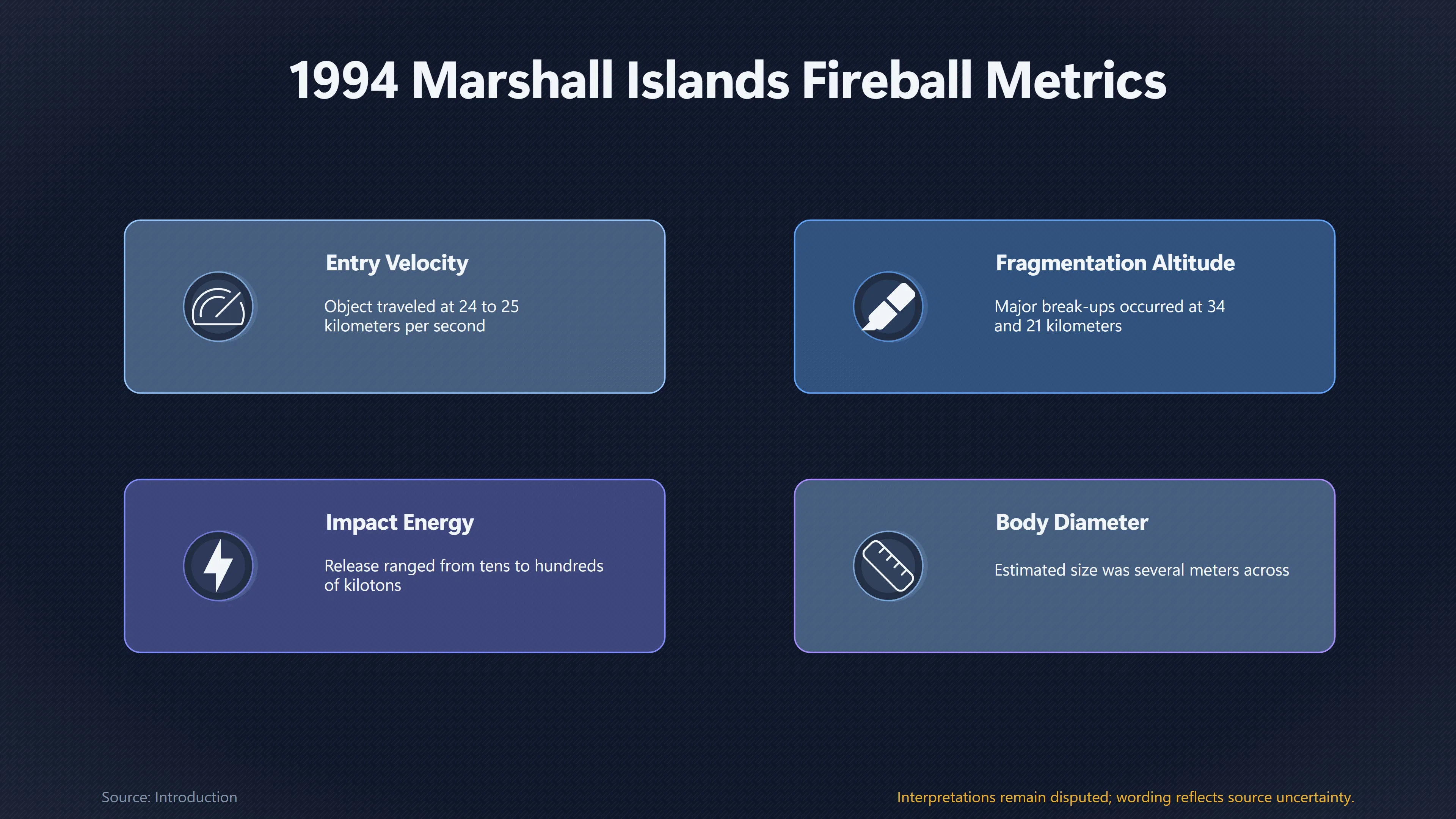
On 1 February 1994, an exceptionally bright fireball entered Earth’s atmosphere over the central Pacific near approximately 2.6–2.7° north latitude and 164.1° east longitude, close to the Marshall Islands. The object travelled at roughly 24–25 kilometres per second before breaking apart high above the ocean. Multiple fragmentation events occurred, with major break-ups at about 34 kilometres and 21 kilometres altitude.[ResearchGate]researchgate.netOpen source on researchgate.net.
To anyone witnessing the event directly, it would likely have appeared extraordinary. Large bolides often display rapidly changing brightness, multiple flashes, fragmentation into glowing pieces and luminous trails. These characteristics can easily resemble descriptions found in UFO reports, particularly where there are few observers or no immediate scientific explanations.
Instead of remaining an anecdotal sighting, however, the event generated an unusually rich technical record because it occurred within the field of view of operational satellite sensors designed to detect high-energy atmospheric phenomena. Researchers were therefore able to investigate it using measured physical data rather than relying solely on witness testimony.[HERO]hero.epa.govFEBRUARY 1, 1994…
How Sensors Established a Natural Cause
The identification of the 1994 fireball rested on several independent lines of evidence that reinforced one another.
First, infrared sensors operated by the US Department of Defense detected the atmospheric energy release, while visible-light instruments operated by the US Department of Energy independently recorded the event. The agreement between different sensor systems greatly reduced uncertainty about what had occurred.[HERO]hero.epa.govFEBRUARY 1, 1994…
Second, analysts reconstructed the object’s trajectory. The measured entry speed—around 24 km/s—is entirely consistent with a natural meteoroid entering Earth’s atmosphere and substantially faster than any aircraft or ballistic missile during atmospheric flight. Researchers also derived a heliocentric orbit, showing that the object originated from an orbit around the Sun before intersecting Earth.[HERO]hero.epa.govFEBRUARY 1, 1994…
Third, the observed fragmentation matched well-understood meteor physics. Instead of remaining intact, the body progressively failed under increasing aerodynamic pressure, producing successive bursts of light as fragments disintegrated. This pattern is expected for stony meteoroids entering at cosmic velocities.[ResearchGate]researchgate.netOpen source on researchgate.net.
Finally, estimates of the object’s size and energy fell within the known range for naturally occurring bolides. Published analyses suggested a body several metres across, with impact energies ranging from tens to hundreds of kilotons depending on modelling assumptions. Although extremely energetic, the event remained entirely consistent with known natural impact phenomena.[HERO]hero.epa.govFEBRUARY 1, 1994…
Why the Event Remains Scientifically Important
The Marshall Islands fireball has continued to appear in later meteoroid research because it provides a valuable calibration case.
Modern studies modelling atmospheric airbursts have repeatedly used the 1994 event to compare theoretical fragmentation models against observed energy deposition. Researchers found that the principal fragmentation episode near 21 kilometres altitude could be reproduced reasonably well, demonstrating that numerical entry models can successfully explain the observed brightness profile without invoking unknown mechanisms.[Wiley Online Library]onlinelibrary.wiley.comWiley Online LibraryThe frequency of window damage caused by bolide airbursts: A quarter century case study - Gi - 2018 - Meteoritics & P…
The event also contributed to the broader development of fireball databases derived from government sensor observations. Today, NASA’s Center for Near-Earth Object Studies (CNEOS) publishes many such detections, allowing scientists to compare new events with historical examples using consistent observational methods.[CNEOS]cneos.jpl.nasa.govOpen source on nasa.gov.
A Practical Identification Hierarchy for New Reports
The 1994 Marshall Islands fireball illustrates a useful hierarchy for evaluating future UFO-like reports from the region.
Highest confidence: Instrumented events recorded simultaneously by independent sensors, radar, satellite systems or other calibrated measurements. These provide physical quantities such as speed, altitude and trajectory that can be tested against known natural or artificial phenomena.
Moderate confidence: Multiple independent eyewitnesses whose observations agree on timing, direction and appearance. These accounts are valuable but remain vulnerable to perceptual error and incomplete information.
Lowest confidence: Single recollections without supporting evidence, particularly when reported long after the event or without precise timing or location.
Applying this hierarchy does not assume that every unexplained observation has a conventional explanation. Rather, it prioritises explanations that are supported by measurable evidence before considering more speculative interpretations.
What the 1994 Fireball Means for the Marshall Islands UFO Record
Within the Marshall Islands, the 1994 fireball occupies a distinctive place because it demonstrates the difference between an initially dramatic observation and a scientifically resolved event.
Unlike disputed UFO narratives that depend primarily on testimony or incomplete documentation, the fireball can be analysed quantitatively. Its velocity, fragmentation sequence, energy release and atmospheric behaviour all fit established meteoroid physics. As a result, it stands as the clearest regional example of how a spectacular aerial phenomenon can be conclusively identified through coordinated sensor observations and physical modelling.[epa.gov]hero.epa.govFEBRUARY 1, 1994…
For the broader Marshall Islands project, this case complements discussions of missile-related sightings around Kwajalein Atoll by showing that not every remarkable object in the region’s skies originates from military activity. Some of the most impressive aerial displays are entirely natural, and the 1994 western Pacific fireball remains the strongest documented example of how modern scientific investigation can distinguish a meteoroid from an apparently unidentified object.
Amazon book picks
Further Reading
Books and field guides related to When a UFO-Like Event Becomes a Meteoroid. Use these as the next step if you want deeper reading beyond the article.
The Demon-Haunted World: Science as a Candle in the Dark
Encourages evidence-based explanations.
Meteor Showers and their Parent Comets
Directly explains meteoroids and fireball events.
NightWatch: A Practical Guide to Viewing the Universe
Helps identify bright natural sky events.
eBay marketplace picks
Marketplace Samples
Live-tested eBay searches with available results related to this page.
Selected frommeteor poster oneBay.co.uk.

Endnotes
1.
Source: researchgate.net
Link:https://www.researchgate.net/publication/305966704_Commission_22_Meteors_and_Interplanetary_Dust_Meteores_Et_Poussiere_Interplanetaire
2.
Source: cneos.jpl.nasa.gov
Link:https://cneos.jpl.nasa.gov/fireballs/
3.
Source: onlinelibrary.wiley.com
Link:https://onlinelibrary.wiley.com/doi/abs/10.1111/maps.13085
Source snippet
Wiley Online LibraryThe frequency of window damage caused by bolide airbursts: A quarter century case study - Gi - 2018 - Meteoritics & P...
4.
Source: cneos.jpl.nasa.gov
Link:https://cneos.jpl.nasa.gov/fireballs/intro.html
5.
Source: agupubs.onlinelibrary.wiley.com
Link:https://agupubs.onlinelibrary.wiley.com/doi/10.1029/2025JE009392
Source snippet
wiley.comDecameter‐Sized Earth Impactors—II: A Bayesian Inference Approach to Meteoroid Ablation Modeling - Chow - 2026 - Journal of Geop...
6.
Source: data.nasa.gov
Title: To do tha
Link:https://data.nasa.gov/dataset/fireball-and-bolide-reports
Source snippet
And Bolide Reports - Dataset - NASA Open Data PortalMarch 31, 2025 — FIREBALL AND BOLIDE REPORTS Total Views 1.3k Recent Views 19 NASA NA...
Published: March 31, 2025
7.
Source: fireballs.ndc.nasa.gov
Link:https://fireballs.ndc.nasa.gov/skyfalls/events/20240221-234856
Source snippet
20240221-234856February 21, 2024 — EVENT: 20240221-234856 iframe Over two hundred eyewitnesses in the states of Pennsylvania, Michigan, O...
Published: February 21, 2024
8.
Source: onlinelibrary.wiley.com
Link:https://onlinelibrary.wiley.com/doi/10.1111/maps.13137
Source snippet
of meteoroid impacts by the Geostationary Lightning Mapper on the GOES‐16 satellite - Jenniskens - 2018 - Meteoritics & Planetary Science...
9.
Source: researchgate.net
Title: (PDF) Photoacoustic Sounds from Meteors
Link:https://www.researchgate.net/publication/313259225_Photoacoustic_Sounds_from_Meteors
10.
Source: jpl.nasa.gov
Title: fireball over californianevada how big was it
Link:https://www.jpl.nasa.gov/news/fireball-over-californianevada-how-big-was-it/
11.
Source: researchgate.net
Title: 46584133 FIRST EARTH BASED DETECTION OF A SUPERBOLIDE ON JUPITER
Link:https://www.researchgate.net/publication/46584133_FIRST_EARTH-BASED_DETECTION_OF_A_SUPERBOLIDE_ON_JUPITER
12.
Source: onlinelibrary.wiley.com
Title: j.1945 5100.1998.tb01607.x
Link:https://onlinelibrary.wiley.com/doi/abs/10.1111/j.1945-5100.1998.tb01607.x
13.
Source: ntrs.nasa.gov
Link:https://ntrs.nasa.gov/citations/19950031830
14.
Source: ntrs.nasa.gov
Link:https://ntrs.nasa.gov/citations/20020006309
15.
Source: ssd-api.jpl.nasa.gov
Link:https://ssd-api.jpl.nasa.gov/doc/fireball.html
16.
Source: cneos.jpl.nasa.gov
Link:https://cneos.jpl.nasa.gov/fireballs/lc/
17.
Source: cneos.jpl.nasa.gov
Link:https://cneos.jpl.nasa.gov/pi/
18.
Source: hero.epa.gov
Link:https://hero.epa.gov/reference/7682933/
Source snippet
FEBRUARY 1, 1994...
Published: February 1, 1994
19.
Source: doi.org
Link:https://doi.org/10.1111/maps.13085
Additional References
20.
Source: youtube.com
Link:https://www.youtube.com/watch?v=llI6gOHW7I8
Source snippet
JPL and the Space Age: The Hunt for Space Rocks...
21.
Source: youtube.com
Title: Meteoroids, Meteorites, Fireballs
Link:https://www.youtube.com/watch?v=B75xmeeKH0c
Source snippet
An interstellar meteorite may have been recovered from the ocean, but is it alien?...
22.
Source: nature.com
Link:https://www.nature.com/articles/367624a0
23.
Source: youtube.com
Title: Keeping Track of Bolides (Really Bright Meteors)
Link:https://www.youtube.com/watch?v=mRGAscKo8B8
Source snippet
Meteoroids, Meteorites, Fireballs - What's the Difference?...
24.
Source: docslib.org
Link:https://docslib.org/doc/3088230/using-bolide-airwaves-to-estimate-meteoroid-source-characteristics-and-window-damage-potential
25.
Source: aquarid.physics.uwo.ca
Link:https://aquarid.physics.uwo.ca/research/fireball/dod.html
26.
Source: osti.gov
Title: Photoacoustic sounds from meteors (Journal Article) | OSTI.GO V
Link:https://www.osti.gov/pages/biblio/1345579
27.
Source: youtube.com
Link:https://www.youtube.com/watch?v=Iz18kmUb-VM
Source snippet
Keeping Track of Bolides (Really Bright Meteors)...
28.
Source: meteorindex.com
Link:https://meteorindex.com/fireballs?page=1&sort=date_asc
29.
Source: sciencedirect.com
Title: Two components in meteor spectra
Link:https://www.sciencedirect.com/science/article/abs/pii/0032063394900256