Within Australian UFOs
Why Did Australia Investigate UFO Reports?
Australia's UFO archives document a Cold War identification system focused on air defence, conventional explanations, and incomplete reports.
On this page
- How the RAAF recorded and checked sightings
- Restricted ranges, security concerns, and Maralinga
- Why routine civilian investigations ended
Page outline Jump by section
Introduction
Australia’s official interest in unidentified flying objects (UFOs), now more commonly called unidentified aerial phenomena (UAP), was driven by national security rather than a search for extraterrestrial life. During the Cold War, reports of unfamiliar objects in Australian airspace had to be assessed because they could represent foreign aircraft, missile tests, satellites, balloons or other potential defence threats. The Royal Australian Air Force (RAAF) therefore developed procedures for recording, checking and, where possible, explaining reports. Most were eventually attributed to conventional causes, while a small minority remained officially “unidentified” because the available evidence was insufficient rather than because an extraordinary explanation had been established.[National Archives of Australia]naa.gov.auNational Archives of Australia Flying saucers – fact or fiction? | naa.gov.auNational Archives of AustraliaFlying saucers – fact or fiction? | naa.gov.auFebruary 28, 2018…
The surviving defence records, many now preserved by the National Archives of Australia, provide an unusually detailed picture of how Australian authorities investigated unusual aerial reports. Rather than revealing a hidden programme focused on alien spacecraft, they document an administrative system concerned with air defence, aviation safety and intelligence during a period of rapid technological change.
Why Australia investigated UFO reports
Australia’s post-war strategic environment explains why government agencies devoted resources to UFO reports. Between the late 1940s and early 1990s, the country was involved in missile development, British nuclear testing, rocket launches and Cold War intelligence activities. Any unidentified object over sensitive facilities had to be treated initially as a possible security concern.
Several developments shaped official policy:
- The emergence of long-range military aircraft and guided missiles.
- Increasing satellite launches after the beginning of the Space Age.
- British and Australian weapons testing at Woomera and Maralinga.[ufotransparency.com]ufotransparency.comintl au woomera weapons testing ufo sightings at weapons testing siteintl au woomera weapons testing ufo sightings at weapons testing site
- Public reporting of unfamiliar astronomical and atmospheric phenomena.
- Concern that hostile surveillance could exploit remote defence installations.
Consequently, UFO reports entered the same broad intelligence workflow as other unidentified airspace observations. Investigators were not attempting to prove or disprove extraterrestrial visitation; they were determining whether an observation represented a genuine defence issue.[National Archives of Australia]naa.gov.auNational Archives of Australia Flying saucers – fact or fiction? | naa.gov.auNational Archives of AustraliaFlying saucers – fact or fiction? | naa.gov.auFebruary 28, 2018…
How the RAAF recorded and checked sightings
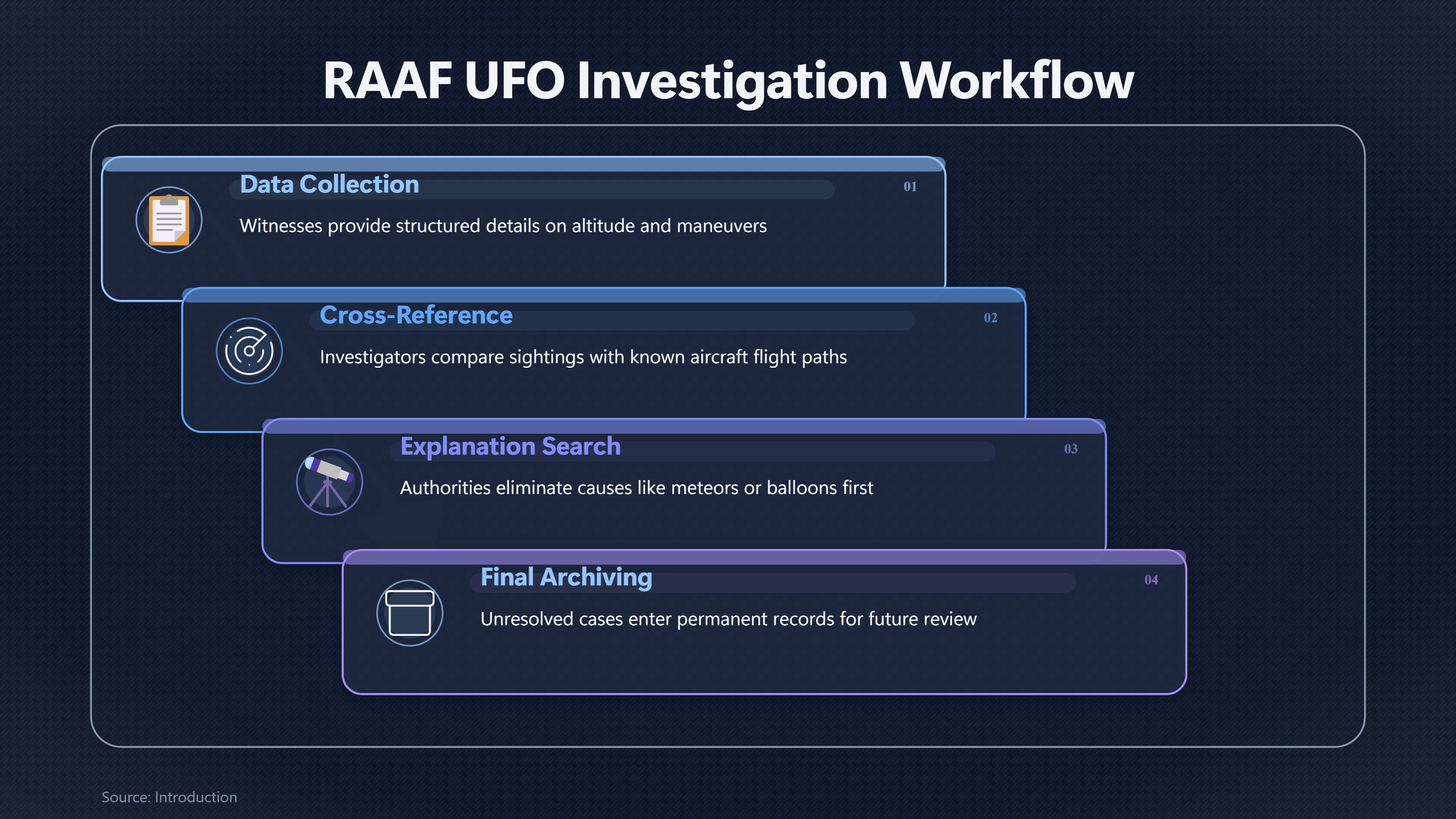
The RAAF established standard procedures for receiving reports from both civilians and military personnel. Witnesses were commonly asked to provide structured information rather than simple narratives.
Typical reports included:
- exact time and location;
- weather conditions;
- estimated altitude and direction;
- colour, brightness and apparent shape;
- duration of the observation;
- speed and manoeuvres;
- presence of sound;
- other witnesses;
- possible photographs or radar observations.
Investigators then attempted to compare the report with known aircraft movements, astronomical objects, meteorological information and other available records. Venus, the Moon, bright stars, meteors, balloons and conventional aircraft repeatedly appeared as satisfactory explanations. Reports from trained observers, such as military pilots or air traffic personnel, generally received closer scrutiny than brief civilian sightings because they often contained more detailed observational data.[National Archives of Australia]naa.gov.auNational Archives of Australia Flying saucers – fact or fiction? | naa.gov.auNational Archives of AustraliaFlying saucers – fact or fiction? | naa.gov.auFebruary 28, 2018…
An important feature of the archive is that an official file records that a report was received—not that its contents were verified. Many files preserve witness testimony alongside correspondence showing attempts to eliminate conventional explanations, with varying degrees of success.
Restricted ranges, security concerns and Maralinga
The most revealing defence investigations occurred around Australia’s restricted military areas, particularly the Woomera Prohibited Area and the Maralinga weapons-testing region in South Australia.
These locations hosted missile trials, British nuclear weapons programmes and experimental research. During periods of active testing, unidentified aerial reports naturally attracted greater official attention because they could indicate:
- unauthorised aircraft;
- surveillance by foreign powers;
- malfunctioning test equipment;
- unusual atmospheric effects associated with testing;
- public misunderstanding of classified activities.
One widely cited archival document concerns a July 1960 sighting near the Wewak area within the Maralinga complex. Initial reports suggested that one of the site’s instrumentation balloons had exploded. Investigators interviewed numerous witnesses, including police officers, scientific staff, military personnel and local observers.
The resulting report illustrates the cautious tone typical of Australian defence investigations. Various explanations—including meteors, static electricity, atmospheric effects and even detached satellite hardware—were considered. Although one investigator speculated about more exotic possibilities, the official submission concluded that available evidence did not permit a definite identification and regarded a meteor or static electricity as the most likely explanation.[National Archives of Australia]naa.gov.auOpen source on naa.gov.au.
The investigation itself is significant because it demonstrates how seriously security officials treated unexplained observations near strategic facilities. The thoroughness reflected concern over defence operations rather than acceptance of extraordinary interpretations.
What the official files actually show
Modern discussions often treat declassified Australian UFO files as evidence of concealed knowledge. The records themselves present a more nuanced picture.
Several consistent patterns emerge:
- Most reports received conventional explanations. Astronomical objects, aircraft and balloons account for many investigated cases.[National Archives of Australia]naa.gov.auNational Archives of Australia Flying saucers – fact or fiction? | naa.gov.auNational Archives of AustraliaFlying saucers – fact or fiction? | naa.gov.auFebruary 28, 2018…
- Some reports remained unresolved. This generally reflected incomplete observations, conflicting testimony or insufficient evidence rather than confirmation of unknown technology.
- Military reports were preserved carefully. Incidents involving pilots, radar operators or defence facilities generated more extensive documentation because they potentially affected national security.
- Investigators sometimes recorded competing hypotheses. Individual officers occasionally proposed unusual possibilities, but these were not equivalent to official government conclusions.
The archives therefore distinguish between an unidentified event and an extraordinary event. An observation could remain officially unidentified simply because investigators lacked enough reliable information to reach a firm conclusion.
Evidence quality inside the archive
The defence files vary considerably in evidential value.
Reports considered relatively stronger usually include multiple independent forms of evidence, such as:
- multiple witnesses;
- trained military observers;
- radar information;
- precise timing;
- contemporaneous documentation.
Weaker reports typically involve:
- single witnesses;
- poor weather or darkness;
- uncertain distance estimates;
- delayed reporting;
- absence of corroborating evidence.
This distinction explains why some famous Australian incidents continue to attract discussion while many hundreds of other archived reports receive little attention. The surviving documentation generally supports careful historical analysis rather than sensational conclusions.
Why routine civilian investigations ended
By the early 1990s, decades of accumulated experience had changed the RAAF’s assessment of UFO reporting.
According to the National Archives, defence authorities concluded that only a very small proportion of reports could not be explained using conventional causes, and those remaining unidentified cases showed no evidence of posing a meaningful threat to Australia’s security. The RAAF therefore ceased routine investigation of civilian UFO reports in 1994.[National Archives of Australia]naa.gov.auNational Archives of Australia Flying saucers – fact or fiction? | naa.gov.auNational Archives of AustraliaFlying saucers – fact or fiction? | naa.gov.auFebruary 28, 2018…
The decision reflected several practical considerations:
- investigation consumed personnel and administrative resources;
- the overwhelming majority of reports proved explainable;
- unresolved cases rarely contained enough evidence for further progress;
- no pattern suggested an emerging national-security threat.
After routine investigations ended, members of the public reporting unusual aerial observations were generally directed towards civilian organisations unless the event involved an immediate aviation or defence concern. Australia therefore did not develop a permanent public UAP office comparable to some more recent overseas initiatives.

What these files contribute to Australia’s UFO history
Australian defence archives remain valuable because they document how a government responded to uncertainty rather than because they resolve the UFO question.
They demonstrate that officials took reports seriously when they intersected with air defence, weapons testing or aviation safety. They also show a consistent investigative approach: collect witness statements, compare them with known phenomena, eliminate ordinary explanations where possible and retain unresolved cases when evidence proved insufficient.
For readers exploring Australia’s broader UFO history, these official records provide an important counterbalance to later folklore. They reveal that the government’s primary concern was identifying potential threats to Australian airspace and defence infrastructure, not confirming extraterrestrial visitors. That distinction is essential when interpreting both famous Australian incidents and the extensive body of declassified defence files that survives today.
Amazon book picks
Further Reading
Books and field guides related to Why Did Australia Investigate UFO Reports?. Use these as the next step if you want deeper reading beyond the article.

UFOs: Generals, Pilots, and Government Officials Go on the Re...
Government investigations are central.
eBay marketplace picks
Marketplace Samples
Live-tested eBay searches with available results related to this page.
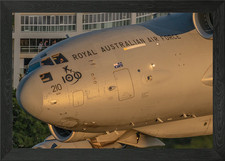
Selected fromRAAF poster oneBay.co.uk.


Endnotes
1.
Source: archives.gov
Link:https://www.archives.gov/research/topics/uaps/rg-collections
Source snippet
ecord Group or Collection | National ArchivesDecember 12, 2025 — RECORDS RELATED TO UNIDENTIFIED FLYING OBJECTS (UFOS) AND UNIDENTIFIED A...
Published: December 12, 2025
2.
Source: archives.gov
Link:https://www.archives.gov/research/topics/uaps/textual-and-microfilm
Source snippet
icrofilm | National ArchivesApril 24, 2025 — RECORDS RELATED TO UNIDENTIFIED FLYING OBJECTS (UFOS) AND UNIDENTIFIED ANOMALOUS PHENOMENA (...
Published: April 24, 2025
3.
Source: archives.gov
Title: Project BLUE BOOK
Link:https://www.archives.gov/research/military/air-force/ufos
4.
Source: archives.gov
Link:https://www.archives.gov/news/articles/project-blue-book-50th-anniversary
5.
Source: archives.gov
Title: Do Records Show Proof of UFOs? | National Archives
Link:https://www.archives.gov/news/articles/do-records-show-proof-of-ufos
6.
Source: naa.gov.au
Title: National Archives of Australia Flying saucers – fact or fiction? | naa.gov.au
Link:https://www.naa.gov.au/blog/flying-saucers-fact-or-fiction
Source snippet
National Archives of AustraliaFlying saucers – fact or fiction? | naa.gov.auFebruary 28, 2018...
Published: February 28, 2018
7.
Source: naa.gov.au
Link:https://www.naa.gov.au/students-and-teachers/student-research-portal/learning-resource-themes/war/defence-equipment-and-weapons/ufo-sightings-weapons-testing-site-woomera
8.
Source: defence.gov.au
Title: Woomera Prohibited Area Access Forms | Defence Activities | Defence
Link:https://www.defence.gov.au/bases-locations/sa/woomera/access/forms
Source snippet
The Woomera Prohibited Area (WPA) Portal is available as part of Defence’s ServiceConnect, and is accessible to all n...
9.
Source: defence.gov.au
Title: The Review’s terms of ref
Link:https://www.defence.gov.au/about/reviews-inquiries/review-woomera-prohibited-area-coexistence-framework
Source snippet
Review of the Woomera Prohibited Area Coexistence Framework | About | DefenceMay 8, 2026 — On 8 May 2026, the Australian Government relea...
Published: May 8, 2026
10.
Source: minister.defence.gov.au
Link:https://www.minister.defence.gov.au/media-releases/2026-05-08/australian-government-response-2025-independent-review-woomera-prohibited-area-coexistence-framework
Source snippet
ernment response to the 2025 independent review of the Woomera Prohibited Area coexistence framework | Defence MinistersMay 8, 2026 —...
Published: May 8, 2026
11.
Source: minister.defence.gov.au
Title: defence.gov.au First Australian-made missiles test-fired | Defence Ministers
Link:https://www.minister.defence.gov.au/media-releases/2026-04-13/first-australian-made-missiles-test-fired
Source snippet
Australian-made missiles test-fired | Defence MinistersApril 13, 2026 — RELEASE DETAILS RELEASE TYPE RELATED MINISTERS AND CONTACTS * * *...
Published: April 13, 2026
12.
Source: minister.defence.gov.au
Link:https://www.minister.defence.gov.au/media-releases/2024-08-16/independent-review-into-woomera-prohibited-area
13.
Source: defence.gov.au
Title: History of the Woomera Prohibited Area | Defence Activities | Defence
Link:https://www.defence.gov.au/bases-locations/sa/woomera/about
14.
Source: defence.gov.au
Title: 2018 review woomera prohibited area coexistence framework
Link:https://www.defence.gov.au/about/reviews-inquiries/2018-review-woomera-prohibited-area-coexistence-framework
15.
Source: media.nationalarchives.gov.uk
Link:https://media.nationalarchives.gov.uk/index.php/ufo-files-national-archives/
16.
Source: dst.defence.gov.au
Title: fire across the desert
Link:https://www.dst.defence.gov.au/publication/fire-across-the-desert
17.
Source: minister.defence.gov.au
Title: defence.gov.au Minister for Defence
Link:https://www.minister.defence.gov.au/media-releases/2014-11-05/minister-defence-ceremony-marks-return-maralinga-tjarutja-lands-woomera
18.
Source: discovery.nationalarchives.gov.uk
Link:https://discovery.nationalarchives.gov.uk/details/r/C16460007
19.
Source: discovery.nationalarchives.gov.uk
Link:https://discovery.nationalarchives.gov.uk/details/r/C14726255
20.
Source: nationalarchives.gov.uk
Title: UF O reports
Link:https://www.nationalarchives.gov.uk/explore-the-collection/explore-by-time-period/postwar/ufo-reports/
21.
Source: nationalarchives.gov.uk
Link:https://www.nationalarchives.gov.uk/help-with-your-research/research-guides/ufos/
22.
Source: nationalarchives.gov.uk
Title: cas 261466
Link:https://www.nationalarchives.gov.uk/freedom-of-information/requests/cas-261466/
23.
Source: naa.gov.au
Link:https://www.naa.gov.au/help-your-research/fact-sheets/d-notices
24.
Source: naa.gov.au
Link:https://www.naa.gov.au/explore-collection/first-australians/other-resources-about-first-australians/british-nuclear-tests-maralinga
25.
Source: naa.gov.au
Title: royal australian air force
Link:https://www.naa.gov.au/explore-collection/defence-and-war-service-records/royal-australian-air-force
26.
Source: discovery.nationalarchives.gov.uk
Link:https://discovery.nationalarchives.gov.uk/details/r/C560658
Additional References
27.
Source: youtube.com
Link:https://www.youtube.com/watch?v=8yFIRaalq10
Source snippet
UFO Hovered for 90 Minutes Over Sydney RAAF Base (2026) - Ross Coulthart...
28.
Source: youtube.com
Title: 665 // Frederick [Valentich]({{ ‘valentich/’ | relative_url }})
Link:https://www.youtube.com/watch?v=AA_JueUmgqM
Source snippet
Australian government UFO files declassified RAAF Schoolyard witnesses in mass UFO sighting demand answers | Australian Story ABC News In...
29.
Source: youtube.com
Link:https://www.youtube.com/watch?v=dyBmXGRp43M
Source snippet
Royal Australian Navy recently declassified UFO report from Pilot at HMAS Albatross...
30.
Source: youtube.com
Link:https://www.youtube.com/watch?v=qr9keQJVikE
Source snippet
Australia's Chief of Air Force hasn't been briefed on UAP (UFOs)...Why?...
31.
Source: youtube.com
Link:https://www.youtube.com/watch?v=92DNvZZpfjw
Source snippet
665 // Frederick Valentich - UFO Mystery?...
32.
Source: ufotransparency.com
Link:https://ufotransparency.com/files/intl-au-a703-554-1-30-part1-a703-554-1-30-part-1
33.
Source: ufotransparency.com
Link:https://ufotransparency.com/international/files/au
34.
Source: ovniarchive.com
Link:https://ovniarchive.com/doc/9928?lang=en
35.
Source: secretsdeclassified.af.mil
Link:https://www.secretsdeclassified.af.mil/Fact-Sheets/Display/Article/459832/project-blue-book/
36.
Source: ufotransparency.com
Title: intl au woomera weapons testing ufo sightings at weapons testing site
Link:https://ufotransparency.com/files/intl-au-woomera-weapons-testing-ufo-sightings-at-weapons-testing-site