Within Uganda UFOs
Which Uganda UFO Records Can Be Trusted?
Declassified files and specialist databases preserve intriguing reports, but collection does not equal authentication.
On this page
- What declassified archives actually establish
- How catalogue repetition creates false confidence
- How to trace a claim back to its source
Page outline Jump by section
Introduction
Uganda’s UFO archive is notable less for its size than for the way it has been assembled. Unlike countries that maintained dedicated official investigation programmes, Uganda has no known national UFO archive compiled by government authorities. Instead, the surviving record is scattered across contemporary newspaper reports, foreign intelligence collections, declassified archives, specialist UFO catalogues and a handful of modern reporting databases. That makes source reliability far more important than the number of cases.
The central lesson is straightforward: preservation is not the same as verification. A report appearing in a CIA reading room, a declassified foreign archive or a well-known UFO database demonstrates that someone collected or catalogued the claim. It does not demonstrate that investigators confirmed an extraordinary event. Understanding how Uganda’s small archive was built is therefore essential before drawing conclusions from it.
What declassified archives actually establish
The most reliable archival material relating to Ugandan UFO reports consists of documents that preserve historical reporting rather than authenticate unexplained aerial phenomena.
For example, declassified intelligence collections held by the United States include occasional press summaries mentioning unusual aerial observations in Uganda. Their evidential value lies in confirming that reports circulated internationally during the Cold War. They do not show that intelligence agencies concluded the objects were anomalous, extraterrestrial or technologically extraordinary. Intelligence services routinely collected foreign press material on many subjects, including natural disasters, political events and unusual observations, regardless of whether the underlying claims proved accurate.
The same distinction applies to records preserved by national archives in countries such as the United States and the United Kingdom. Official archive guides repeatedly explain that UFO collections contain reports, correspondence and investigations, many of which ultimately received conventional explanations or remained unresolved because of insufficient information rather than compelling evidence of unknown technology. The archival record documents administrative activity, not proof of extraordinary phenomena.[National Archives]archives.govOpen source on archives.gov.
For Uganda specifically, surviving archival references generally establish only three points:
- an observation was reportedly made;
- someone considered the report significant enough to preserve or circulate;
- later researchers can trace that report to an identifiable historical document.
Anything beyond those three conclusions requires additional evidence.
Why Uganda’s archive is unusually fragmented
Uganda differs from countries with extensive official UFO files because no evidence has emerged of a sustained domestic investigative programme comparable to Project Blue Book in the United States or the Ministry of Defence reporting system formerly operated in Britain.
Instead, today’s record is assembled from several different layers:
- contemporary newspaper articles;
- foreign diplomatic or intelligence collections;
- later UFO catalogues compiled by private researchers;
- modern online databases accepting public submissions;
- occasional references in books and magazines.
Each layer introduces opportunities for information loss.
Original newspaper articles may disappear or survive only in summary form. Later catalogues often compress detailed reports into one or two sentences. Online databases may omit references to the original publication entirely. As a result, many Ugandan cases cannot be independently reconstructed from primary evidence.
This fragmentation explains why some frequently cited Ugandan incidents contain remarkably little descriptive information despite decades of repetition.
How catalogue repetition creates false confidence
One of the most important reliability problems in Uganda’s UFO literature is the repeated recycling of the same small group of historical cases.
Many specialist catalogues copied earlier compilations rather than returning to original newspapers. Over time, identical claims appeared across multiple books, databases and websites. To a casual reader this can create the impression that numerous independent sources confirm the same incident.
In reality, several publications may ultimately depend on one brief newspaper report or one earlier catalogue entry.
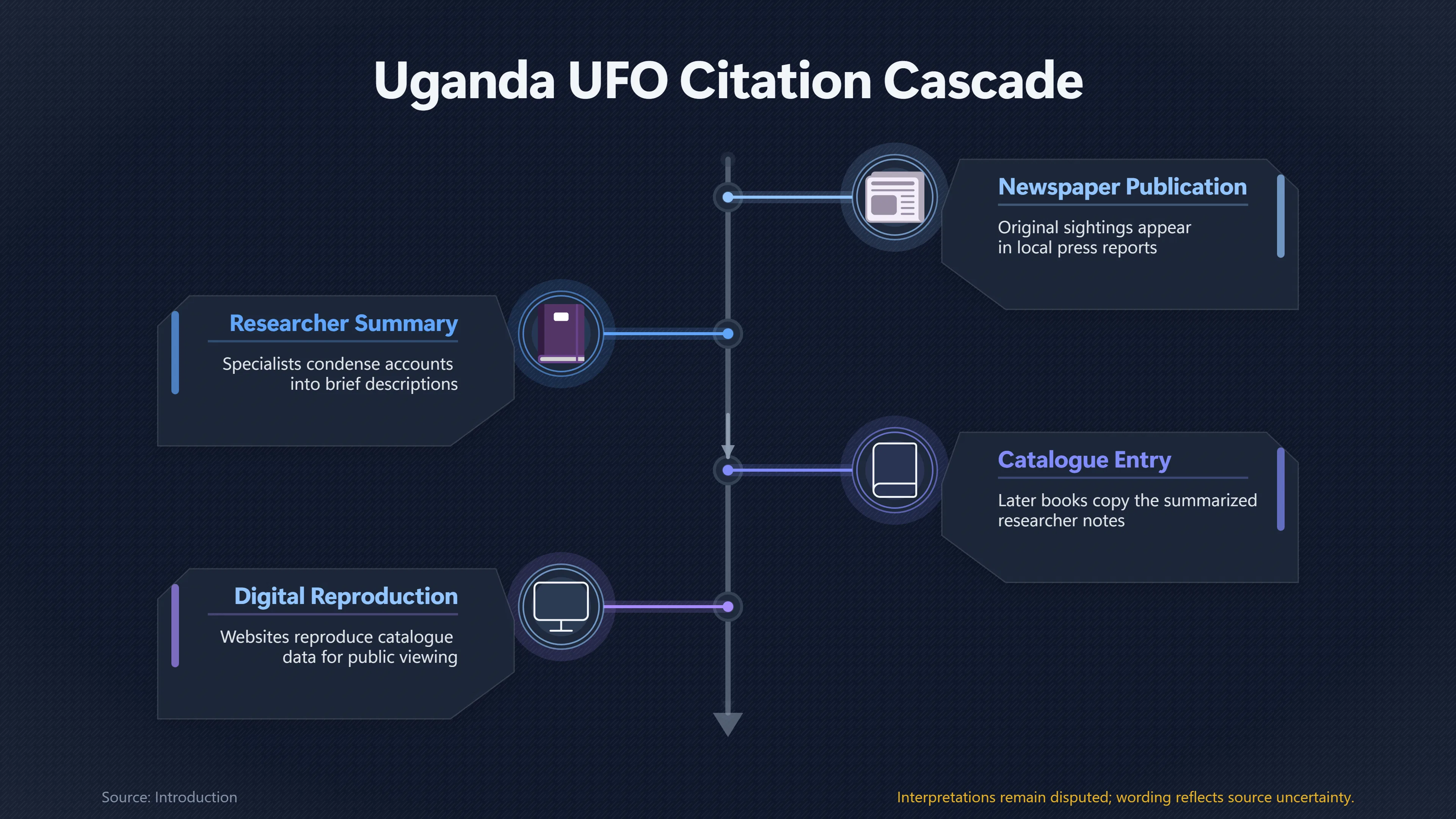
This process produces what historians sometimes describe as citation cascades:
- A contemporary report appears in a newspaper.
- A UFO researcher summarises it.
- Later catalogues copy the summary.
- Websites reproduce the catalogue.
- Modern articles cite several websites as though they represent independent confirmation.
The apparent quantity of evidence therefore increases while the underlying evidential base remains unchanged.
This problem is particularly important for Uganda because relatively few original reports survive for comparison.
The 1962 Kampala fireball illustrates good source practice
The August 1962 Kampala incident demonstrates how stronger sourcing can improve confidence even when the original object was initially unidentified.
Multiple contemporary accounts describe a bright greenish-blue object travelling rapidly across the sky before fragmenting. Contemporary officials reportedly identified the phenomenon as a large meteor after examining the available information.
Here the archive preserves several useful features:
- approximate date;
- geographical location;
- witness descriptions;
- reported official assessment;
- behaviour consistent with known meteor phenomena.
The event therefore remains historically valuable while also illustrating an important distinction: an object may initially be unidentified yet later receive a credible conventional explanation.
Because the reported explanation is supported by the observed fragmentation and luminous flight characteristics, the case is generally stronger as evidence of an investigated meteor than as evidence for an unexplained craft.
The Lake Victoria claim illustrates weak source transmission
The reported March 1973 Lake Victoria incident associated with President Idi Amin occupies the opposite end of the reliability spectrum.
The story appears repeatedly in UFO databases and compilations, usually stating that Amin and numerous witnesses allegedly observed an object descend into Lake Victoria. However, the available documentation is exceptionally limited.
Key elements are absent:
- original newspaper reproduction;
- precise observation time;
- detailed witness statements;
- physical evidence;
- photographs;
- official investigation records;
- independent contemporary confirmation.
Because later catalogues largely repeat the same short description, repeated publication should not be mistaken for corroboration.
The historical existence of the claim is reasonably well established. The historical accuracy of the reported event is much less certain.
How to trace a Ugandan UFO claim back to its source
Readers evaluating Ugandan UFO reports can usually distinguish stronger and weaker cases by following the documentary chain backwards.
A practical reliability hierarchy is:
Source typeReliability for historical reconstructionReliability for proving an unexplained eventContemporary newspaper with identifiable dateHighModerateGovernment report describing an investigationHighDepends on findingsDeclassified intelligence copy of press reportingModerateLowSpecialist catalogue with citationsModerateLowCatalogue without original referenceLowVery lowRepeated online summaries copied from earlier databasesVery lowVery low
The most valuable question is therefore not “How many websites mention this?” but “What is the earliest identifiable source?”
If multiple modern sites ultimately trace back to a single paragraph published decades earlier, the evidential foundation has not become stronger simply because the story is more widely repeated.
What modern reporting databases add—and what they do not
Modern reporting databases preserve recent witness accounts that might otherwise disappear. They also provide searchable records across countries, making Uganda’s sparse reporting more accessible.
However, these databases generally function as repositories rather than investigative agencies. Inclusion normally indicates that a report was submitted, not that it was independently verified.
Likewise, newly organised searchable collections of declassified UFO material improve access to historical government records but do not alter the evidential status of the underlying documents. Better indexing makes historical research easier; it does not transform preserved reports into authenticated events.[UFO Declassified]ufo-declassified.comUFO Declassified Document Database | UFO DeclassifiedUFO DeclassifiedDocument Database | UFO DeclassifiedJuly 10, 2026…
Which Uganda UFO records deserve the greatest confidence?
Taken together, Uganda’s archive supports several cautious conclusions.
The historical record clearly shows that unusual aerial observations have occasionally been reported within Uganda since at least the mid-twentieth century. Some reports entered international archives through diplomatic reporting, intelligence collection or later specialist cataloguing. That documentary trail is genuine and historically interesting.
The strongest individual records are those supported by identifiable contemporary reporting and plausible investigative context, such as the 1962 Kampala fireball that was reportedly assessed as a meteor. Cases surviving only as brief catalogue entries without recoverable primary documentation deserve substantially more caution.
Ultimately, Uganda’s UFO archive is best understood as a record of historical reporting rather than a catalogue of authenticated unexplained phenomena. Its greatest research value lies not in the quantity of sightings but in demonstrating how historical claims evolve as they pass from newspapers into archives, from archives into catalogues, and from catalogues into modern online discussions.
Amazon book picks
Further Reading
Books and field guides related to Which Uganda UFO Records Can Be Trusted?. Use these as the next step if you want deeper reading beyond the article.

UFOs: Generals, Pilots, and Government Officials Go on the Re...
Provides context for evaluating historical international cases.
Wonders in the Sky: Unexplained Aerial Objects from Antiquity...
Places unusual sky reports in historical context.
The UFO Enigma
Directly addresses how physical traces and scientific evidence should be evaluated.
The Report on Unidentified Flying Objects
Directly relevant to Project Blue Book investigations.
eBay marketplace picks
Marketplace Samples
Live-tested eBay searches with available results related to this page.
Selected fromUFO poster oneBay.co.uk.

Current eBay listing
I Want To Believe UFO Poster Giclée Fine Art Heavyweight Print



Current eBay listing
VINTAGE UFO FLYING SAUCERS COMIC ADVERTISING A2 POSTER PRINT
Endnotes
1.
Source: archives.gov
Link:https://www.archives.gov/research/topics/uaps/publications
2.
Source: archives.gov
Title: National Archives Project BLUE BOOK
Link:https://www.archives.gov/research/military/air-force/ufos
Source snippet
National ArchivesProject BLUE BOOK - Unidentified Flying Objects | National Archives...
3.
Source: ufo-declassified.com
Title: UFO Declassified Document Database | UFO Declassified
Link:https://ufo-declassified.com/documents/
Source snippet
UFO DeclassifiedDocument Database | UFO DeclassifiedJuly 10, 2026...
Published: July 10, 2026
4.
Source: archives.gov
Link:https://www.archives.gov/research/topics/uaps/textual-and-microfilm
Source snippet
Records Related to Unidentified Flying Objects (UFOs) and Unidentified Anomalous Phenomena (UAPs) at the National Archives: Textual and M...
5.
Source: ufo-declassified.com
Title: It adds 23 Department of War video files and a 17-item document package spanning
Link:https://ufo-declassified.com/topics/pursue-release-04/
Source snippet
PURSUE Release 04 | UFO DeclassifiedJuly 10, 2026 — PURSUE RELEASE 04 Direct Answer PURSUE Release 04 is the fourth public tranche of UAP...
Published: July 10, 2026
6.
Source: ufo-declassified.com
Title: UF O Declassified — Explore Government UAP Files
Link:https://ufo-declassified.com/
Source snippet
40 new records are now indexed. Open batch → SEARCH THE UFO FILES RELEASE 04 NOW INDEXED Search 207 document recor...
7.
Source: archives.gov
Link:https://www.archives.gov/research/topics/uaps/rg-collections
Source snippet
ecord Group or Collection | National ArchivesDecember 12, 2025 — RECORDS RELATED TO UNIDENTIFIED FLYING OBJECTS (UFOS) AND UNIDENTIFIED A...
Published: December 12, 2025
8.
Source: archives.gov
Link:https://www.archives.gov/research/catalog/catalog-bulk-downloads/uap-bulk-download
9.
Source: archives.gov
Link:https://www.archives.gov/research/topics/uaps/faqs
10.
Source: cia.gov
Title: Ask Molly: Did CIA Really Study Psychic Powers?
Link:https://www.cia.gov/stories/story/ask-molly-did-cia-really-study-psychic-powers/
11.
Source: archives.gov
Title: Do Records Show Proof of UFOs? | National Archives
Link:https://www.archives.gov/news/articles/do-records-show-proof-of-ufos
12.
Source: cia.gov
Title: CI A Posts More Than 12 Million Pages of CREST Records Online
Link:https://www.cia.gov/stories/story/cia-posts-more-than-12-million-pages-of-crest-records-online/
13.
Source: archives.gov
Link:https://www.archives.gov/research/guide-fed-records/groups/263.html/1000
14.
Source: cia.gov
Title: cias role in the study of ufos 1947 1990
Link:https://www.cia.gov/resources/csi/studies-in-intelligence/studies-in-intelligence-1997/cias-role-in-the-study-of-ufos-1947-1990/
15.
Source: cia.gov
Title: SCIENTIST S REFUTE CLAIMS OF ‘UFO’ SIGHTINGS | CIA FOIA (foia.cia.gov)
Link:https://www.cia.gov/readingroom/document/cia-rdp81r00560r000100010014-6
16.
Source: nationalarchives.gov.uk
Title: The National Archives UFO reports
Link:https://www.nationalarchives.gov.uk/explore-the-collection/explore-by-time-period/postwar/ufo-reports/
Source snippet
The National ArchivesUFO reports - The National Archives...
17.
Source: nationalarchives.gov.uk
Link:https://www.nationalarchives.gov.uk/help-with-your-research/research-guides/ufos/
Additional References
18.
Source: youtube.com
Title: DECLASSIFIED UFO FILES: Why does science ignore them and governments don’t?
Link:https://www.youtube.com/watch?v=wunCPG7EBXs
Source snippet
UFO Crash Retrieval - The Kalahari UAP Incident // 3D CGI Animation / Unreal Engine 5...
19.
Source: youtube.com
Title: From flying saucers to orbs: Pentagon’s declassified UFO files released
Link:https://www.youtube.com/watch?v=vPsGi8EUzVo
Source snippet
All the videos from Pentagon's first batch of UFO files...
20.
Source: youtube.com
Title: All the videos from Pentagon’s first batch of UFO files
Link:https://www.youtube.com/watch?v=WpRWkuYu9V8
Source snippet
DECLASSIFIED UFO FILES: Why does science ignore them and governments don't?...
21.
Source: youtube.com
Title: The Ariel School UFO Incident: 60 Students Saw Aliens
Link:https://www.youtube.com/watch?v=JUNO7qqSJ9o
Source snippet
From flying saucers to orbs: Pentagon's declassified UFO files released...
22.
Source: mediacentre.go.ug
Link:https://mediacentre.go.ug/press-room
23.
Source: youtube.com
Title: UFO Crash Retrieval
Link:https://www.youtube.com/watch?v=CBKYNwC-bjs
24.
Source: history.navy.mil
Title: mil UF O Research Guide
Link:https://www.history.navy.mil/content/history/nhhc/research/library/bibliographies-and-research-guides/research-guides/ufo-research-guide.html
25.
Source: nicap.org
Title: hall IUR1994
Link:https://www.nicap.org/papers/hall-IUR1994.htm